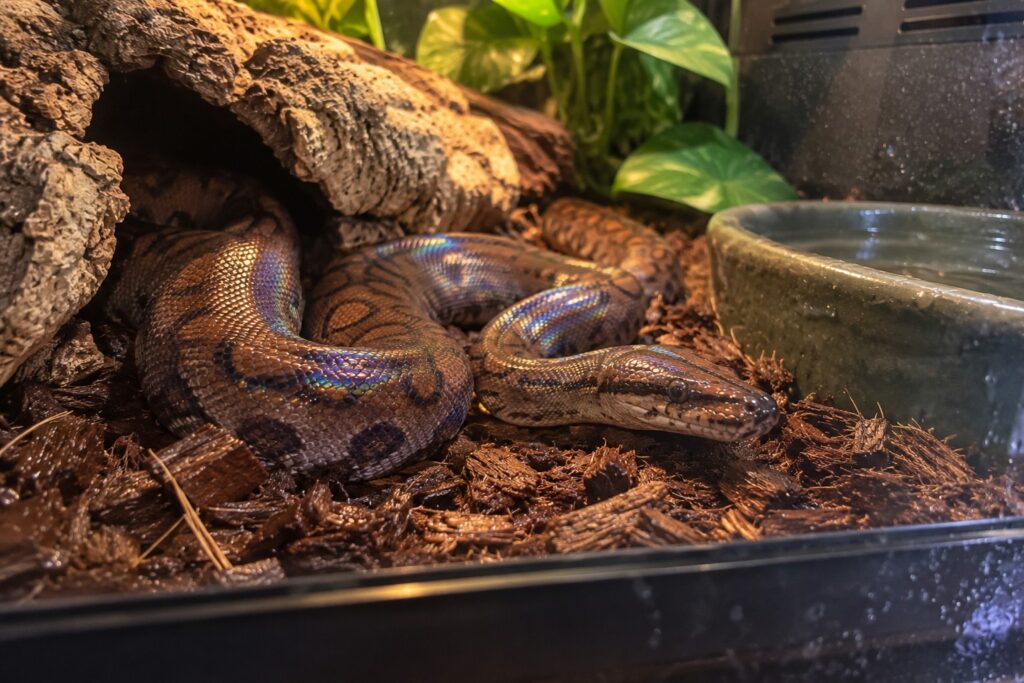
The first time a Colombian rainbow boa moves under good light, you understand why people buy them. The brown body suddenly flashes blue and purple, like oil on water. Colombian rainbow boa care isn’t hard, but it comes with one balancing act most snakes don’t ask for. They need humidity well above a ball python’s, and if you get it by soaking the enclosure, you trade stuck sheds for scale rot and respiratory infections.
This guide covers the numbers, how Colombians differ from Brazilians, feeding, and a five-check routine for keeping humidity high without the problems.
Colombian Rainbow Boa Care Quick Specs
A Colombian rainbow boa needs a 4 x 2 x 2 foot enclosure as an adult, a warm spot of 88 to 90°F, a cool end of 75 to 80°F, humidity of 70 to 80%, and one appropriately sized rodent every 10 to 14 days as an adult.
| Parameter | Target |
|---|---|
| Adult length | 4 to 6 feet, females usually larger |
| Lifespan | 20 to 30 years |
| Adult enclosure | 4 x 2 x 2 feet minimum, PVC preferred |
| Warm spot | 88 to 90°F |
| Warm side air | 82 to 86°F |
| Cool end | 75 to 80°F |
| Night | 72 to 76°F |
| Humidity | 70 to 80%, higher during shed |
| Adult feeding | One rat every 10 to 14 days |
Colombians are one of the easier boas to start with. They’re hardy, they stay a manageable size, and most settle into calm adults.
Colombian vs Brazilian Rainbow Boa
When people search for rainbow boa care, they usually mean one of two snakes. Colombian rainbow boas (Epicrates maurus) are brown with faint markings and the strong sheen. Brazilian rainbow boas (Epicrates cenchria) are bright orange with bold rings, and they’re the ones in most photos.
The care is close, but not the same. Brazilians need even more humidity, often 75 to 90%, and they’re less forgiving when it drops. They also tend to be a bit more defensive as babies and cost more. Colombians tolerate small slips in humidity better and are usually cheaper.
If you want the easier of the two, get a Colombian, since Colombian rainbow boa care leaves more room for small mistakes. Everything in this guide is written for Colombians, and if you keep a Brazilian, run the humidity toward the top of the range.
Setting Up the Enclosure
A PVC enclosure is the best choice in Colombian rainbow boa care. It holds humidity and heat far better than glass with a screen top, which you’d otherwise be fighting every day. Adults need at least 4 x 2 x 2 feet. Hatchlings and juveniles do better in a smaller enclosure or tub at first, around 20 to 30 gallons in floor space, since a baby in a huge space feels exposed and stays defensive.
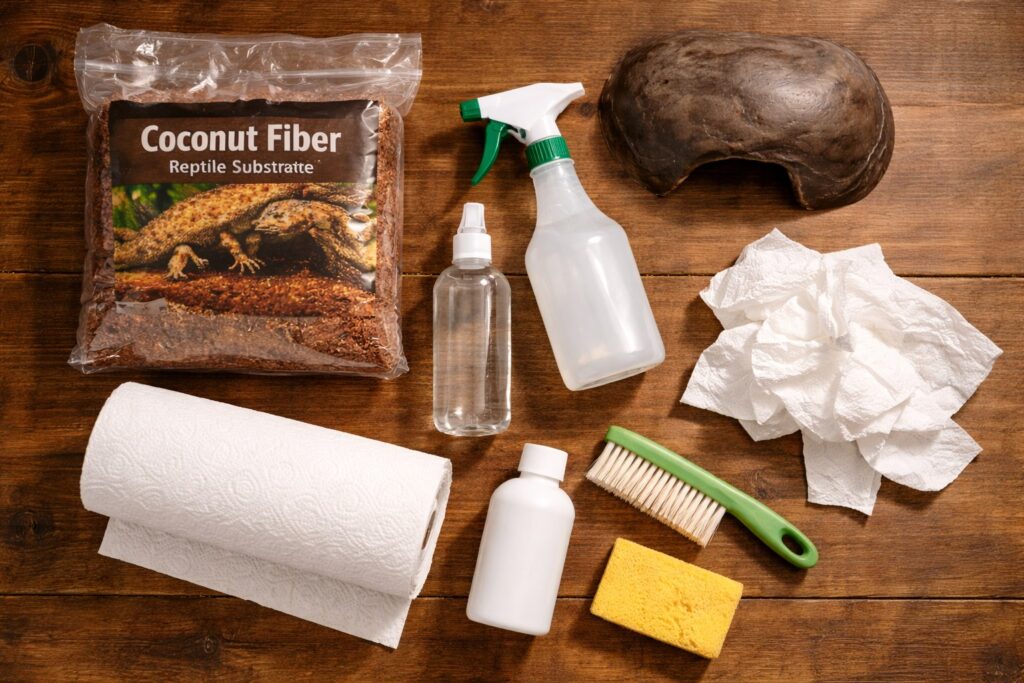
For substrate, use the same moisture holding substrates used for ball pythons: cypress mulch, coco husk, or a soil mix, about 3 to 4 inches deep. Mix a layer of sphagnum moss into the bottom to hold moisture. Avoid aspen, which molds at this humidity, and never use cedar or pine.
Add two snug hides, one on each end, plus a humid hide packed with damp sphagnum moss. A large, heavy water bowl on the warm side helps raise humidity as it evaporates, and rainbow boas like to soak. Colombians climb a little, especially young ones, so a sturdy branch or two is a nice addition. Fill the rest with fake plants and cork for cover.
Heat and Light
Aim for a warm spot of 88 to 90°F, warm side air of 82 to 86°F, and a cool end of 75 to 80°F. Nights can drop to 72 to 76°F. A radiant heat panel or a deep heat projector mounted inside a PVC enclosure works best, and every heat source goes on a thermostat. Put a guard over any bulb, since a climbing boa will wrap around it.
Measure the actual surface where the snake rests with an infrared temp gun, and keep a digital probe on each end. Warm, humid air feels hotter than it reads, so trust the numbers, not your hand.
UVB isn’t required, but a low output tube on a 12 hour timer is a good addition, and that sheen looks its best under good light.
Feeding a Colombian Rainbow Boa
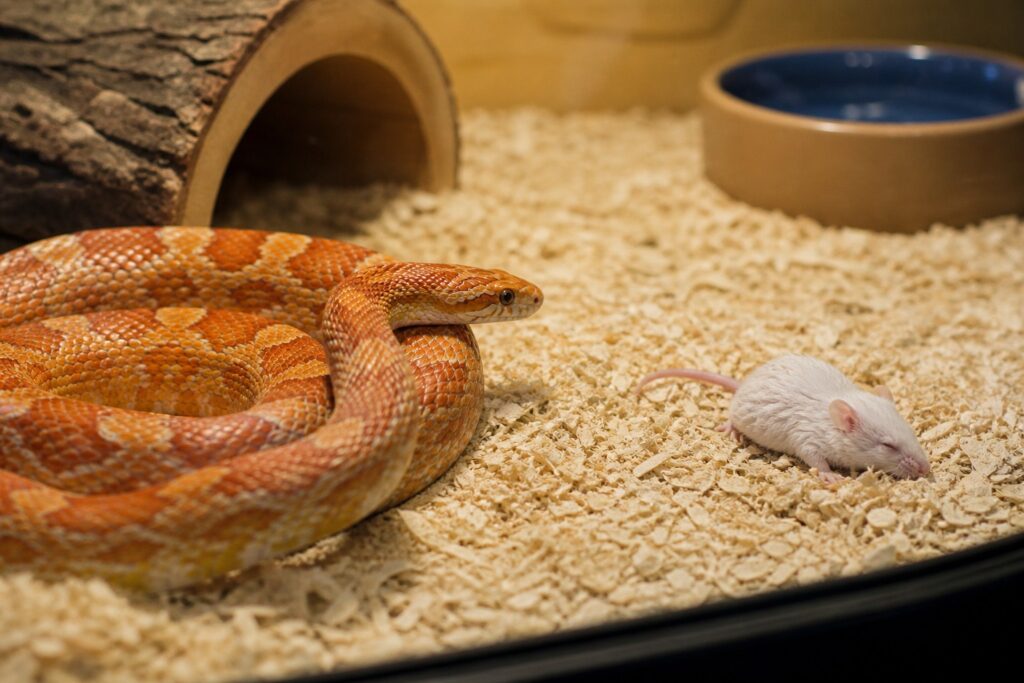
Feeding is one of the easy parts of Colombian rainbow boa care. They’re usually strong eaters. Feed frozen thawed rodents about as wide as the widest part of the snake’s body. Colombian rainbow boa care rarely involves the long hunger strikes ball pythons are known for.
- Hatchlings: one pinky or fuzzy mouse every 5 to 7 days
- Juveniles: one hopper or adult mouse every 7 to 10 days
- Adults: one small or medium rat every 10 to 14 days
Warm the prey in a sealed bag in hot water and offer it with long tongs. Don’t handle for 48 hours after a meal. Watch the body shape. Rainbow boas get heavy if they’re fed too often, and a healthy adult should look firm and muscular, not round.
Handling and Temperament
Baby Colombians can be nippy and quick to strike, a lot like a young carpet python. Most grow out of it within the first year with short, regular handling. Tap the snake gently with a hook before you pick it up so it knows food isn’t coming, then lift from below in one smooth move.
Adults are usually calm and slow moving in the hand, which is a big part of why Colombian rainbow boa care suits first-time boa keepers. Keep sessions to 10 to 15 minutes, since warm, humid snakes can cool off quickly in a dry room.
5 Humidity Checks for Colombian Rainbow Boa Care
This is where most problems in Colombian rainbow boa care come from. The goal is 70 to 80% in the air, without wet substrate under the snake. Work through these in order.
1. Read humidity at snake level. Put a digital hygrometer probe a few inches above the substrate in the middle of the enclosure, not next to the water bowl. The cheap stick-on dials are often 10 to 20 points off.
2. Check whether it crashes between mistings. If humidity hits 80% after you mist and falls to 50% by evening, the enclosure is leaking moisture, not short on water. Cover more of any screen, move the water bowl to the warm side, and mix sphagnum into the bottom layer of substrate. If you still need to mist, it’s easy to forget a session, so set a misting reminder in the Exotic Reptile Care app for morning and evening.
3. Feel the substrate under the hides. The top layer can be slightly damp, but the substrate the snake lies on should never be wet or muddy. Soggy bedding is the main cause of scale rot, which shows up as brown, red, or blistered belly scales. Replace any wet patches and stop pouring water into the substrate.
4. Look at the last shed. A clean, one-piece shed means humidity is right. A shed in patches, or stuck skin on the tail tip, means it’s too dry, especially in the week before the shed. Raise humidity toward 80% when the eyes go cloudy, and make sure the humid hide is damp.
5. Listen and watch for respiratory signs. Wheezing, clicking, bubbles at the nose, or open mouth breathing mean the enclosure is too wet and too cool, or the air isn’t moving. Raise the warm side temperature, add a little ventilation, and get the snake to a reptile vet. Respiratory infections in boas can get serious quickly.
Frequently Asked Questions
Are Colombian rainbow boas good for beginners?
Yes, if you’re ready to manage high humidity. They’re hardy, eat well, and usually become calm adults. A Colombian is more forgiving than a Brazilian.
How big do Colombian rainbow boas get?
Most reach 4 to 6 feet, with females usually larger than males.
What humidity does a Colombian rainbow boa need?
70 to 80%, raised toward the top of that range during shed. Brazilian rainbow boas need even more, often 75 to 90%.
How often should I feed a Colombian rainbow boa?
Hatchlings every 5 to 7 days, juveniles every 7 to 10 days, and adults every 10 to 14 days.
Why does my rainbow boa shimmer?
The scales have tiny ridges that split light like a prism, which creates the rainbow sheen. It’s strongest right after a shed.
Good Colombian rainbow boa care comes down to a PVC enclosure, a measured warm spot, and humidity that comes from the air, not from wet bedding. Get that balance right and you’ll have a calm, long-lived snake that lights up every time you open the doors.