Most ball python care problems show up the same way: a snake that won’t eat. New keepers panic, buy a different prey item, try live, try a different brand of frozen mice, and the snake still refuses. Nine times out of ten the food was never the problem. The warm side was too cool, the hides were wrong, or the snake was being handled every evening. Get the setup right and ball pythons are one of the easiest snakes you can keep, which is exactly why they’re the most popular pet snake in the world.
This guide covers the numbers that matter, how to feed by age, and the seven mistakes behind most of the “my ball python won’t eat” posts you’ll see online.
Ball Python Care at a Glance
Ball pythons need a secure enclosure with two hides, a warm side surface of 88 to 92°F, humidity between 60 and 80 percent, and a frozen-thawed rodent every 5 to 14 days depending on age. Here are the key numbers in one place.
| Care area | Target | Notes |
|---|---|---|
| Adult enclosure | 48 x 24 x 24 inches minimum | Go bigger for snakes over 5 feet |
| Warm side surface | 88 to 92°F | Measure the surface, not the air |
| Ambient warm side | 80 to 85°F | Air temperature above the hot spot |
| Cool side | 76 to 80°F | Never below 75°F at night |
| Humidity | 60 to 80% | Up to 90% during a shed |
| Hatchling feeding | Every 5 to 7 days | Fuzzy or hopper mice |
| Adult feeding | Every 10 to 14 days | Medium rats for most adults |
| Prey size | 1 to 1.5 times the snake’s widest point | Too big causes regurgitation |
| Adult length | Males 2 to 3.5 ft, females 3 to 5 ft | Females are noticeably heavier |
| Lifespan | 20 to 30 years | Many live longer |
Are Ball Pythons Good Pets?
Yes, ball pythons are good pets for beginners, as long as you’re ready for a long commitment. They’re calm, rarely bite once settled, stay a manageable size, and don’t need a huge room-sized enclosure like a boa or a reticulated python. A healthy ball python can easily live 20 to 30 years, so the snake you buy at 20 could still be with you at 50.
The trade-off is their reputation as picky eaters. Ball pythons are shy ambush predators, and when they feel exposed, cold, or stressed, they stop eating long before they show any other sign. That’s why ball python care is mostly about the environment. Get it stable and feeding usually takes care of itself.
Buy captive bred, not wild caught. Captive bred snakes already take frozen-thawed prey, carry far fewer parasites, and settle faster. A normal pattern snake makes just as good a pet as an expensive morph.
Enclosure: Size, Hides, and Substrate
Start a hatchling in something around 20 by 11 by 13 inches, move to roughly 36 by 18 by 18 inches once it’s a juvenile, and give an adult at least a 4 by 2 by 2 foot enclosure. A small snake in a huge empty tank feels exposed and often refuses food, so size up as the snake grows rather than buying the adult enclosure on day one.
PVC enclosures are the easiest way to hold heat and humidity. Glass tanks work, but you’ll need to cover most of the screen lid and three sides to keep humidity up and make the snake feel secure.
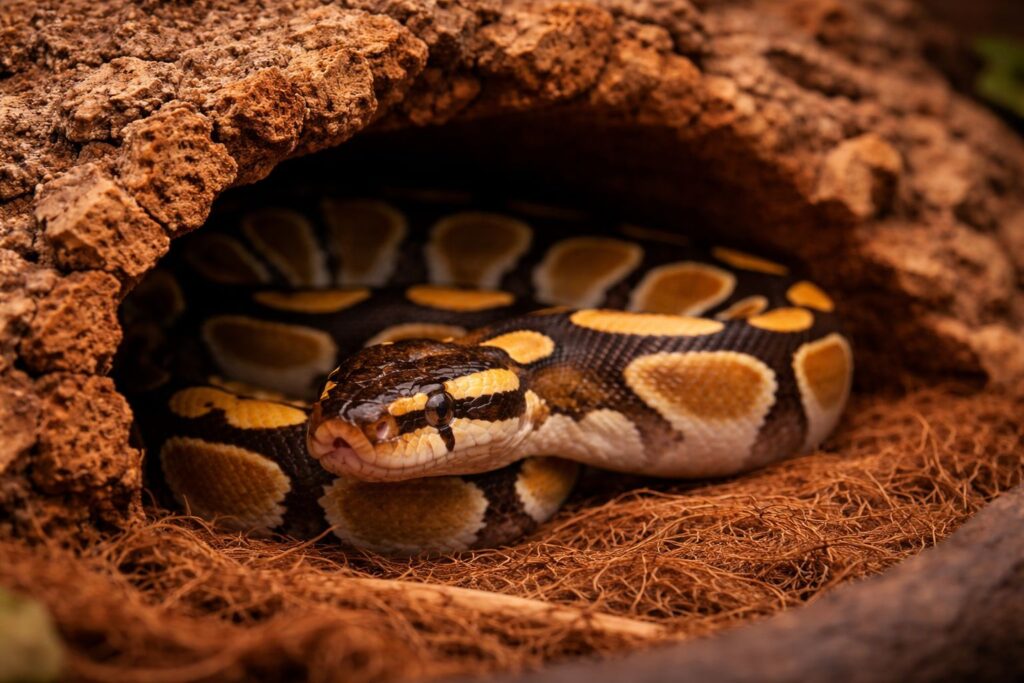
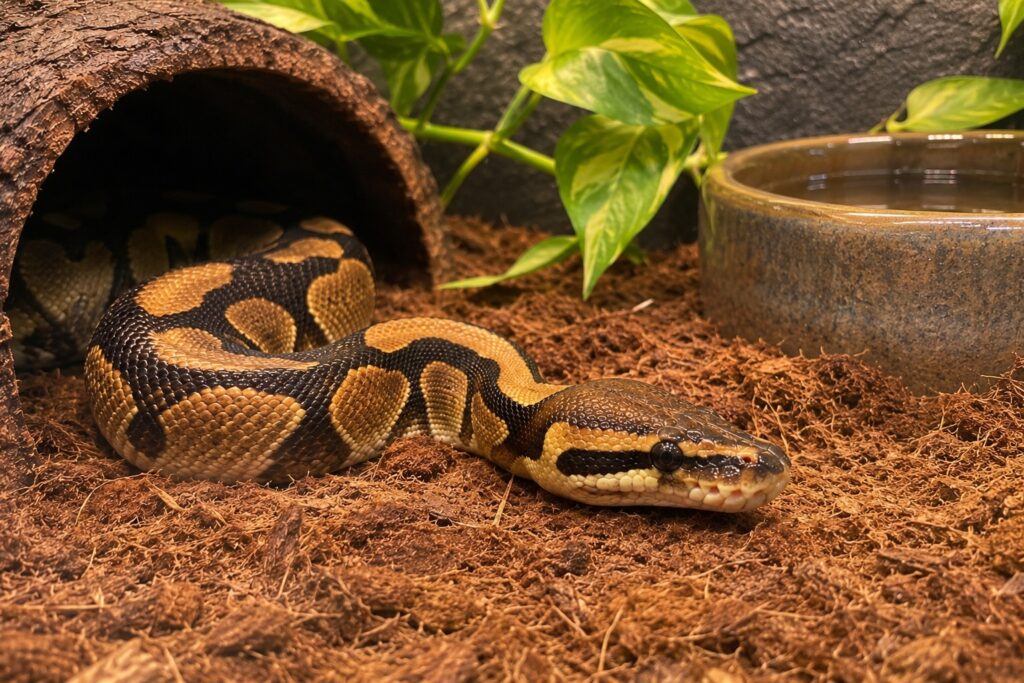
Hides matter more than anything else in the enclosure. Use at least two identical, snug hides, one on the warm side and one on the cool side, so the snake never has to choose between feeling safe and being at the right temperature. A ball python should touch the walls of its hide on all sides when curled up. Fill the open space with fake plants, cork bark, and branches. Clutter is security for this species.
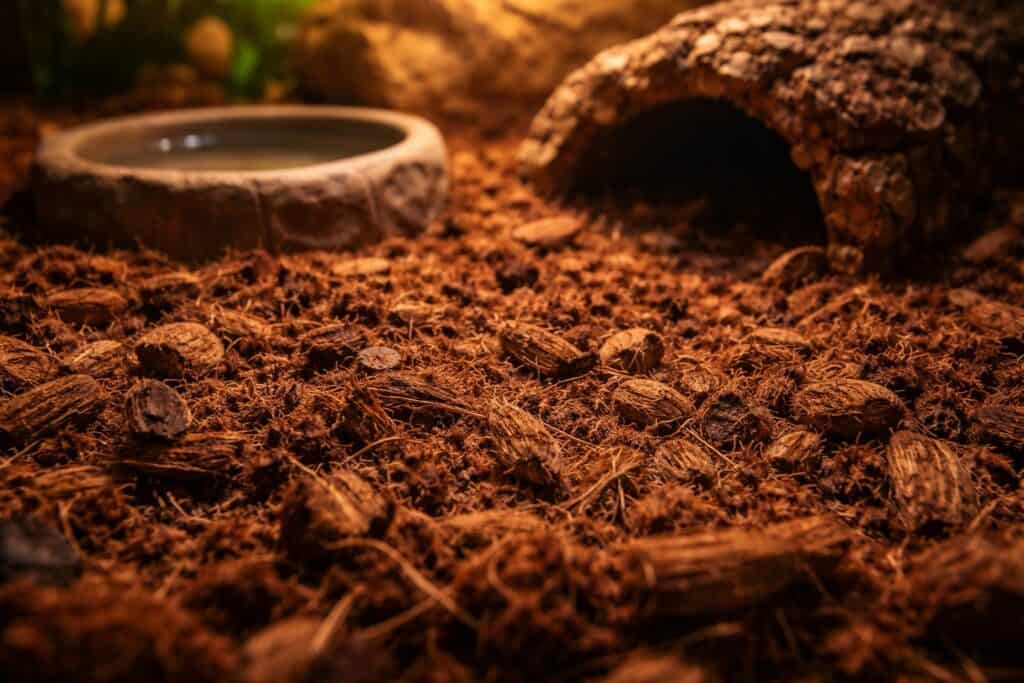
For substrate, coconut fiber, cypress mulch, or a topsoil and play sand mix at 3 to 4 inches deep all hold humidity well. Skip aspen, which molds when kept damp, and never use cedar or pine shavings. Our guide on which substrates work and which to skip compares them side by side, and the full enclosure build walks through putting it all together.
Heat and Humidity
Ball pythons need a warm side surface of 88 to 92°F, an ambient warm side of 80 to 85°F, and a cool side of 76 to 80°F. At night the enclosure should never drop below 75°F. A heat mat or heat tape under one end works well for surface heat, and a ceramic heat emitter or deep heat projector can add ambient warmth in a cold room.
Every heat source needs a thermostat. An unregulated heat mat can climb well past 100°F and burn a snake that sits on it, and ball pythons will sit on a heat source that’s hurting them. Use an infrared temperature gun on the surface the snake actually lies on, not a stick-on dial on the glass. Here’s how to measure and set ball python temperatures properly.
Humidity should stay between 60 and 80 percent, measured with a digital hygrometer at snake level. A big water bowl on the warm side, damp substrate, and a covered lid usually get you there. If yours keeps falling below 60, our guide to humidity that keeps dropping goes through the fixes in order.
UVB isn’t strictly required for ball pythons, but there’s growing evidence that a low-output UVB tube on a 12 hour day cycle benefits them. If you add one, mount it inside a PVC enclosure, since PVC blocks UV.
Feeding Your Ball Python
Feeding is the part of ball python care people worry about most, and it’s simpler than it looks. Feed hatchlings every 5 to 7 days, juveniles every 7 days, sub-adults every 7 to 10 days, and adults every 10 to 14 days. Prey should be 1 to 1.5 times the width of the snake at its widest point. Switch from mice to rats early, because adult mice are too small for a grown ball python and many snakes that start on rats never become picky.
Frozen-thawed is safer than live. A live rat can badly injure a snake that isn’t hungry, and that happens more often than people think. Thaw the rodent in the fridge, warm it in a sealed bag in warm water until it’s slightly warm to the touch, and offer it with long tongs in the evening when ball pythons hunt.
Don’t handle your snake for at least 48 hours after a meal. Stress during digestion is one of the main causes of regurgitation. Our feeding schedule by age and weight has the full prey-size chart.
Adults sometimes stop eating for 4 to 8 weeks over winter. If body weight holds and the snake is alert, that’s normal. Keep offering every 10 to 14 days and don’t switch foods.
Handling
Give a new ball python one to two weeks to settle before handling, then keep sessions to 10 to 15 minutes a few times a week. Pick the snake up from the middle of its body, support it with both hands, and let it move through your hands rather than gripping it. A ball python that balls up tight is nervous. One that’s exploring with its head up and tongue flicking is comfortable.
Skip handling for two days after a meal and while the snake is in shed. Wash your hands afterwards, because reptiles can carry salmonella even when they look healthy. The CDC’s guidance on reptiles and amphibians covers the basics, especially if you have young children in the house.
Shedding
Ball pythons shed every 4 to 8 weeks, more often while they’re growing. About a week before a shed, the eyes turn milky blue and the skin looks dull. Most snakes refuse food during this blue phase, and that’s fine. The eyes clear a few days before the shed itself.
A healthy shed comes off in one piece. If it comes off in patches, humidity is too low. Raise it toward 80 to 90 percent for the next shed cycle and add a humid hide with damp sphagnum moss. For bits that are already stuck, our guide to stuck shed shows how to remove it safely.
7 Ball Python Care Mistakes That Make Them Refuse Food
When a ball python won’t eat, work through these in order. They’re ranked by how often they’re the real cause.
1. The warm side is too cool. If the surface under the warm hide is below 88°F, the snake can’t digest properly and often won’t eat. Check it with a temperature gun before anything else.
2. Not enough cover. One hide, an open tank, or a hide that’s too big all leave a ball python feeling exposed. Add a second identical hide and fill the open space with clutter.
3. Too much handling. Daily handling, especially in the first few weeks, is one of the most common reasons a new snake won’t take its first meals. Stop handling completely until it has eaten three times in a row.
4. Humidity is too low. Chronic low humidity leads to bad sheds and a stressed snake. Get it back to 60 to 80 percent.
5. It’s in shed or just finished one. A snake in blue won’t eat. Wait 2 to 3 days after the shed is complete. If it’s still refusing after that, our guide to a ball python not eating after a shed covers what to check next.
6. The prey changed or is the wrong size. Switching from rats to mice, from one rodent supplier to another, or offering something too large can all cause refusals. Go back to whatever the snake last ate well.
7. It’s a seasonal fast. Adults, especially males, often fast through winter. If the weight is stable, this isn’t a problem.
The only way to know which of these you’re dealing with is records. Log every meal, refusal, shed, and weigh-in in the feeding tracker in the Exotic Reptile Care app, and you’ll see at a glance whether a refusal is a one-off or the third in a row. Good ball python care records also catch the sign that matters most: a slow drop in weight.
Health Problems to Watch For
Most ball python care problems that need treatment start with the setup. Respiratory infections show up as wheezing, bubbles at the nostrils, or open-mouth breathing, and are usually caused by temperatures that are too low. Regurgitation is most often caused by handling too soon after a meal, prey that’s too large, or a warm side that’s too cool. Scale rot appears as brown or discolored belly scales and comes from substrate that’s kept wet rather than humid. And snake mites look like tiny moving black dots around the eyes and chin, often with a snake soaking in its water bowl for days.
Any snake that’s steadily losing weight, breathing with its mouth open, or has regurgitated twice in a month needs a reptile vet. Find one before you need one through the ARAV vet directory.
Frequently Asked Questions
How long do ball pythons live?
Ball pythons usually live 20 to 30 years in captivity with good care, and many live longer. They’re a long-term commitment.
How big do ball pythons get?
Adult males usually reach 2 to 3.5 feet, and adult females 3 to 5 feet. Females are also much heavier.
How often should I feed my ball python?
Hatchlings every 5 to 7 days, juveniles every 7 days, sub-adults every 7 to 10 days, and adults every 10 to 14 days. Prey should be 1 to 1.5 times the snake’s widest point.
Good ball python care comes down to a stable warm side, snug hides, and humidity in range. When your snake refuses a meal, check those three before you change the food.