You check the hygrometer and it reads 35 percent. Your ball python just had a terrible shed, with dry flaky skin stuck to its head and patchy pieces clinging to the tail. Sound familiar? Ball python humidity too low is one of the most common husbandry problems in the hobby, and it causes more issues than most keepers realize. Bad sheds are just the beginning. Low humidity can lead to dehydration, respiratory infections, and a snake that stops eating for weeks.
Ball pythons come from the tropical savannas of West and Central Africa, where humidity regularly sits between 60 and 80 percent and climbs even higher at night. Replicating that in a glass tank in your living room, especially if you live somewhere dry, takes a bit of effort. But once you get it dialed in, it’s easy to maintain. Let’s go through what’s going wrong and how to fix it.
How Low Is Too Low for Ball Python Humidity
The target range for ball python humidity is 60 to 80 percent. Some keepers aim for 50 to 60 percent as a baseline, and that can work if you provide a humid hide, but anything consistently below 50 percent is going to cause problems. Below 40 percent and you’re almost guaranteed shedding issues within the next cycle. If you keep more than one species, our reptile temperature and humidity guide compares the correct ranges across all of them.
A lot of the old care guides and pet store sheets still recommend 40 to 60 percent. That information is outdated. More recent research into wild ball python habitats shows that these snakes spend most of their time in burrows and termite mounds where humidity is consistently high, often above 70 percent. The idea that ball pythons need moderate humidity was based on surface-level climate data, not on what conditions they actually seek out underground.
If your hygrometer is reading below 50 percent on a regular basis, you need to make changes. And if your snake is showing signs like retained shed, wrinkled skin, sunken eyes, or spending all its time soaking in the water bowl, those are all red flags that your ball python humidity is too low and has been for a while.
Why Screen Top Enclosures Are the Biggest Problem
If you’re keeping your ball python in a glass aquarium with a mesh screen lid, that’s probably your number one issue. Screen tops let moisture escape constantly. You can mist all day long and the humidity will drop back down within an hour because the warm air inside the tank rises and carries all that moisture straight out through the mesh.
This is the setup most pet stores sell as a starter kit, and it’s the worst possible option for maintaining humidity. You end up in an endless cycle of misting, watching the humidity spike to 70 percent, then watching it crash back to 35 percent two hours later. Those spikes and crashes aren’t great for your snake either. Consistent humidity matters more than occasionally hitting the right number.
The most effective fix is switching to a PVC or enclosed plastic enclosure. Brands that make purpose-built reptile enclosures with solid walls and minimal ventilation are designed for exactly this problem. They hold humidity naturally because moisture has nowhere to escape. If you’re not ready to buy a new enclosure, you can cover 75 to 80 percent of the screen top with aluminum foil, HVAC tape, or a cut piece of acrylic. Leave some ventilation open so air can still circulate, but blocking most of that screen will make a dramatic difference.
Why Ball Python Humidity Stays Too Low on the Wrong Substrate
The substrate you use plays a huge role in how well your enclosure holds humidity. If you’re using aspen shavings, newspaper, or paper towels, you’re getting almost zero humidity retention. Aspen actually molds when it gets wet, so you can’t even mist it without creating a different problem.
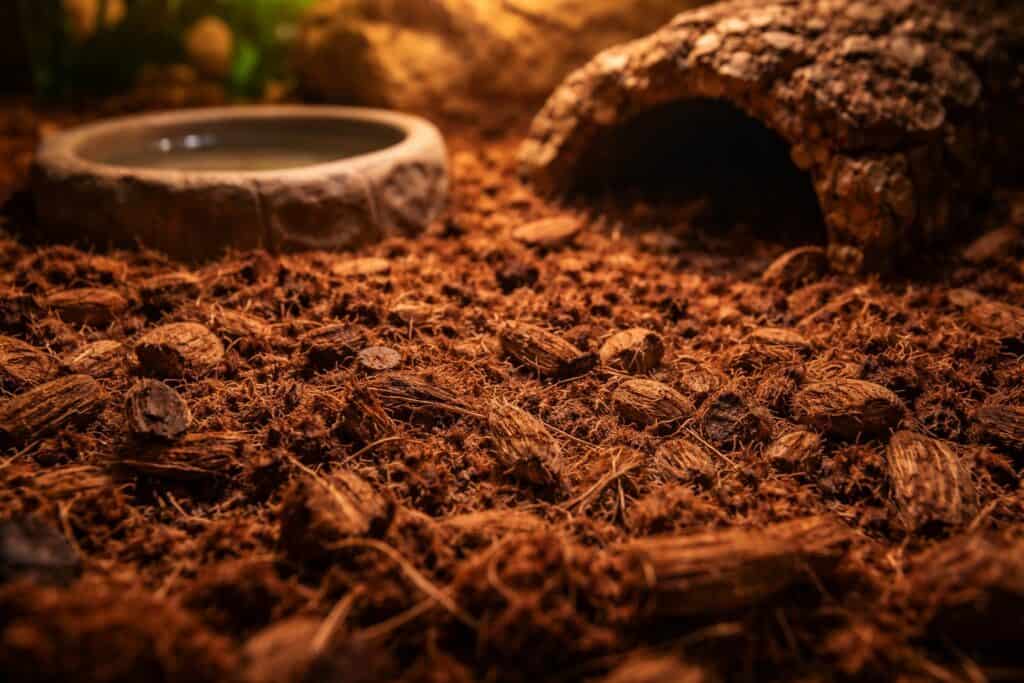
Switch to a humidity-friendly substrate like coconut fiber, cypress mulch, or a mix of the two. These substrates absorb water, hold it, and release moisture slowly into the air over time. You want at least 3 to 4 inches of depth. A thin layer won’t hold enough water to make a meaningful difference. When you pour water into one corner of the substrate, it should absorb and stay damp without creating puddles or standing water on the surface.
Some keepers use a mix of organic topsoil and sphagnum moss, which works extremely well for holding humidity in the 70 to 80 percent range. The key is that the top layer of substrate can feel slightly dry to the touch while the deeper layers stay moist. Your snake isn’t lying on wet ground, but the moisture is continuously evaporating upward and keeping the air humid.
Your Water Bowl Is an Underrated Tool
A lot of keepers use a small water bowl tucked in one corner and call it done. But the size and placement of your water bowl has a real impact on enclosure humidity. A larger, shallow bowl with more surface area allows more water to evaporate into the air. Place it closer to the warm side of the enclosure, not directly under the heat source but near enough that the warmth speeds up evaporation.
This alone won’t fix ball python humidity too low if your enclosure is leaking moisture through a screen top. But combined with the right substrate and a more enclosed setup, a properly sized water bowl can bump your humidity by 5 to 10 percent without any extra effort. Refill it daily since the evaporation is doing its job when the water level drops faster than usual.
A Humid Hide Helps When Ball Python Humidity Is Too Low
Even in a well-set-up enclosure, it helps to give your ball python a humid microclimate it can access whenever it wants. This is where a humid hide comes in. Take a plastic hide or container, cut an entrance hole, and line the inside with damp sphagnum moss. Place it on the cool side or in the middle of the enclosure.
The inside of a humid hide will sit at 80 to 90 percent humidity even when the rest of the enclosure is lower. Your snake can crawl in when it needs extra moisture, especially during a shed cycle. Check the moss every few days and re-moisten it when it starts drying out. Replace the moss entirely every two to three weeks to prevent mold.
A humid hide isn’t a replacement for getting your overall enclosure humidity right, but it’s a great safety net. If your snake is consistently choosing to spend all its time in the humid hide and never comes out, that’s a sign the rest of the enclosure is still too dry.
How to Monitor Humidity the Right Way
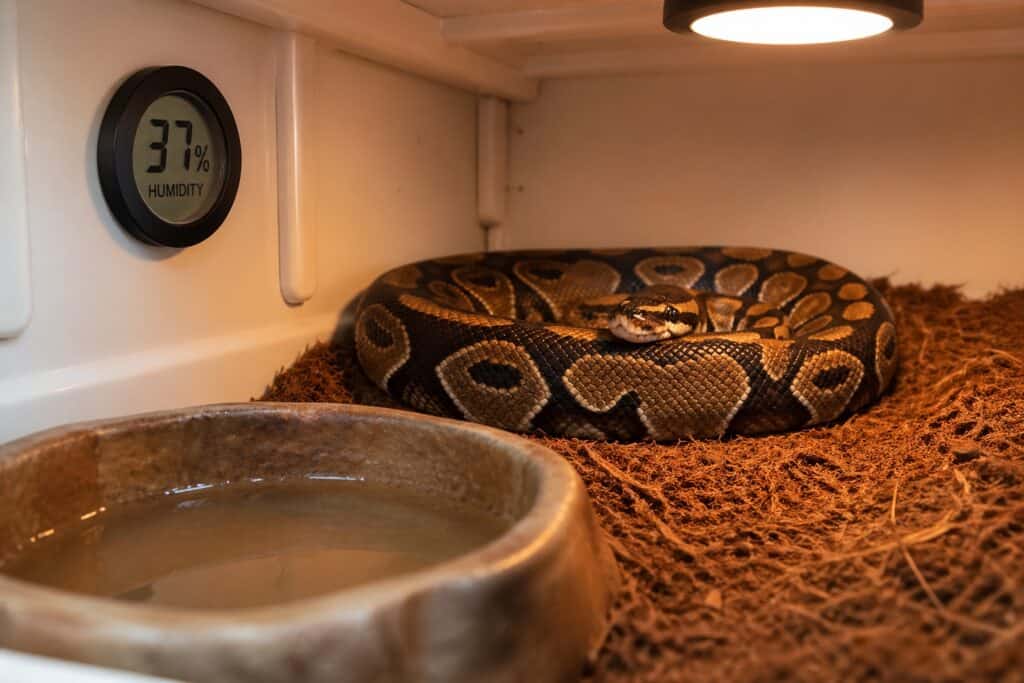
Cheap analog hygrometers, the round dial kind that stick to the glass, are unreliable. They can be off by 10 to 20 percent in either direction, which is a massive margin of error when you’re trying to maintain a specific range. Invest in a digital hygrometer with a probe. Place the probe at substrate level in the middle of the enclosure, not up near the top of the tank where the reading will be different from what your snake is actually experiencing.
Checking humidity once a day isn’t really enough if you’re troubleshooting a dry enclosure. A hygrometer with a min/max function lets you see the lowest point your humidity dropped to overnight, which is when it usually dips the most. If your daytime readings look fine but the overnight low is hitting 35 percent, you still have a problem.
Logging your humidity readings alongside feeding and shedding data gives you a clear picture of how conditions affect your snake’s health. The Exotic Reptile Care app lets you track all of this in one place. When you can see that every bad shed lines up with a week of low humidity readings, it makes the connection obvious and motivates you to keep the levels consistent.
What Happens When You Don’t Fix It
Retained shed is the most visible consequence of low humidity, but it’s not the most dangerous one. Chronic low humidity dries out the mucous membranes in your ball python’s respiratory tract. Over time, this creates tiny injuries in the lung tissue that bacteria can exploit. Respiratory infections in ball pythons show up as wheezing, open-mouth breathing, excess mucus, and bubbling around the nostrils. Left untreated, an RI can kill a snake.
Dehydration is the other slow-moving problem. A chronically dehydrated ball python will have wrinkled skin between the scales, sunken eyes, and reduced appetite. Some will soak in their water bowl excessively trying to compensate. If your snake is sitting in its water dish for hours every day, don’t assume it just likes baths. It’s trying to tell you something.
For the full setup that keeps humidity stable, see our ball python enclosure guide.
Getting ball python humidity right isn’t complicated once you understand the mechanics. Seal the enclosure, use the right substrate, size up the water bowl, and add a humid hide as backup. Check your readings daily until you’re confident the levels are stable, and your snake will shed clean every single time.
Ball python humidity too low: frequently asked questions
What humidity does a ball python need?
The target range is 60 to 80 percent. You can run 50 to 60 percent as a baseline if you provide a humid hide, but anything consistently below 50 percent starts causing problems, and below 40 percent you’re almost guaranteed a bad shed. The older 40 to 60 percent guidance from pet store sheets is outdated.
How do I raise ball python humidity fast?
Start with the biggest leak, which is usually a screen top. Cover 75 to 80 percent of it with foil or acrylic, switch to a moisture-holding substrate like coconut fiber or cypress mulch at 3 to 4 inches deep, and add a larger water bowl near the warm side. Those three changes fix most cases of ball python humidity too low without constant misting.
Why does my ball python’s humidity drop so fast?
A mesh screen lid is the usual culprit. Warm air rises inside the tank and carries moisture straight out through the mesh, so you mist, spike to 70 percent, and crash back to 35 within an hour or two. The wrong substrate makes it worse. Aspen, newspaper, and paper towels hold almost no moisture, so there’s nothing releasing humidity back into the air.
Is misting a good way to keep humidity up?
Not on its own. Misting gives you a short spike that vanishes fast, and those swings between high and low are worse for your snake than a slightly lower but stable reading. Misting is a supplement, not a fix. Get the enclosure sealed and the substrate right first, and you’ll barely need to mist at all.
Can low humidity kill a ball python?
Not directly, but its downstream effects can. Chronic dryness damages the respiratory tract and opens the door to respiratory infections, which can be fatal if left untreated. Long-term low humidity also causes dehydration and repeated bad sheds. Retained shed around the eyes or tail tip can cut off circulation and cause tissue damage.
How do I know if the fix is actually working?
Use a digital hygrometer with a probe at substrate level and a min/max function, since overnight is when humidity dips lowest. Daytime readings can look fine while the overnight low hits 35 percent. Logging those readings next to shed and feeding data in the Exotic Reptile Care app makes it obvious when a bad shed lines up with a dry week.