Your bearded dragon is going to spend most of its life inside its tank. That’s not a dramatic statement, it’s just the reality of keeping a reptile indoors. So the enclosure you set up isn’t just a box with a heat lamp. It’s their entire world. The temperature gradient, the lighting, the layout, all of it affects whether your bearded dragon thrives or just survives. Getting your bearded dragon tank right from the start saves you from chasing problems later, things like glass surfing, appetite loss, and stress that all trace back to enclosure issues.
Bearded Dragon Tank Setup at a Glance
| Component | Recommendation |
|---|---|
| Tank Size (Adult) | 120 gallon / 4′ x 2′ x 2′ |
| Basking Surface Temp | 100 to 110°F |
| Cool Side Temp | 75 to 80°F |
| UVB | T5 HO linear, 2/3 enclosure length |
| Substrate (Adult) | 70/30 topsoil and play sand mix |
| Substrate (Baby) | Tile, shelf liner, or paper towel |
| Night Heat | Ceramic heat emitter (no light) |
What Size Bearded Dragon Tank Do You Actually Need
This is where most new keepers get it wrong. A baby bearded dragon looks tiny sitting in a 40 gallon tank, and pet stores will happily sell you a 20 gallon “starter kit” to save money. Don’t fall for it. A 20 gallon works for maybe two months before your beardie outgrows it. You’ll end up buying a bigger tank anyway, so skip the upgrade cycle entirely.
For a baby (under 6 months), a 40 gallon breeder is the minimum. Some keepers go straight to an adult-sized enclosure and just provide more cover so the baby feels secure. That’s a perfectly fine approach.
For a juvenile (6 to 12 months), you need at least a 75 gallon.
For an adult, 120 gallons is the standard recommendation now. The old “40 gallon is fine for an adult” advice is outdated. A 4 foot by 2 foot by 2 foot enclosure (roughly 120 gallons) gives your beardie enough room to thermoregulate properly, move around, and actually behave like a bearded dragon instead of sitting in one spot all day. If you’ve ever seen a beardie in a 120 versus a 40, the difference in activity level is obvious. The same 4 x 2 x 2 footprint also suits other desert lizards of similar size. If you’re comparing species, uromastyx care uses the same enclosure with a much hotter basking spot and no insects.
Front-opening enclosures are better than top-opening aquariums. Bearded dragons interpret things coming from above as predators. Reaching in from the top stresses them out, especially when they’re young. A front-opening door lets you interact with your beardie at their level.
Heating and Temperature Gradient in Your Bearded Dragon Tank
Bearded dragons are desert animals. They need a hot basking spot and a cooler side to move between throughout the day. Without this gradient, they can’t regulate their body temperature, and that affects everything from digestion to immune function.
Your basking surface should hit 100 to 110 degrees Fahrenheit. Not the air temperature above the basking spot. The actual surface your beardie sits on. Use an infrared temperature gun to check this. Ambient warm side should be around 85 to 90 degrees, and the cool side should sit between 75 and 80.
For basking heat, a halogen flood bulb works best. Regular household halogen PAR38 bulbs from the hardware store do the same job as expensive “reptile basking bulbs” at a fraction of the cost. Mount it on the same side as your UVB, about 8 to 12 inches from the basking surface. Adjust the height until you hit the right surface temperature.
At night, all lights go off. Bearded dragons need a dark, cool nighttime period. If your house drops below 65 degrees at night, use a ceramic heat emitter, not a colored “night light.” Red and blue bulbs do disrupt their sleep despite what some outdated care sheets say.
If your beardie is avoiding the basking spot entirely, the temperature might be wrong, or the setup might need adjusting. We covered this in detail in our guide on bearded dragon not basking.
UVB Lighting Setup
This is the single most important piece of equipment in your bearded dragon tank, and it’s the one most commonly done wrong. Bearded dragons need strong UVB exposure to synthesize vitamin D3 and metabolize calcium. Without it, they develop metabolic bone disease. It’s not a matter of if, it’s when.
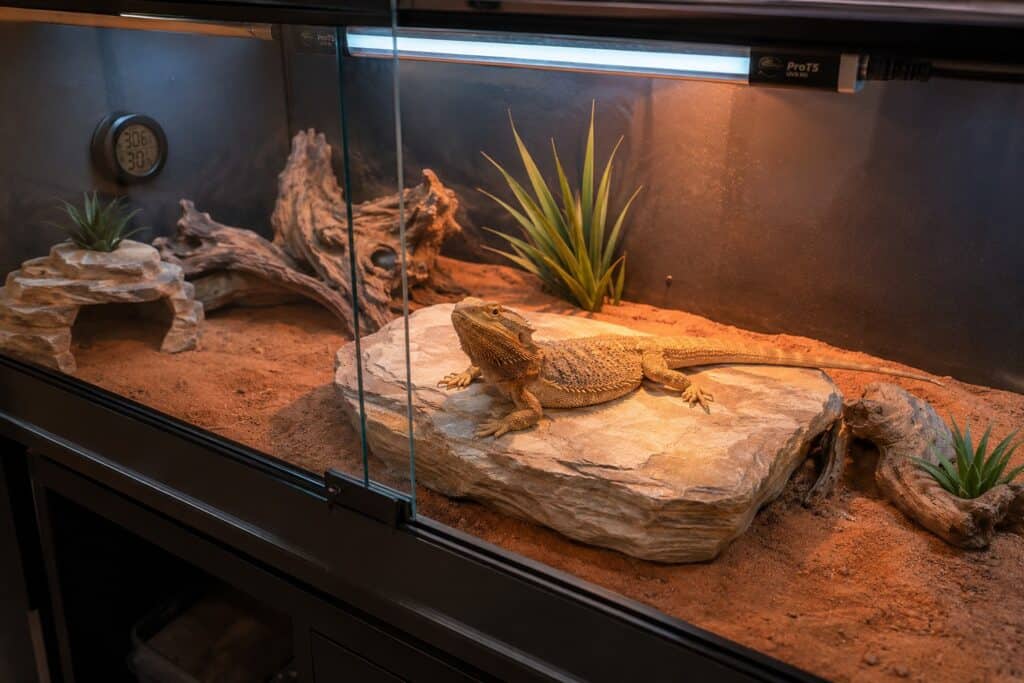
Use a T5 HO (high output) linear UVB tube that covers two thirds of the enclosure length. A 24 inch tube in a 48 inch tank, or a 34 inch tube if you can find one. The Arcadia 12% or Zoo Med T5 10.0 are the go-to options. Mount it inside the enclosure if there’s a mesh screen lid, because mesh filters out a significant amount of UVB. If you have a front-opening enclosure with no screen between the bulb and your beardie, you can mount it on top.
Compact coil UVB bulbs are not adequate for bearded dragons. They produce a narrow cone of UVB that doesn’t cover enough area. Your beardie would have to sit directly under it at exactly the right distance to get any benefit. Linear tubes spread UVB across a wide area, which is what these animals actually need.
Replace your UVB tube every 6 months with a T8, or every 12 months with a T5. The bulb will still produce visible light long after the UVB output has degraded below useful levels. You can’t tell by looking at it. Mark the install date on the bulb with a marker and set a reminder so you don’t forget.
Substrate and Tank Layout
The substrate debate in bearded dragon groups is almost as heated as the ball python bedding wars. Here’s what actually matters: babies and juveniles should be on a solid, non-particulate substrate like tile, shelf liner, or paper towel. Impaction risk is real with loose substrate at this age because young beardies are clumsy eaters and will accidentally scoop up mouthfuls of whatever is under their food.
For healthy adults in a properly heated tank, a topsoil and play sand mix (roughly 70/30) works great and lets them dig, which is a natural behavior. This is the substrate used in most bioactive setups too. If you’re interested in going that route, our guide on bioactive reptile enclosures walks through the full process.
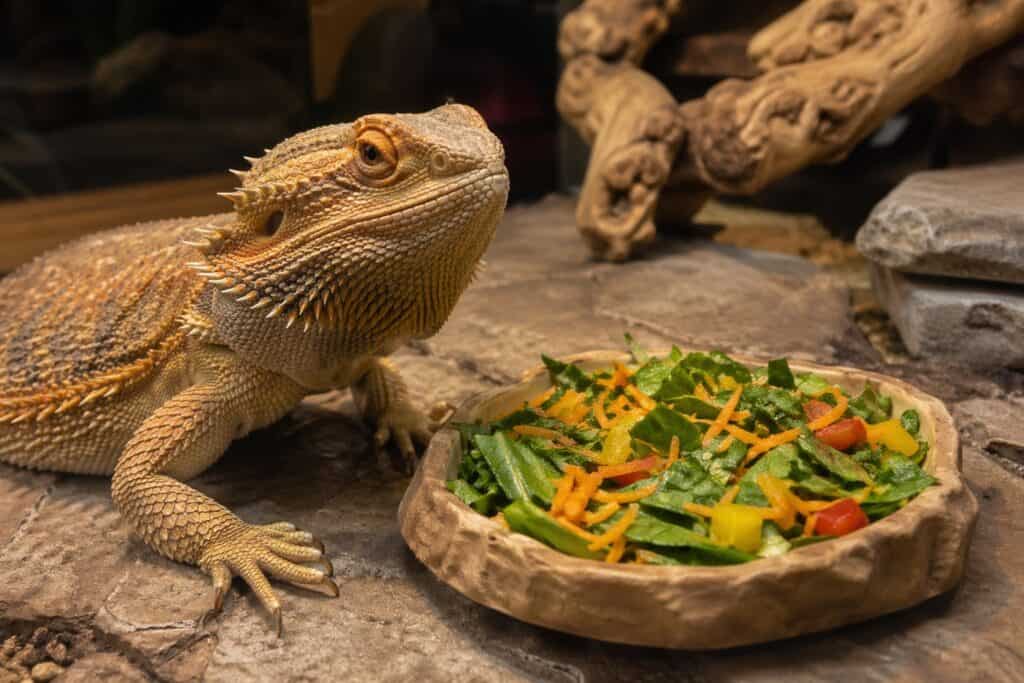
Inside the tank, your beardie needs a few key things. A flat basking surface (a large flat rock or stone slab works better than a branch for beardies since they like to flatten out). At least one hide on the cool side. Something to climb, but nothing so tall they can get within a few inches of the heat lamp and burn themselves. And a food dish for greens on the cool side.
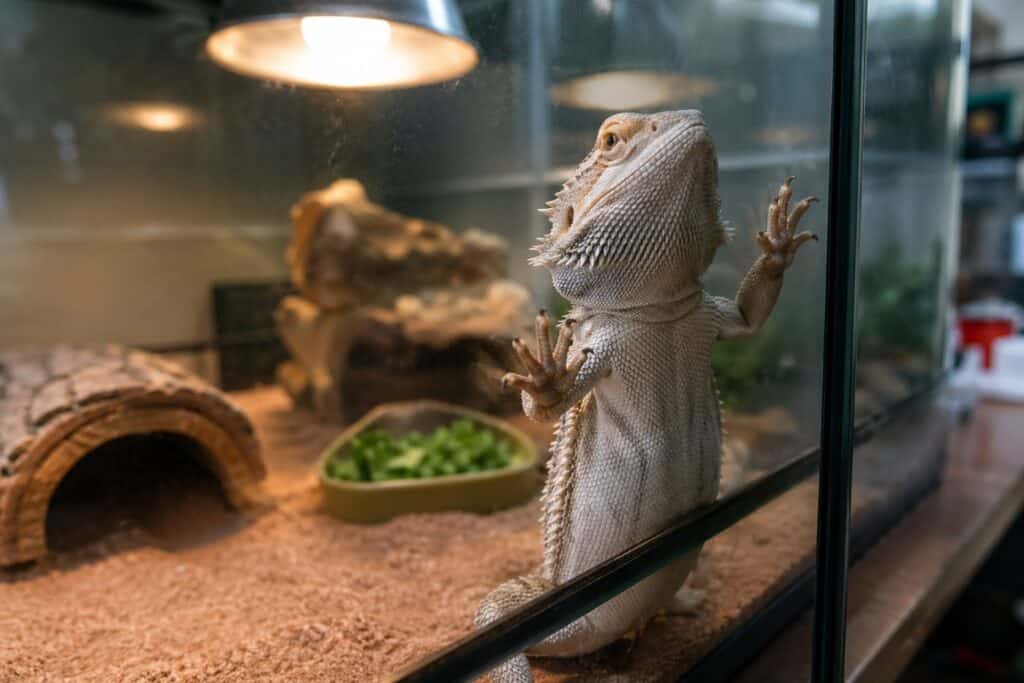
Don’t overcrowd the enclosure. Bearded dragons like open space to move through. Two or three pieces of decor plus the basking spot is plenty. If your tank looks like a cluttered obstacle course, your beardie will feel trapped rather than enriched, and that’s one of the causes behind glass surfing behavior.
Keeping Your Bearded Dragon Tank on Track
Once your tank is dialed in, the ongoing work is monitoring. Temperatures drift as bulbs age, seasons change, and room conditions shift. What worked perfectly in winter might run hot in summer if your house warms up. Checking basking temps weekly and ambient temps every few days keeps you ahead of problems instead of reacting to them.
Tracking things like feeding response, weight, and shedding over time also helps you spot trends before they become health issues. A beardie that’s slowly eating less over two weeks might need a temperature check. One that’s gaining weight too fast might be getting too many feeders and not enough greens. The Exotic Reptile Care app makes this easy with feeding logs, weight charts, and reminders for things like UVB bulb replacement and cleaning schedules, so nothing slips through the cracks.
Common Bearded Dragon Tank Mistakes
There are a few mistakes that come up over and over in online groups, and they’re all easy to avoid once you know about them.
Using a tank that’s too small. Already covered this, but it’s worth repeating. A 40 gallon tank for an adult beardie causes stress and limits thermoregulation. Upgrade to 120 gallons.
Skipping the temperature gun. Guessing temps based on how the tank “feels” or relying on a cheap stick-on thermometer leads to basking spots that are 15 degrees off target. An infrared temp gun costs around $15 and takes the guesswork out entirely.
Placing the UVB and basking lamp on opposite ends. Your beardie should be able to bask and absorb UVB at the same time. Mount both on the same side, with the basking spot underneath the overlap between the heat lamp and the UVB tube.
No cool side hide. If your beardie can’t escape the heat and the light, they’re forced to sit in conditions they’d naturally move away from. Always provide a hide on the cool end.
Using colored night bulbs. Red, blue, and purple “night heat” bulbs disrupt sleep cycles. If you need overnight heat, use a ceramic heat emitter, which produces heat without any light.
Bearded Dragon Tank FAQ
Can I keep a baby bearded dragon in a 120 gallon tank?
Yes. Just add extra cover like fake plants and a few hides so the baby doesn’t feel exposed in the open space. Plenty of keepers skip the upgrade cycle entirely and start with the adult-sized enclosure from day one.
Do bearded dragons need a screen or glass top?
Glass tops trap heat and humidity, which can push temperatures too high. A mesh screen top works better for ventilation, though it does filter some UVB. If you use a screen, mount the UVB fixture inside the enclosure to compensate. Front-opening enclosures with built-in mesh ventilation are the best option overall.
How often should I replace the UVB bulb?
Every 6 months for T8 tubes, every 12 months for T5 HO tubes. The bulb will still produce visible light after the UVB degrades, so you can’t tell by looking at it. Mark the install date on the tube and set a reminder.
Can two bearded dragons share one tank?
No. Bearded dragons are solitary and territorial. Cohabitation leads to stress, dominance issues, food competition, and injuries. Even two that seem to “get along” are usually just tolerating each other while one slowly declines. One beardie per tank, always.
What’s the best way to monitor tank temperatures?
Use an infrared temperature gun for basking surface temps and a digital thermometer with probes on both the warm and cool side for ambient readings. Stick-on strip thermometers are inaccurate and should not be relied on.
Your Beardie’s Home for the Next 10+ Years
A bearded dragon that’s well cared for can live 10 to 15 years. That means the tank you set up today needs to work for a long time. Invest in the right size from the start, get the lighting and heating right, keep the layout simple, and stay on top of monitoring. Your beardie can’t tell you when something is off, but their behavior will, as long as you’re paying attention.