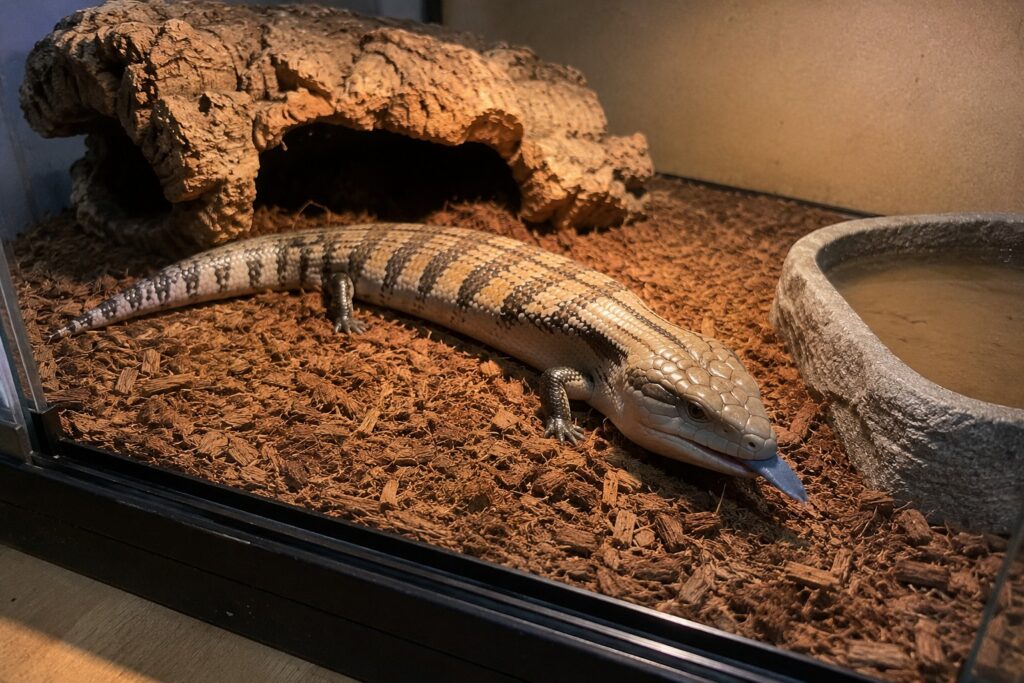
Blue tongue skinks are one of the most underrated pet reptiles out there. They’re docile, handleable, curious, and packed with personality. But they’re also bigger and heavier than most people expect, and that means the blue tongue skink enclosure you set up needs to account for a stocky lizard that likes to dig, explore, and spread out. A setup that works for a leopard gecko or a corn snake isn’t going to cut it here. Blueys need floor space, a solid temperature gradient, and substrate deep enough to burrow into. Get those right and everything else falls into place. This guide covers the enclosure specifically. For diet, handling, health, and the differences between Northern and Indonesian species, start with our blue tongue skink care guide.
Blue Tongue Skink Enclosure at a Glance
| Component | Recommendation |
|---|---|
| Enclosure Size (Adult) | 4′ x 2′ x 2′ minimum (roughly 120 gallon) |
| Enclosure Type | Front-opening, wood or PVC preferred |
| Basking Surface Temp | 100 to 110°F |
| Cool Side Temp | 75 to 80°F |
| Humidity | 40 to 60% (species dependent) |
| UVB | T5 HO linear, 2/3 enclosure length |
| Substrate | Cypress mulch, coconut husk, or topsoil mix |
| Substrate Depth | 3 to 4 inches minimum |
What Size Blue Tongue Skink Enclosure Do You Need
Adult blue tongue skinks reach 18 to 24 inches depending on the species, and they’re thick, heavy lizards. They’re ground dwellers that need horizontal space to roam, not height to climb. A 4 foot by 2 foot by 2 foot enclosure is the minimum for an adult. This is roughly equivalent to a 120 gallon tank, but the dimensions matter more than the gallon number.
For juveniles under 10 inches, a 40 gallon breeder works temporarily. But like bearded dragons, you’ll outgrow it fast. Most keepers are better off going straight to the adult-sized enclosure and adding extra hides so the juvenile feels secure.
Front-opening enclosures are strongly preferred. Blue tongue skinks are ground-level animals, and reaching in from the top startles them. A front-opening door lets you interact at their level, which builds trust faster and makes routine maintenance easier.
Wood and PVC enclosures hold heat and humidity better than glass tanks. Glass works, but you’ll fight to keep temperatures stable, especially if the room is cool. If you go with glass, cover three sides with a background or insulation to reduce heat loss. A screen top on a glass tank also makes humidity harder to maintain, so partial covering helps.
Heating and Temperature Gradient
Blue tongue skinks need a clear hot-to-cool gradient across the enclosure. This is how they thermoregulate, moving between warm and cool zones depending on what their body needs at any given time. Without a proper gradient, digestion slows down, immune function drops, and behavior changes.
The basking surface should hit 100 to 110 degrees Fahrenheit. Use an infrared temperature gun to measure the actual surface, not the air above it. A halogen flood bulb is the best basking heat source. Standard PAR38 halogen bulbs from the hardware store work just as well as branded reptile bulbs and cost a fraction of the price.
The cool side should sit around 75 to 80 degrees. If the cool side is above 85, the enclosure is either too small or the basking lamp is too powerful.
Night temperatures can drop to the low 70s or even upper 60s without issue. Turn all lights off at night. If the room stays above 65 degrees, no supplemental nighttime heat is needed. If it drops lower, a ceramic heat emitter on a thermostat keeps things stable without adding light.
Always use a thermostat on any heat source. This isn’t optional. An unregulated heat lamp can overshoot by 20 degrees and burn your skink. A basic on/off thermostat is fine for overhead heating. Dimming thermostats are even better because they prevent the on/off cycling that causes temperature swings.
UVB Lighting
The debate around UVB for blue tongue skinks has shifted in the same direction as crested geckos. The old advice said they don’t need it. Current evidence strongly suggests they benefit from it. Skinks with UVB access show better appetite, more activity, brighter coloring, and fewer calcium-related health issues.
Use a T5 HO linear tube that covers about two thirds of the enclosure length. The Arcadia 12% or Zoo Med T5 10.0 are standard recommendations. Mount it inside the enclosure if you have a screen top, since the mesh filters a significant amount of UVB. In a wooden or PVC enclosure, the fixture typically mounts directly inside.
Keep the basking branch or platform 10 to 12 inches below the UVB tube. Place the UVB on the same side as the basking lamp so your skink gets heat and UVB exposure at the same time.
Replace T5 tubes every 12 months. They’ll still produce visible light long after the UVB output drops below useful levels. Write the install date on the tube with a marker.
Substrate and Humidity in Your Blue Tongue Skink Enclosure
This is where species matters. Not all blue tongue skinks have the same humidity requirements, and substrate choice directly affects humidity levels.
Northern blue tongue skinks (the most commonly kept species) do well at 40 to 60% humidity. Cypress mulch or a topsoil and sand mix works great. Both hold moderate moisture and let the skink burrow.
Indonesian species like Merauke, Halmahera, and Irian Jaya blue tongue skinks need higher humidity, typically 60 to 80%. Coconut husk, cypress mulch, or a bioactive ABG mix works best for these species. You’ll need to mist more frequently and the substrate should stay slightly damp but never waterlogged.
Regardless of species, substrate should be at least 3 to 4 inches deep. Blue tongue skinks are natural burrowers and will dig into the substrate to sleep, thermoregulate, and feel secure. Shallow substrate frustrates this behavior and leads to stress. If you’ve kept ball pythons, the substrate approach is different here. Our ball python substrate guide covers humidity-holding substrates that also work well in skink setups.
Avoid sand by itself, reptile carpet, and pine or cedar shavings. Sand alone doesn’t hold humidity. Reptile carpet traps toenails and bacteria. Pine and cedar contain oils that are toxic to reptiles.
If you’re interested in a low-maintenance substrate setup, a bioactive enclosure works exceptionally well for blue tongue skinks. The deep substrate, moderate humidity, and consistent temperatures create perfect conditions for a cleanup crew. Our bioactive enclosure guide has the full breakdown on drainage layers, substrate mixes, and isopod colonies.
Inside the Blue Tongue Skink Enclosure
Blue tongue skinks don’t need elaborate decor, but they do need a few essentials.
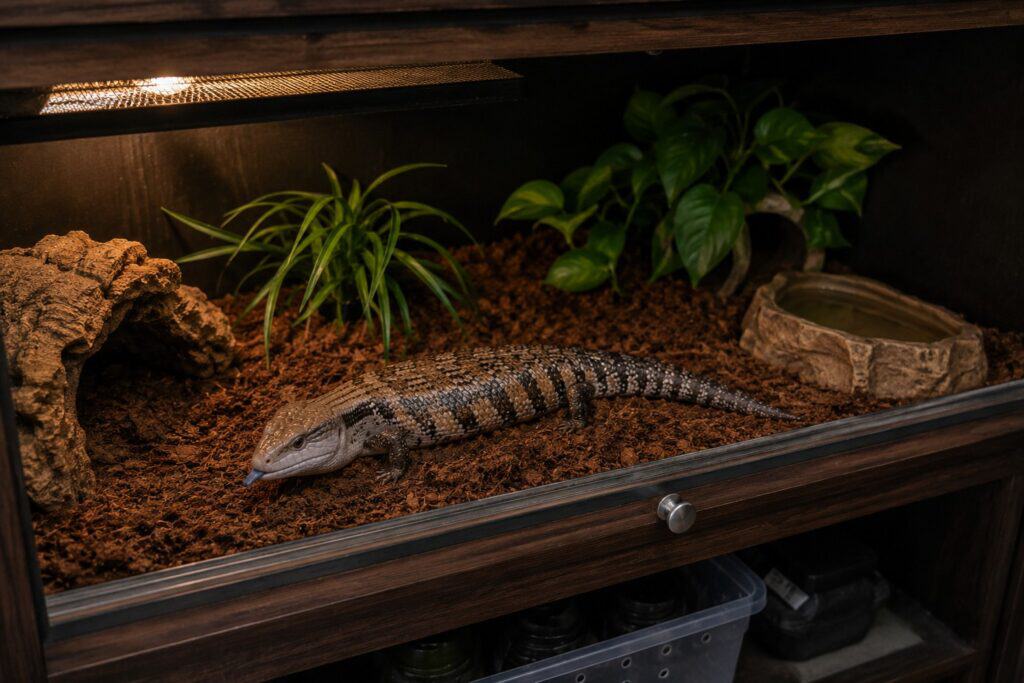
Two hides minimum, one on the warm side and one on the cool side. The hides should be snug enough that the skink feels enclosed on all sides. Cork bark flats, half logs, or commercial reptile hides all work. If your skink is always wedged behind the background or buried in substrate instead of using its hides, the hides might be too large or too exposed.
A water dish big enough for the skink to soak in. Blue tongue skinks love soaking, especially before a shed. A heavy ceramic dish that won’t tip over works best. Change the water daily.
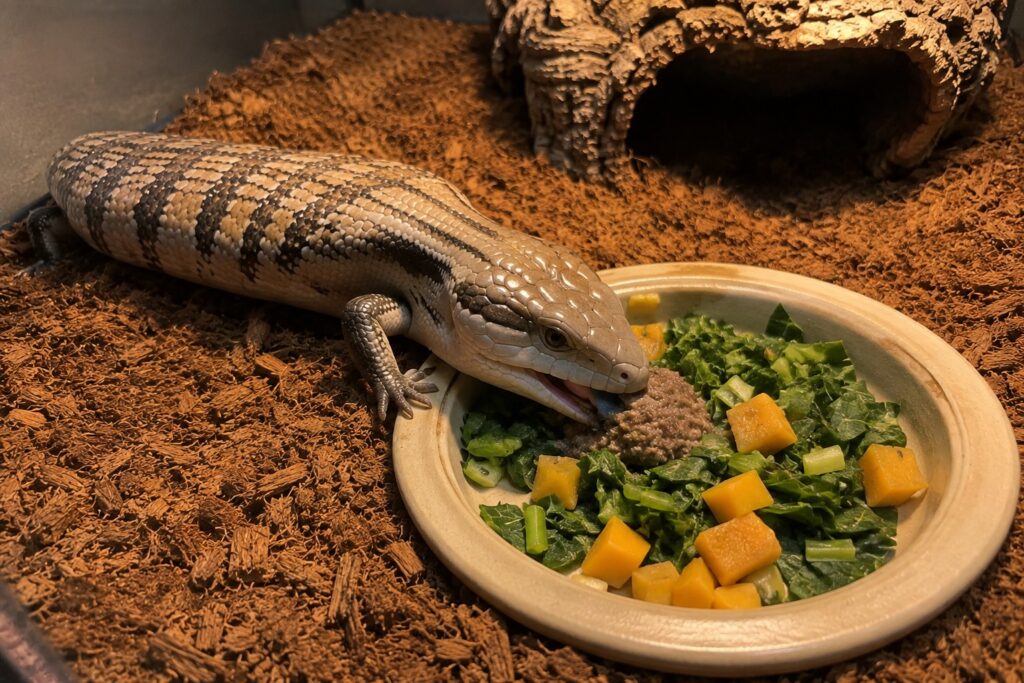
You’ll also want a separate shallow food dish, ideally on a tile or slate slab rather than straight onto substrate. Blue tongue skinks eat wet food and they’re messy about it, so anything served directly on cypress mulch comes back up with mulch stuck to it. What actually goes in that dish is covered in our blue tongue skink diet guide.
A basking platform. This can be a flat rock, a slate tile, or even a sturdy piece of cork bark. It should sit directly under the basking lamp at the right distance to hit target surface temperatures.
Beyond that, keep it simple. A piece of driftwood or a couple of fake plants for visual barriers is enough. Blue tongue skinks don’t climb much and prefer open floor space to navigate. An overcrowded enclosure makes them feel trapped rather than enriched.
Cleaning and Maintenance
Blue tongue skinks are messier than most reptiles. They produce large, wet droppings and tend to walk through them. Spot clean daily by removing droppings and any soiled substrate. A full substrate change every four to six weeks keeps things fresh, unless you’re running a bioactive setup where the cleanup crew handles waste breakdown.
Wipe down the water dish daily, disinfect hides and decor monthly, and deep clean the entire enclosure every two to three months. The cleaning schedule is similar to what we outlined in our guide on how often to clean a snake enclosure, but skinks tend to need spot cleaning more frequently because of the volume and consistency of their waste.
Tracking Your Blue Tongue Skink Enclosure Conditions
Blue tongue skinks are hardy animals, but subtle enclosure issues build up over time. A basking spot that’s dropped 10 degrees because the bulb is aging, humidity that’s creeping too low because the weather changed, or a feeding response that’s gradually declining are all things you might miss day to day but would catch instantly in a weekly log.
The Exotic Reptile Care app lets you log feedings, track weight over time, and set reminders for substrate changes, UVB replacement, and cleaning schedules. For a reptile that can live 15 to 20 years, having records from the start makes a real difference when troubleshooting problems down the road.
Blue Tongue Skink Enclosure FAQ
Can I use a fish tank for a blue tongue skink?
A 40 gallon fish tank works temporarily for a juvenile, but adults need a 4 x 2 x 2 foot enclosure minimum. Standard fish tanks are also top-opening, which startles ground-dwelling skinks. A front-opening enclosure is a much better long-term investment.
Do blue tongue skinks need a heat mat?
Not as a primary heat source. Overhead heating from a halogen basking lamp is more natural and heats the skink from above like sunlight would. Heat mats can be used as supplemental belly heat, but only with a thermostat, and they shouldn’t replace overhead basking heat.
Can I keep two blue tongue skinks together?
No. Blue tongue skinks are solitary and territorial. Cohabitation causes chronic stress, food competition, and bite injuries, even between skinks that appear to tolerate each other. One skink per enclosure.
How deep should the substrate be?
At least 3 to 4 inches. Blue tongue skinks burrow to sleep, regulate temperature, and feel secure. Shallow substrate prevents this natural behavior and increases stress.
What humidity level does my blue tongue skink need?
It depends on the species. Northern blue tongue skinks (Australian) do well at 40 to 60%. Indonesian species (Merauke, Halmahera, Irian Jaya) need 60 to 80%. Know your species before you set up the enclosure.
A Setup That Grows With Your Skink
Blue tongue skinks aren’t demanding once the enclosure is right. They need space, heat, a place to dig, and clean water. That’s really it. Start with a 4 x 2 x 2 enclosure, get the gradient dialed in, choose the right substrate for your species, and keep up with spot cleaning. Do that and you’ve got a setup that works for the next 15 to 20 years with a reptile that actually seems to enjoy your company.