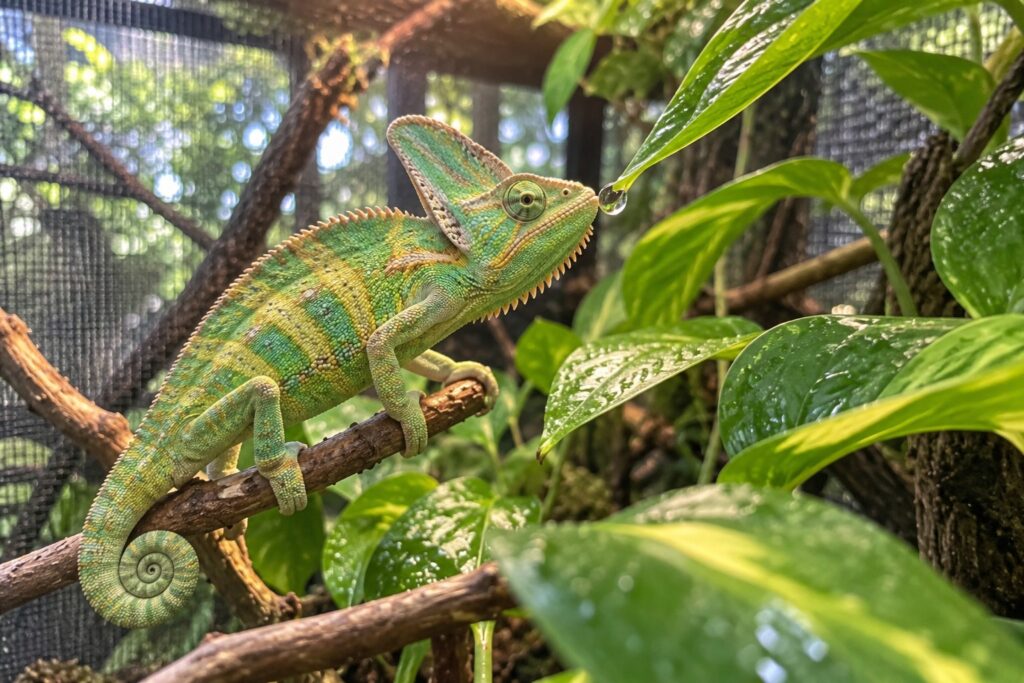
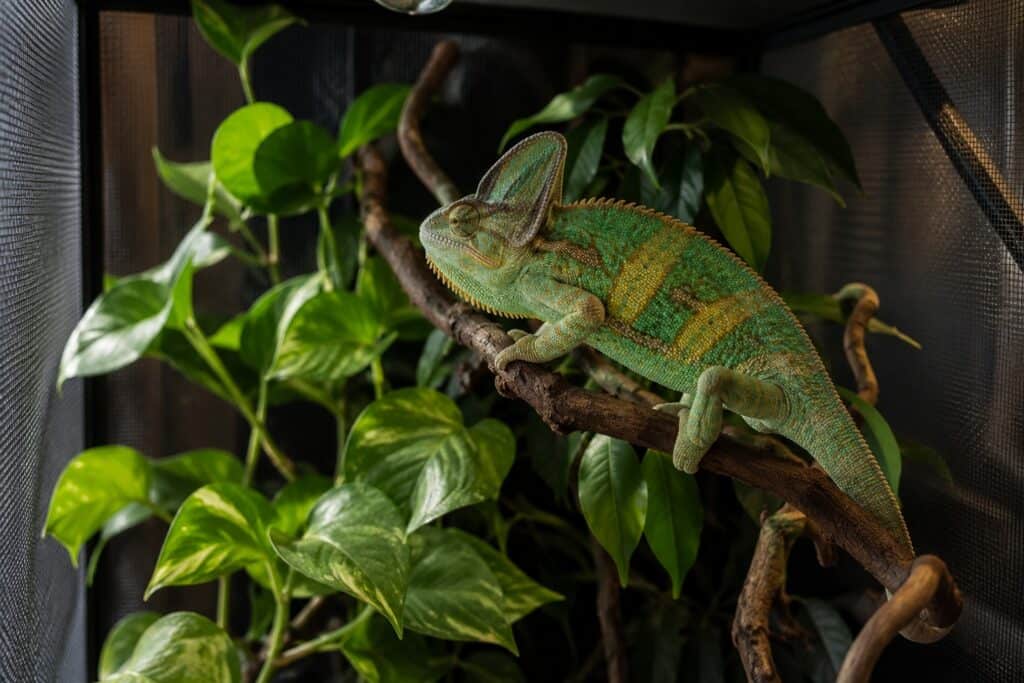
Chameleons are one of those reptiles that look incredible in photos and videos, and then reality hits when you start researching what they actually need. The truth is, a chameleon enclosure is fundamentally different from what most other reptiles require. Where ball pythons need tight, warm, humid boxes and bearded dragons need wide open tanks with intense heat, chameleons need tall, airy, plant-filled spaces with moving water, precise temperature gradients, and airflow that most glass enclosures can’t provide. Get the chameleon enclosure wrong and you’ll be dealing with respiratory infections, stress, and a chameleon that hides all day and refuses to eat. This guide covers the build itself. Diet, supplements, handling, and the honest question of whether this species suits you are in our veiled chameleon care guide. If you haven’t picked a species yet, start with our chameleon care overview, which puts veiled and panther side by side.
Chameleon Enclosure Setup at a Glance
| Component | Recommendation |
|---|---|
| Enclosure Type | Screen/mesh cage (not glass) |
| Size (Adult Veiled/Panther) | 24″ x 24″ x 48″ minimum |
| Basking Temp | 85 to 95°F (veiled), 80 to 85°F (panther) |
| Ambient Temp | 72 to 78°F |
| Nighttime Temp | 60 to 70°F (veiled), 65 to 70°F (panther) |
| Humidity | 50 to 70% (veiled: 40 to 60%), achieved through misting |
| UVB | T5 HO linear, mounted on top of screen |
| Drainage | Required, dripper and/or misting system |
Why Screen Enclosures, Not Glass
This is the biggest difference between chameleons and nearly every other popular reptile. Chameleons need constant airflow. Stagnant air leads to respiratory infections, which are one of the top killers of captive chameleons. A glass terrarium, no matter how well ventilated, traps air and humidity in a way that creates exactly the conditions chameleons get sick in.
A full screen mesh enclosure lets air circulate freely through all four sides and the top. The standard recommendation for an adult veiled or panther chameleon is a 24 x 24 x 48 inch screen cage. This is a tall, spacious setup that gives your chameleon vertical climbing space and allows proper airflow from every direction.
There are exceptions. If you live somewhere extremely dry or cold, a hybrid enclosure with two or three glass sides and one screen side can work, but you need to be very intentional about ventilation. For most keepers in most climates, full screen is the safer choice.
Smaller species like pygmy chameleons and some smaller montane species do better in smaller glass enclosures with moderate ventilation, but those are specialized setups. This guide focuses on veiled and panther chameleons since they’re what most people are keeping. Once the cage is built, our panther chameleon care guide covers feeding, egg laying in females, and the daily checks that catch problems early.
Lighting and UVB in Your Chameleon Enclosure
Chameleons need strong UVB exposure. This is non-negotiable. Without adequate UVB, they can’t metabolize calcium and they’ll develop metabolic bone disease, which causes deformed bones, jaw problems, and eventually death.
Use a T5 HO linear UVB tube. The Arcadia 6% or Zoo Med T5 5.0 are the standard choices for chameleons. Mount it on top of the screen lid. Yes, the screen does filter some UVB, but with a T5 HO tube, there’s still plenty getting through for the distances involved. Place a basking branch 6 to 8 inches below the screen so your chameleon can position itself at the right UVB distance.
The basking light goes on the same end as the UVB. A standard incandescent or halogen bulb works fine. You want the basking branch surface to reach about 85 to 95 degrees, or 80 to 85 for a panther. Don’t use high-wattage bulbs that create an intense hot spot. Chameleons burn easily because they sit under the basking light for extended periods and don’t always move away quickly enough.
A 12-hour light cycle with all lights off at night is standard. Chameleons benefit from a nighttime temperature drop into the mid to upper 60s. This mimics natural conditions and supports their sleep cycle. Don’t use any nighttime heating unless your room drops below 60 degrees, and if you do, use a ceramic heat emitter only.
Humidity and Watering
Chameleons don’t drink from water bowls. This catches a lot of new keepers off guard. They drink water droplets off leaves, which means you need an active watering system, not a dish sitting on the floor of the enclosure.
There are two main approaches, and using both together works best.
A drip system is the simplest option. A container with a pinhole at the bottom sits on top of the screen cage and drips water onto a large leaf below. Your chameleon sees the droplets forming and licks them off. This provides a slow, consistent water source throughout the day.
An automated misting system is the more effective option. It sprays a fine mist through nozzles mounted inside the enclosure on a timer. Two to three misting sessions per day, each lasting two to four minutes, keeps humidity up and gives your chameleon plenty of opportunities to drink. Run one session in the morning, one midday, and one in the evening.
Because of all this water, drainage is essential. Water pools at the bottom of a screen enclosure fast. You need a drainage tray underneath, or a substrate tray with a drain hole connected to a bucket. Some keepers use a bare bottom with a drainage pan, others use a bioactive substrate setup with a proper drainage layer. If you’re interested in that route, our guide on bioactive reptile enclosures covers drainage layers and substrate choices.
Humidity should sit between 50 and 70% during the day for panthers, and a bit lower for veiled chameleons at around 40 to 60%, spiking higher during and after misting either way. Like crested geckos, chameleons benefit from humidity cycling rather than a constant level.
Plants and Interior Layout
A chameleon enclosure without plants isn’t really a chameleon enclosure. Live plants serve multiple purposes: they provide climbing surfaces, drinking surfaces for water droplets, hiding spots, and they help maintain humidity.
The go-to plants for chameleon enclosures are pothos, ficus benjamina, schefflera (umbrella plant), and hibiscus. All are safe, sturdy enough to support a chameleon’s weight, and thrive under the UVB and basking lights. Pothos is nearly indestructible and can be trained to vine along branches throughout the enclosure.
Branch placement matters. Create a network of horizontal and diagonal branches at multiple heights. Your chameleon needs a basking branch near the top (6 to 8 inches from the UVB and heat lamp), mid-level branches for general perching, and lower branches for cooler retreats. Use natural branches or dowels. Avoid smooth surfaces that your chameleon can’t grip.
Fill the enclosure densely enough that your chameleon feels hidden but can still move freely. If you can see your chameleon clearly from every angle, there isn’t enough plant coverage. If you can’t find your chameleon at all, that’s about right. They’ll come out to bask and hunt when they feel secure.
Don’t add another chameleon. Chameleons are strictly solitary animals. Even seeing another chameleon through the glass of a neighboring enclosure causes chronic stress. Keep cages out of visual contact with each other.
Common Chameleon Enclosure Mistakes
Using a glass terrarium for a veiled or panther chameleon. This is the single most common mistake. Airflow matters more than anything else for chameleon respiratory health. Screen cages are the standard for a reason.
No drainage plan. You’re putting a lot of water into this enclosure every day through misting and dripping. Without drainage, you get standing water, mold, and bacterial growth at the bottom of the cage. Plan for drainage before you set anything else up.
Basking spot too hot. Chameleons don’t need the intense basking temps that bearded dragons do. An 85 degree basking surface is plenty for most species. Burns are common in chameleons kept under overpowered basking bulbs.
No live plants. Artificial plants don’t hold water droplets the same way, don’t help with humidity, and don’t provide the flexible climbing surfaces chameleons prefer. At least some of the plants in the enclosure should be real.
Water bowl instead of dripper or misting. Chameleons won’t recognize standing water as a water source. They need to see droplets moving on leaves. A chameleon with a water bowl and no dripper is a dehydrated chameleon.
Handling too often. This isn’t an enclosure mistake exactly, but it relates to stress. Chameleons tolerate handling, they don’t enjoy it. Frequent handling causes chronic stress that shows up as dark coloring, hiding, and appetite loss. Let your chameleon live in its enclosure and observe from outside most of the time.
Keeping Your Chameleon Enclosure on Track
Chameleons are more sensitive to environmental shifts than most reptiles. A few days of low humidity, a burned-out UVB bulb, or a misting system that stopped working can snowball into a health problem fast. Tracking your care routine helps catch these gaps before your chameleon shows symptoms.
The Exotic Reptile Care app lets you set reminders for misting, UVB bulb replacement, feeding schedules, and supplement days. You can also track weight over time to make sure your chameleon is growing steadily, which is one of the best indicators that your husbandry is on point.
Chameleon Enclosure FAQ
Can I keep a chameleon in my bedroom?
Yes, as long as the room doesn’t get too cold at night (below 60°F) or too hot during the day (above 85°F ambient). Keep the enclosure away from windows with direct sunlight, which can overheat a screen cage quickly.
How often should I clean a chameleon enclosure?
Spot clean droppings daily. Wipe down leaves and branches every one to two weeks. If you’re using a bare bottom drainage setup, rinse the tray daily. Bioactive setups need less maintenance since the cleanup crew handles waste breakdown.
Do chameleons need a basking spot at night?
No. All lights and heat sources should be off at night. Chameleons benefit from a natural nighttime temperature drop. If your room stays above 60°F, no nighttime heating is needed.
Can I use artificial plants only?
You can, but it’s not ideal. Artificial plants don’t hold water droplets as well, which reduces your chameleon’s drinking opportunities. A mix of real and artificial plants is the minimum recommendation. All live plants is better.
What size enclosure does a baby chameleon need?
A 16 x 16 x 30 inch screen cage works for juveniles up to about 4 to 5 months old. After that, move them into the full adult-sized 24 x 24 x 48 enclosure. Don’t keep a growing chameleon in a small cage longer than necessary.
Build It Right the First Time
Chameleon keeping has a reputation for being difficult, and compared to a ball python or leopard gecko, it is. But most of the difficulty comes from the enclosure setup. Get the airflow, lighting, watering, and plant coverage right from the start and day-to-day chameleon care is actually pretty straightforward. The screen cage, the misting system, the drainage, the live plants, that’s the hard part. Once it’s done, you just maintain it. And a healthy chameleon in a well-built enclosure is one of the most rewarding reptiles you can keep.