If there’s one thing that makes or breaks corn snake husbandry, it’s temperature. Get the corn snake temperature gradient wrong and you’ll see feeding refusals, bad sheds, sluggish behavior, and eventually real health problems. The frustrating part is that the numbers themselves aren’t complicated. Warm side, cool side, done. But actually getting those temps to hold steady in a real enclosure, with real room temperatures fluctuating throughout the day, is where most keepers run into trouble.
Here’s the corn snake temperature gradient at a glance before we get into how to actually hold these numbers steady.
| Enclosure Zone | Target Temperature |
|---|---|
| Warm side surface (inside warm hide) | 83 to 88°F |
| Cool side | 72 to 78°F |
| Nighttime warm side | No lower than 75°F |
| Where to measure | Basking surface, not the air above it |
What Corn Snake Temperature Gradient Do You Actually Need?
A corn snake needs a warm side and a cool side so it can thermoregulate, meaning it moves back and forth to control its body temperature. Without this gradient, the snake can’t properly digest food, fight off illness, or shed cleanly.
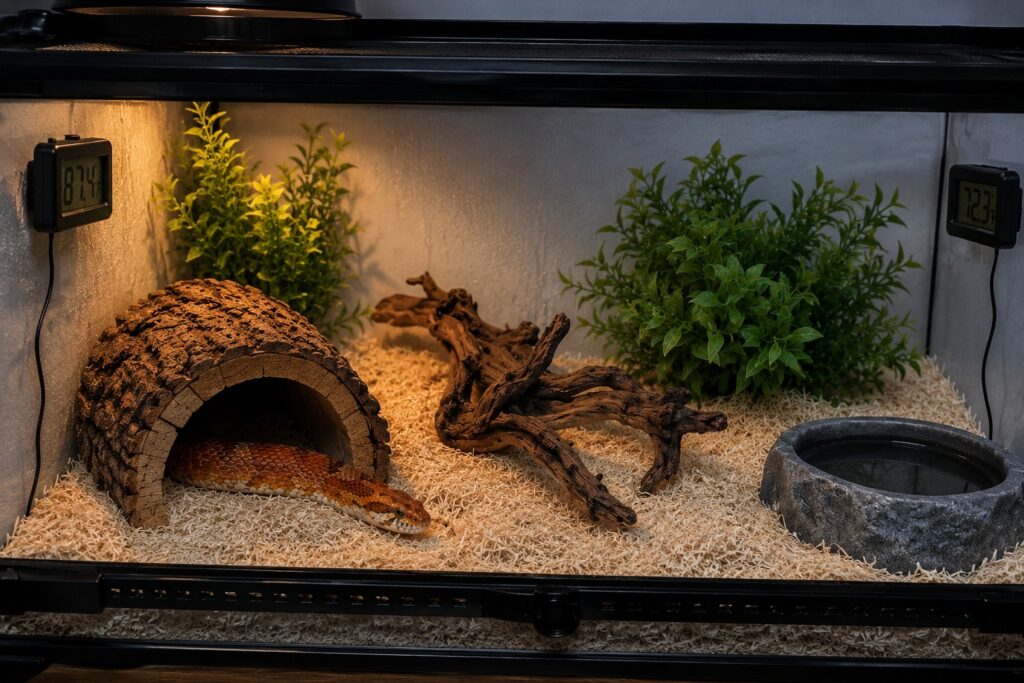
Here are the numbers that matter. The warm side surface temperature, specifically where the snake sits inside its warm hide, should be 83 to 88 degrees Fahrenheit. The cool side should sit around 72 to 78 degrees. At night, temps can drop a few degrees across the whole enclosure, but the warm side shouldn’t fall below 75.
The basking surface is what counts most, not the air temperature a foot above the substrate. A lot of keepers make the mistake of measuring ambient air temps and thinking everything’s fine when the actual floor temperature where the snake rests is 10 degrees different. Use a temperature gun or a digital probe thermometer placed directly on the warm side surface to get an accurate reading.
Why the Gradient Matters More Than a Single Number
Corn snakes aren’t sitting under a heat lamp all day in the wild. They’re moving between sun-warmed surfaces and cool underground refuges depending on what their body needs at the moment. After eating, they need warmth to digest. During rest, they retreat to cooler areas.
If you don’t have a proper corn snake temperature gradient, the snake has no options. An enclosure that’s uniformly 85 degrees might sound warm enough, but the snake can’t cool down when it needs to, which causes stress. Flip that around, if the whole enclosure is 75 degrees because the heating isn’t strong enough, digestion slows down or stops, and regurgitation becomes a real risk.
The gradient gives your snake control over its own body temperature. That’s the whole point. Warm on one end, cool on the other, and the snake decides where to be.
Heat Mats vs. Overhead Heating for Corn Snakes
This is one of those debates that never really ends in the corn snake community, but here’s the practical breakdown.
Under-tank heat mats are the most popular option for corn snakes and they work well. You stick one to the bottom of the enclosure on the warm side, covering roughly one-third of the floor space. The mat warms the surface and the hide sitting on top of it, giving the snake belly heat for digestion. The cool side stays unheated and naturally stays at room temperature.
The non-negotiable rule with heat mats is that you must use a thermostat. A heat mat without a thermostat can easily reach 110 degrees or higher, which will burn your snake. A proportional thermostat is ideal because it adjusts power smoothly rather than cycling on and off, which prevents temperature spikes. Set the thermostat probe directly on the warm side surface, under or inside the warm hide.
Overhead heating, like ceramic heat emitters or deep heat projectors, works too. Some keepers prefer it because it creates a more natural heat distribution and warms the air as well as surfaces. The downside is that overhead heat rises, so you may need higher wattage to get adequate floor-level warmth, and it can dry out the enclosure faster. If you go overhead, you’ll still want a thermostat controlling it, and you should use a guard around any heat source the snake can reach.
Some keepers use both, especially in larger enclosures or cooler rooms. A heat mat for consistent belly heat at night and an overhead source during the day is a solid combo. Just make sure the cool side stays cool. If your cool side is creeping above 80 degrees, your gradient is too compressed and the snake doesn’t have a proper cool retreat.
Signs Your Corn Snake Temperature Gradient Is Off
Corn snakes are pretty tolerant, but they’ll tell you when the corn snake temperature gradient is off if you know what to look for.
If your snake is spending all its time on the cool side, the warm side is probably too hot. If it’s always sitting on the warm side and never moves, the cool side might be too cold, or the warm side might not be warm enough and the snake is desperately trying to soak up whatever heat it can.
Regurgitation after feeding is a classic sign that digestion temps are too low. The snake ate, but its body can’t produce enough metabolic heat to digest the meal, so it comes back up. If this happens, don’t feed again for at least two weeks and double-check your warm side temps.
Poor sheds are another indicator. A corn snake that’s consistently leaving pieces of skin behind might not have the right temperature and humidity combo. Temps that are too low slow the shedding process, and the skin dries out before the snake can peel it all off.
Chronic refusal to eat, especially during cooler months, often comes down to the room temperature dropping and pulling the enclosure temps down with it. If your reptile room is 65 degrees in winter, your heat mat is working overtime and might not be keeping up.
Monitoring Temps and Staying Consistent
You need at least two thermometers in a corn snake enclosure. One probe on the warm side surface, one on the cool side. Digital probe thermometers are cheap and accurate. The stick-on dial thermometers that come with starter kits are mostly garbage. They measure air temperature at the glass wall, which tells you almost nothing useful.
A temperature gun is also worth having. You can quickly scan the surface temps across the entire enclosure in seconds and get a real picture of your gradient. They’re around 15 to 20 dollars and last forever.
If you want to stay on top of things without constantly eyeballing thermometers, the Exotic Reptile Care app lets you set care reminders for temp checks and log any changes you notice. If your snake starts refusing meals or has a rough shed, you can look back at your logs and see if something shifted with the environment around the same time. It’s the kind of data that makes troubleshooting way easier.
Seasonal Adjustments Most Keepers Miss
Room temperature changes with the seasons, and that directly affects your corn snake temperature gradient. In summer, your room might be 78 degrees and the heat mat barely has to work. In winter, the room drops to 65 and suddenly your warm side is five degrees cooler than you think.
Check your temps at least once a week, and pay extra attention during seasonal transitions. You might need to bump up the thermostat setting in winter or add a secondary heat source. Some keepers move their enclosures away from exterior walls in colder months to avoid drafts.
If you’re in a part of the house where temps swing dramatically between day and night, a ceramic heat emitter on a thermostat running 24/7 can help smooth things out. The goal is consistency. Corn snakes don’t need perfection, but they do need stability. A gradient that holds steady day after day is way better than one that’s perfect at noon and falls apart at midnight. For more detailed temperature and humidity recommendations across species, see our complete reptile temperature and humidity guide.
Get the gradient right, keep it consistent, and your corn snake will handle the rest.
Corn snake temperature gradient: frequently asked questions
What temperature should each side of a corn snake enclosure be?
The warm side surface, right where the snake rests inside its warm hide, should be 83 to 88F, and the cool side should sit around 72 to 78F. At night the whole enclosure can drop a few degrees, but keep the warm side above 75F. Measure the surface where the snake actually sits, not the air a foot above it, since those readings can differ by 10 degrees.
Do corn snakes need heat at night?
Usually a mild nighttime drop is fine and even natural, as long as the warm side doesn’t fall below 75F. In a warm room you can often let the heat mat and thermostat handle it without extra equipment. In a cold room, a thermostat-controlled ceramic heat emitter running overnight keeps the corn snake temperature gradient from collapsing while you sleep. Avoid colored night bulbs, which disturb the snake’s cycle.
Is a heat mat or a heat lamp better for corn snakes?
Both work. Under-tank heat mats are the popular choice because they give belly heat for digestion, cover about a third of the floor, and pair simply with a thermostat. Overhead sources like ceramic emitters warm the air more naturally but dry the enclosure faster and need higher wattage to reach floor level. Whichever you pick, a thermostat is non-negotiable, since an unregulated mat can hit 110F and burn your snake.
What happens if a corn snake gets too cold?
Digestion is the first casualty. A snake that’s too cool can’t produce enough metabolic heat to break down a meal, which leads to regurgitation and, over time, feeding refusals. Cold snakes also shed poorly and become sluggish and more prone to illness. If yours has stopped eating as the weather cooled, temperature is the first thing to check, and our guide on a corn snake not eating for weeks walks through the rest.
Why does my corn snake stay on one side all the time?
It’s telling you the gradient is off. A snake camped permanently on the cool side usually means the warm side is too hot. One that never leaves the warm side often means the cool side is too cold or the warm side isn’t warm enough, so it’s clinging to what little heat it can find. A correctly set corn snake temperature gradient lets the snake move freely between both ends throughout the day.
How do I keep temperatures stable through the seasons?
Room temperature is the hidden variable. A mat that holds 86F in a 78F summer room can drop to 81F when winter pulls the room down to 65F. Check temps weekly, bump the thermostat or add a secondary heat source in colder months, and move enclosures off exterior walls to avoid drafts. Setting temp-check reminders and logging readings in the Exotic Reptile Care app makes it easy to see if a bad shed or refused meal lines up with a temperature shift.