Get reptile temperature and humidity right and you have solved most of reptile keeping before you have even picked up a pair of feeding tongs. Get them wrong and you will chase stuck sheds, appetite loss, and respiratory infections for months without understanding why. These two numbers sit underneath almost every health problem new keepers run into, because a reptile’s digestion, shedding, and immune function all depend on the environment you build for it. The catch is that the correct ranges are species specific. A ball python and a leopard gecko need very different setups, and copying one onto the other causes real harm. This guide gives you the actual numbers for every popular species, plus how to hit them and how to know you are measuring them correctly.
Why Temperature and Humidity Matter So Much for Reptiles
Correct reptile temperature and humidity ranges sit underneath almost every health problem new keepers run into, and it starts with a basic fact: reptiles are ectotherms. That is the technical way of saying they cannot make their own body heat. A dog or a person burns food to stay warm from the inside. A reptile borrows heat from its surroundings instead, moving between warm and cool spots to land on the body temperature it needs at any given moment. That single fact drives everything about how you set up an enclosure.
When temperature is wrong, the damage is quiet at first. Too cold and digestion slows down or stalls, which shows up as a snake that stops eating or a lizard that gets sluggish and loses weight. Food can even sit and rot in the gut if it is too cold to process. When humidity is wrong, the problems are just as sneaky. Too dry and you get stuck shed, dehydration, and toes that lose circulation under retained skin. Too wet and you get respiratory infections and scale rot. Neither one announces itself on day one. They build over weeks, which is exactly why so many keepers do not connect the symptom to the cause.
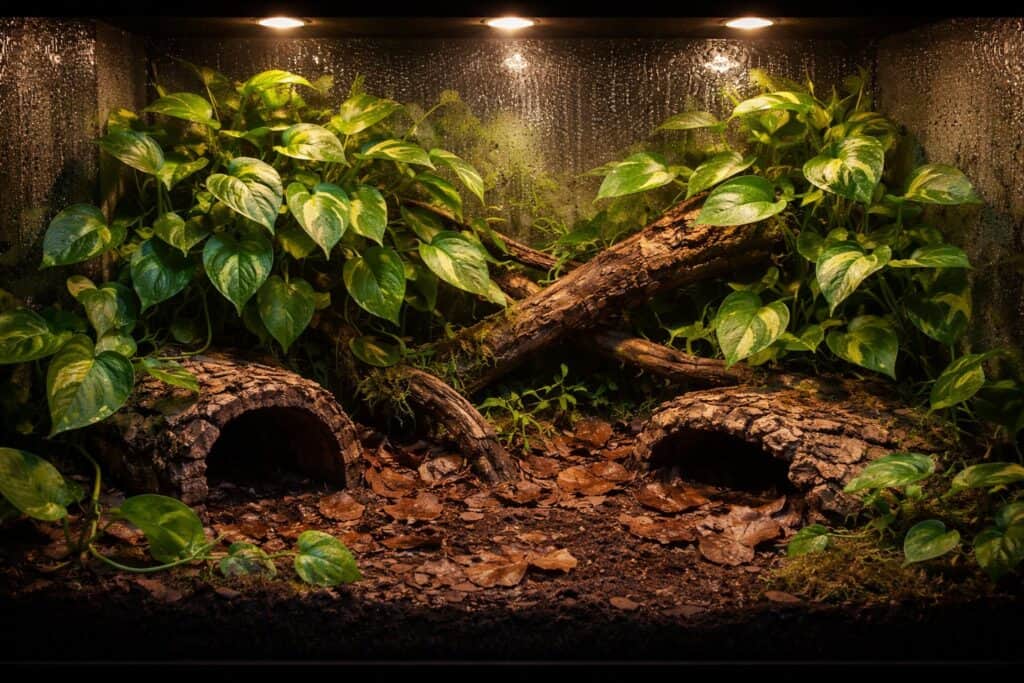
The other thing to understand is that you are never aiming for a single temperature. You are building a gradient. One warm side, one cool side, and usually a hotter basking spot for species that bask. The whole point is to give the animal choices, so it can move toward heat when it needs to digest and retreat to the cool end when it has had enough. An enclosure held at one flat temperature, even the “right” one, takes that choice away and stresses the animal. Same goes for humidity in many species, where a wet hide or a daily wet-to-dry cycle matters more than one number on a gauge.
Reptile Temperature and Humidity Chart (Quick Reference)
These are the reptile temperature and humidity ranges we use across our individual species care guides, so they will match what you read in the full articles linked further down. All temperatures are in Fahrenheit. Bookmark this table, it is the part you will come back to.
Ball Python
| Parameter | Range |
|---|---|
| Basking / warm surface | 88 to 92°F |
| Warm side | 88 to 90°F |
| Cool side | 76 to 78°F |
| Night temp | 72 to 75°F |
| Humidity | 60 to 80% (up to 90% in shed) |
Leopard Gecko
| Parameter | Range |
|---|---|
| Basking / warm floor | 88 to 92°F |
| Warm side | 88 to 92°F |
| Cool side | 75 to 80°F |
| Night temp | 68 to 72°F |
| Humidity | 30 to 40% (moist hide for shed) |
Crested Gecko
| Parameter | Range |
|---|---|
| Basking spot | Not needed |
| Warm side | 72 to 78°F |
| Cool side | 68 to 74°F |
| Night temp | 65 to 72°F |
| Humidity | 70 to 80% after misting, ~50% daytime |
Bearded Dragon
| Parameter | Range |
|---|---|
| Basking spot | 100 to 110°F (adult) |
| Cool side | 75 to 85°F |
| Night temp | 65 to 75°F |
| Humidity | 30 to 40% |
Corn Snake
| Parameter | Range |
|---|---|
| Basking spot | Not required |
| Warm side | 85 to 88°F |
| Cool side | 75 to 78°F |
| Night temp | 65 to 72°F |
| Humidity | 40 to 50% |
Red-Eyed Crocodile Skink
| Parameter | Range |
|---|---|
| Basking spot | Not required |
| Warm side | 80 to 82°F |
| Cool side | 72 to 75°F |
| Night temp | 68 to 72°F |
| Humidity | 80 to 90% |
African Fat-Tailed Gecko
| Parameter | Range |
|---|---|
| Basking / warm floor | 90 to 95°F |
| Warm side | 88 to 92°F |
| Cool side | 78 to 80°F |
| Night temp | 70 to 75°F |
| Humidity | 50 to 60% (moist hide for shed) |
A few notes that the table cannot hold. Ball pythons do not strictly need a basking lamp the way a bearded dragon does, but the warm side surface should sit in that 88 to 92 range. Bearded dragon babies can take a hotter basking surface, up to about 115, and juveniles around 105 to 110, while adults sit at 100 to 110. Crested geckos are the odd one out here: they do not bask, and their biggest risk is heat, not cold. Anything sustained above about 82 degrees is dangerous for a crestie, so for them the job is keeping the enclosure cool and humid, not warm.
Temperature: Getting It Right
Understanding the Gradient
Every enclosure needs zones. The basking spot is the single hottest point, directly under the heat source, for species that bask to digest and process UVB. The warm side is the general warm zone around that spot. The cool side is the retreat at the far end. And the night temperature is where the whole enclosure is allowed to settle after the lights go out. Most reptiles actually benefit from a modest night drop, it mirrors what happens in the wild and supports healthier long term rhythms. What you are building is a range the animal can move through, not a single setting.
How to Heat an Enclosure
You have two broad approaches: overhead heat and under-tank heat. Overhead heating, using a halogen flood bulb, a deep heat projector, or a ceramic heat emitter, warms surfaces and air from above the way the sun does. It creates the most natural gradient and is the better default for most species today, especially baskers like bearded dragons. Under-tank heat mats warm from below and were the old standard for belly-heat species like leopard geckos and ball pythons. They still work, particularly in glass tanks, as long as they are sized and placed correctly.
Whichever you choose, one rule is not negotiable: every heat source goes on a thermostat. An unregulated heat mat or bulb can spike well past safe temperatures and cause serious burns, and a mat against glass can climb past 110 degrees without one. A simple on/off thermostat is fine for a mat. A dimming or proportional thermostat is better for overhead bulbs because it eases power up and down to hold a target instead of just cutting out. If you buy one piece of equipment beyond the heat source itself, make it the thermostat.
Common Temperature Mistakes
The big one is trusting the stick-on dial gauges that come bundled with starter kits. They are wildly inaccurate. Throw them out and use a digital thermometer with probes. The second mistake is measuring air temperature when surface temperature is what matters. Your bearded dragon sits on a rock, not in the air two inches above it, and that rock can read 120 while the air reads 105. Use an infrared temp gun pointed at the actual basking surface. The third mistake is having no real cool side at all, so the animal has nowhere to escape the heat. If your cool side is reading as warm as your warm side, you do not have a gradient, you have a hot box.
Humidity: Getting It Right
How Humidity Affects Shedding and Respiratory Health
Humidity is mostly a shedding and hydration story on the low end, and a respiratory story on the high end. Too little moisture and reptiles cannot shed cleanly. Snakes shed in one piece and need enough humidity to loosen the old skin, and geckos get retained shed on toes and tail tips that can constrict and cause tissue loss. Too much moisture, sitting wet all the time with poor airflow, and you invite respiratory infections and scale rot. The target is species specific, which is the whole reason the chart above exists.
Raising Humidity
If your numbers run low, start with substrate. A moisture-retaining substrate like coconut fiber or a soil mix holds water and releases it slowly, acting like a reservoir between mistings. A few inches of it does a lot of work. Next, look at the water bowl: moving it to the warm side increases evaporation and ambient humidity. Misting adds short term spikes, useful for species that drink droplets or need a humid window for shedding. And a humid hide, a small box packed with damp sphagnum moss, gives the animal a high-moisture pocket to use when it needs one, which is essential for leopard geckos and very helpful for ball pythons in shed.
Lowering Humidity
If you are running too wet, the first lever is ventilation. More airflow, often by opening up a screen top you had covered, lets moisture escape. Switching to a drier substrate helps for arid species. And the most common self-inflicted cause is simply over-misting, soaking the enclosure every few hours when the species only needs an evening spike and a daytime dry-down. Back off the misting and let the enclosure breathe.
Common Humidity Mistakes
The biggest is chasing a single number all day. Many species, crested geckos especially, want a cycle: a high spike after misting that gradually falls through the day, then repeats. Holding them at a flat high number is its own problem. The second mistake is ignoring that wet-and-dry rhythm and keeping everything permanently damp, which is how respiratory infections start. There’s a related one that catches people out: closing off vents to hold humidity up. Veterinary guidance is explicit that cutting ventilation to maintain temperature and humidity is a bad trade and routinely causes skin and respiratory disease – raise the moisture with substrate and a humid hide instead, and leave the airflow alone. Aim for the pattern the species evolved with, not a frozen gauge reading.
Species-Specific Notes
Ball Python. Tropical, so they want 60 to 80 percent humidity with a warm side around 88 to 90 and a cool side near 76 to 78. Low humidity is the usual culprit behind bad sheds. If yours is struggling, see our full guide on fixing low ball python humidity, and our complete ball python enclosure setup for the full picture.
Leopard Gecko. Arid, so keep ambient humidity at 30 to 40 percent and provide a moist hide for shedding rather than soaking the whole tank. Warm floor 88 to 92, cool side 75 to 80. The full build is in our leopard gecko enclosure guide, and since leopard geckos are the belly-heat species on this list rather than a basker, the floor-surface numbers get their own treatment in our leopard gecko heating guide.
Crested Gecko. Tropical and cool-loving. They need a humidity cycle, spiking to 70 to 80 percent after an evening mist and drying to around 50 percent by afternoon, and they overheat easily above 82 degrees. If your readings keep crashing low, here is how to fix crested gecko humidity that is too low.
Bearded Dragon. Desert species that need a hot basking surface, 100 to 110 for adults, and a dry 30 to 40 percent humidity. The most common error is a basking spot that runs too hot. Our guide on bearded dragon basking temperature that is too high covers the signs and fixes.
Corn Snake. A hardy, moderate species: warm side 85 to 88, cool side 75 to 78, humidity 40 to 50 percent. Getting the gradient right is most of the job, walked through in our corn snake temperature gradient guide.
Blue Tongue Skink. This is the species where the numbers split by subspecies. Northerns sit at 40 to 60 percent humidity while Indonesians like Merauke and Halmahera want 60 to 80, and both need a 100 to 110 basking surface with a 75 to 80 cool side. Getting the wrong half of that range is the most common bluey mistake. The full detail is in our blue tongue skink care guide.
Box Turtle. Temperate rather than tropical or desert, so the numbers are milder than most keepers expect: a basking surface around 85 to 90, ambient 75 to 85, a night drop into the upper 60s or low 70s, and humidity held at 60 to 80 percent. Chronic dryness is the usual problem and shows up as flaky shell and sunken eyes long before anything more obvious. The substrate depth and misting side of it is in our box turtle enclosure guide, and the wider picture – diet, brumation, and the fifty-year commitment people underestimate – is in the box turtle care guide.
Russian Tortoise. The arid counterpart to a box turtle, and the numbers reflect it: a basking surface around 95 to 100, ambient in the low 80s falling to the mid 70s at the cool end, and humidity kept low at 40 to 50 percent. Damp substrate is the main risk with this species rather than dryness, which is the opposite of nearly everything else on this page. Full detail in our Russian tortoise care guide, and if the humidity readings are the problem it’s usually substrate rather than air, which the Russian tortoise enclosure setup covers.
Veiled Chameleon: 85 to 95F on the basking branch surface for adults, 72 to 80F ambient, and a night drop into the 60s. Humidity 40 to 60 percent with a clear dry-down between mistings, since constant dampness in a screen cage causes more problems than brief dryness. The rest of the species, including their very particular watering needs, is in our veiled chameleon guide.
Panther Chameleon. Cooler at the basking branch than a veiled and more humid: 80 to 85F basking surface, 72 to 78F ambient, a night drop to 65 to 70F, and 50 to 70 percent humidity by day with a higher overnight spike. Full detail in our panther chameleon guide.
Uromastyx. The hottest setup on this page: 120 to 130F on the basking surface, 95 to 100F warm side air, a 75 to 85F cool end, and very dry air at 20 to 35 percent humidity. Most sick uros are simply kept too cool. Full detail in our guide to keeping a uromastyx.
How to Measure and Monitor Accurately
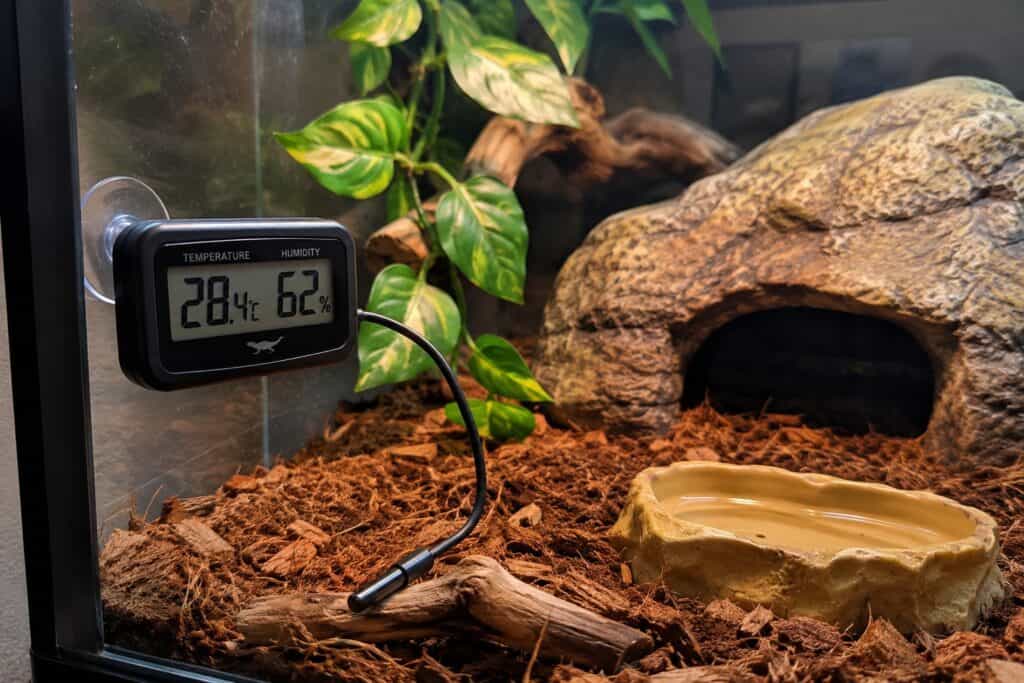
Your reptile temperature and humidity readings are only as good as your tools. Use a digital probe thermometer and a digital hygrometer, never the analog stick-on dials, and use an infrared temp gun for surface and basking temperatures. Placement matters too. Put a temperature probe on the warm side and another on the cool side so you can see the actual gradient, and position the hygrometer in the middle of the enclosure at mid height for a representative ambient reading rather than right next to the misting zone where it will read artificially high.
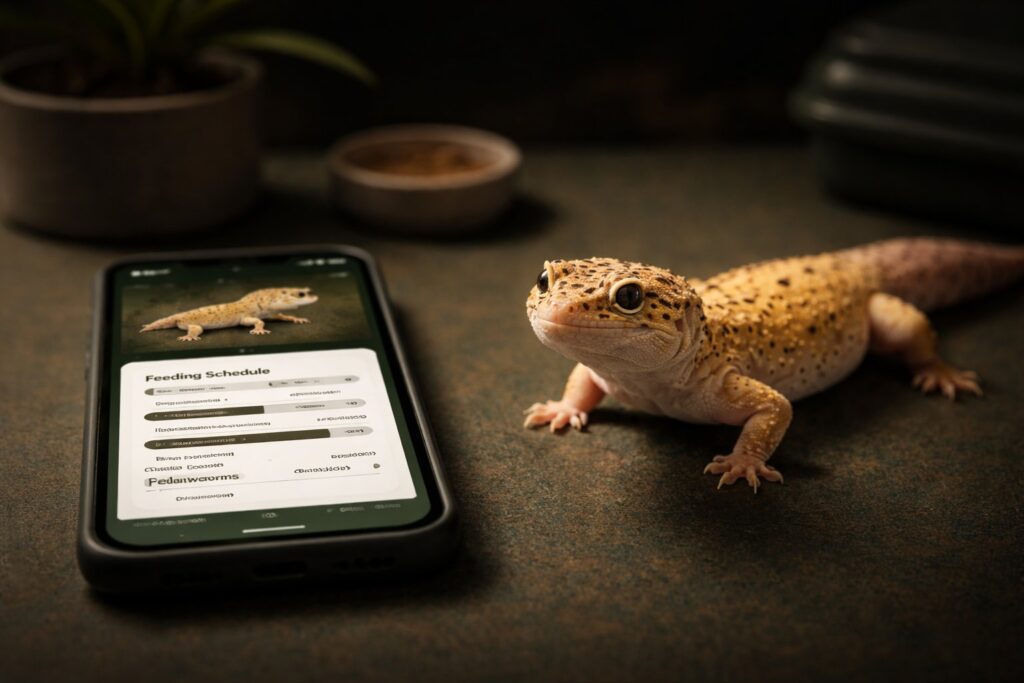
Here is the honest hard part, though. Knowing the numbers is the easy bit. The real challenge is catching them when they drift, because they always drift. Bulbs lose output as they age, substrate dries out between cleanings, and seasonal changes quietly shift everything by a few degrees or percent. A setup that was perfect in January can be running hot or dry by June without you noticing. The Exotic Reptile Care app lets you log temperature and humidity readings and set reminders to check them and to mist on schedule, so a slow drift shows up in your logs before it shows up as a sick animal. That kind of pattern is hard to hold in your head and easy to see when it is written down.
Troubleshooting Quick Reference
Use this to jump from a symptom to a likely cause and the right guide.
- Stuck shed or retained skin → humidity likely too low → ball python humidity fix, leopard gecko shedding problems, ball python stuck shed.
- Not eating or sluggish → temperatures likely too low, digestion has stalled → check the gradient against the chart, and see our ball python feeding schedule.
- Wheezing, clicking, or bubbles around the mouth or nose → humidity too high or temps too low, possible respiratory infection → correct the environment and see a reptile vet.
- Gaping or hiding from the basking spot → basking surface too hot → bearded dragon basking temperature too high.
FAQ
What temperature should a reptile tank be at night?
It depends on the species, but most tolerate and even benefit from a modest night drop. Ball pythons sit around 72 to 75, leopard geckos can drop to 68 to 72, bearded dragons to 65 to 75, and corn snakes to 65 to 72. A gentle nighttime dip mimics the wild and supports healthier long term rhythms, as long as it does not fall below the species’ safe floor.
Can humidity be too high for a reptile?
Yes, and it is just as harmful as too low. Sustained high humidity with poor ventilation leads to respiratory infections and scale rot, especially in arid species like leopard geckos and bearded dragons. The fix is more airflow, a drier substrate, and less misting. Aim for the species’ correct range rather than assuming wetter is safer.
Do all reptiles need a basking light?
No. Baskers like bearded dragons rely on a hot basking spot for digestion and vitamin D3. Ball pythons and leopard geckos need a warm side but not a true basking lamp, and crested geckos do not bask at all and actually risk overheating under one. Match the heat source to the species rather than defaulting to a basking bulb for everything.
What is the best way to measure enclosure humidity?
Use a digital hygrometer, not the cheap analog dial that comes with starter kits. Place it in the middle of the enclosure at mid height, away from the water bowl and the misting zone, so it reads representative ambient humidity rather than a local spike. For species that run on a humidity cycle, check it at both the post-misting high and the daytime low.
Why is my reptile not shedding properly?
Almost always low humidity. Snakes need enough moisture to shed in one piece, and geckos need a humid hide to avoid retained skin on toes and tail tips. Raise humidity toward the species’ correct range, add a moist hide, and the problem usually resolves on its own.
Reptile temperature and humidity are the foundation everything else sits on. Dial them in to the species-correct numbers in the chart, build a real gradient, and monitor consistently so you catch drift before it becomes a problem. When in doubt, come back to the chart and the individual species guides linked above.