Most geckos in the hobby sleep all day. Day geckos don’t. They’re bright green, fast, awake when you are, and running across the leaves the moment the lights come on, which is why people fall for them. Day gecko care is simple once the setup is right, but there are three things that catch new keepers out: they need strong light, they need a fruit diet alongside insects, and you basically can’t handle them.
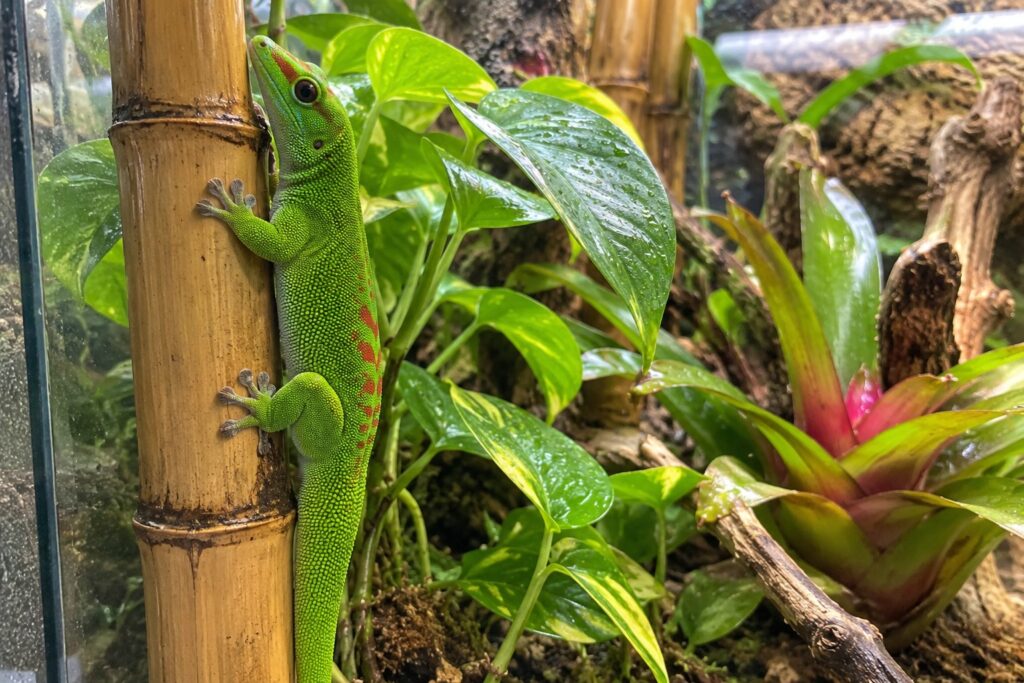
This guide focuses on the two day geckos people keep most often, the giant day gecko and the gold dust day gecko. Care for the other Phelsuma species is very similar.
Day Gecko Care Quick Specs
A day gecko needs a tall planted enclosure, a basking spot of 90 to 95°F, ambient temperatures of 78 to 85°F, humidity of 60 to 80%, UVB, and a mix of insects and fruit-based gecko diet.
| Parameter | Giant Day Gecko | Gold Dust Day Gecko |
|---|---|---|
| Adult length | 10 to 12 inches | 4 to 6 inches |
| Lifespan | 10 to 20 years | 8 to 12 years |
| Minimum enclosure | 18 x 18 x 24 inches | 12 x 12 x 18 inches |
| Better enclosure | 18 x 18 x 36 inches | 18 x 18 x 24 inches |
| Basking spot | 90 to 95°F | 90 to 95°F |
| Ambient | 78 to 85°F | 78 to 85°F |
| Night | 65 to 75°F | 65 to 75°F |
| Humidity | 60 to 80% | 60 to 80% |
| UVB | T5 HO 5 to 6% | T5 HO 5 to 6% |
Giant day geckos are the easiest place to start. They’re bigger, tougher, and a bit less nervous than the small species.
Why You Shouldn’t Handle a Day Gecko
Day geckos have extremely thin, delicate skin. Grab one, even gently, and the skin can tear right off in patches. It’s a defense that lets them slip out of a predator’s grip, and it works just as well against your fingers. The skin usually grows back, but it’s painful, it’s an infection risk, and it often leaves scarring.
They also drop their tails easily and move far faster than you’d expect. A day gecko that gets loose in a room is very hard to catch without hurting it.
So treat a day gecko as a display animal. Do your maintenance around it, not with it. If you need to move one for a deep clean or a vet visit, guide it gently into a clear cup or container with a piece of card, never by grabbing. If you want a gecko you can hold, a crested or leopard gecko is a much better choice.
Setting Up a Day Gecko Enclosure
In day gecko care, height matters more than floor space because day geckos are arboreal, and they live on vertical surfaces. A front opening glass terrarium works best, because it holds humidity and lets you reach in without coming from above.
Fill the enclosure with vertical climbing surfaces. Bamboo stalks are a classic for day geckos and they love them, partly because in the wild many species live on palms and bamboo. Add cork tubes, sturdy branches, and lots of plants. Smooth-leaved plants like pothos, bromeliads, dracaena, and sansevieria give them perching spots and somewhere to lick water droplets off.
A planted bioactive setup suits day geckos very well, since it holds humidity steadily and they spend most of their time up in the plants anyway. If you want to go that way, here’s how to set up a bioactive enclosure that drains properly. Otherwise, a coco fiber and topsoil mix a few inches deep works fine.
Keep the doors shut and check gaps carefully. Small day geckos especially can slip through a surprisingly narrow opening.
Heat and Light: The Part That Matters Most
This is where good day gecko care really starts. These geckos bask in full sun in the wild, and they need bright light and real UVB to stay healthy and colorful.
Use a T5 HO 5 to 6% UVB tube running most of the length of the enclosure, on a 12 hour timer. Add a low wattage halogen or basking bulb over one side to create a basking spot of 90 to 95°F on the top branch or bamboo. The rest of the enclosure should sit around 78 to 85°F, with cooler spots lower down. At night, let it drop to 65 to 75°F with all lights off.
Bright plant lights over a planted tank are worth adding too. Day geckos are noticeably more active and better colored in a well lit enclosure, and the plants grow better.
Put the basking bulb on a thermostat and check temperatures with an infrared temp gun. Make sure the gecko can’t touch the bulb or a hot screen, since they climb everywhere.
Humidity and Water in Day Gecko Care
Aim for 60 to 80% humidity, with a dry-down between mistings. Mist the enclosure thoroughly in the morning and again in the evening. Day geckos drink by licking droplets off leaves and glass, and many will ignore a water dish completely, so misting is their main water source.
Missed mistings show up fast in this species. You’ll see stuck shed on the toes and tail tip, or a gecko that looks thin and wrinkled. If your schedule gets busy, it helps to set a misting reminder in the Exotic Reptile Care app so mornings and evenings don’t slip, or put an automatic misting system on a timer.
Avoid keeping the enclosure constantly wet. Good airflow and a proper dry-down matter as much as the humidity number.
Feeding a Day Gecko
Day geckos eat both insects and fruit. In the wild they lick nectar, pollen, and soft fruit, and they hunt small insects. Good day gecko care copies both halves.
For insects, offer crickets, small dubia roaches, black soldier fly larvae, and the occasional waxworm as a treat. Size them no larger than the space between the gecko’s eyes. Giant day geckos eat insects every two to three days. Gold dust day geckos eat smaller insects on a similar schedule.
For the fruit half, the easiest and most balanced option is a powdered fruit-based gecko diet, the same powdered fruit diets sold for crested geckos. Mix it to a ketchup-like consistency and offer it in a small ledge feeder two to three times a week. Replace it after a day or two before it spoils. Small amounts of mashed papaya or mango can be offered now and then, but plain fruit shouldn’t replace the complete powdered diet.
Dust insects with calcium at most feedings. If you have good UVB, plain calcium without D3 works for most meals, with a multivitamin about once a week.
Reading the Calcium Sacs
This is the one day gecko care health check that’s unique to the group, and it’s worth learning. Look at the sides of your day gecko’s neck, just behind the head. Healthy adult day geckos, especially females, often have small rounded bulges there. These are the endolymphatic sacs, where they store calcium.
Here’s how to read them:
Small, visible bulges in an adult female: normal. She’s storing calcium, often for egg production.
No visible sacs in an adult female: possible calcium shortage. Check your calcium dusting and the age of your UVB tube. If she’s laying eggs, she needs more calcium than a male.
Very large, bulging sacs: can mean too much calcium or vitamin D3 being stored. Look at your supplements, especially if you’re using calcium with D3 at every feeding alongside UVB.
Males: often show small sacs or none at all, which is normal.
Watch them alongside other signs. A day gecko with weak grip, trembling, a soft or rubbery jaw, or kinks in the spine may have metabolic bone disease. Look also for loss of color, sunken eyes, and stuck shed that keeps happening. If you see any of these, find a reptile vet with exotics experience rather than waiting.
Housing Day Geckos Together
Keep males separate. Two male day geckos in one enclosure will fight, sometimes badly. A male and female pair can work in a large enclosure, but expect eggs, and watch closely for bullying. Females can sometimes be kept together in a big, well planted enclosure, but it isn’t guaranteed.
Some keepers house day geckos with small, quiet species like mourning geckos in large bioactive setups. It can work, but day geckos will eat anything small enough to fit in their mouth, including baby mourning geckos, so it carries real risk. For a first setup, one day gecko per enclosure is the safe choice.
Frequently Asked Questions
Are day geckos good for beginners?
Giant day geckos are a reasonable first gecko if you want a display animal rather than a pet to handle. They need strong lighting and regular misting, but their care isn’t complicated.
Can you hold a day gecko?
It’s best not to. Their skin tears very easily and they drop their tails, so handling should be limited to moving them when absolutely necessary, using a cup rather than your hands.
What do day geckos eat?
Insects like crickets and dubia roaches, plus a powdered fruit-based gecko diet a few times a week. Dust insects with calcium and give a multivitamin weekly.
Do day geckos need UVB?
Yes. They’re active in daylight and depend on UVB for calcium metabolism. Use a T5 HO 5 to 6% tube on a 12 hour timer.
How long do day geckos live?
Giant day geckos often live 10 to 20 years. Gold dust day geckos usually live 8 to 12 years.
Good day gecko care comes down to bright light, morning and evening misting, a balanced mix of insects and fruit diet, and keeping your hands off. Get those right and you’ll have one of the most colorful, active reptiles in the hobby running around your plants every day.