Most big snakes come with a catch: they bite, they climb everything, or they eat you out of house and home. Dumeril’s boas mostly don’t. They’re heavy, slow, calm Madagascan ground boas that spend their days half buried in leaf litter, and many of them are as easygoing in the hand as a snake gets. Dumeril’s boa care has one real surprise, though. These snakes can skip meals for weeks or months at a time, and every new keeper panics the first winter it happens.
This guide covers the setup numbers, the enclosure a heavy ground boa needs, feeding by age, and what to check when yours stops eating.
Dumeril’s Boa Care Quick Specs
A Dumeril’s boa needs a wide enclosure of at least 6 x 2 x 2 feet as an adult, a warm spot of 86 to 90°F, a cool end of 75 to 80°F, humidity of 50 to 60%, and one appropriately sized rat every 3 to 4 weeks as an adult.
| Parameter | Target |
|---|---|
| Adult length | 5 to 7 feet, females larger and much heavier |
| Lifespan | 20 to 30+ years |
| Adult enclosure | 6 x 2 x 2 feet minimum, 6 x 3 x 2 for big females |
| Warm spot | 86 to 90°F |
| Warm side air | 80 to 84°F |
| Cool end | 75 to 80°F |
| Night | 72 to 76°F |
| Humidity | 50 to 60%, up to 70% during shed |
| Adult feeding | One rat every 3 to 4 weeks |
That lifespan is the part to take seriously. A Dumeril’s boa you buy as a baby can easily outlive two or three cars.
Why Dumeril’s Boa Care Is Different From Other Boas
Dumeril’s boas come from the drier forests and scrub of southern and western Madagascar. That shapes almost everything about how to keep one.
They’re ground dwellers. Unlike a carpet python or a young rainbow boa, a Dumeril’s rarely climbs, and an adult that does climb is usually looking for somewhere warmer. They need floor space, not height.
They need less humidity than most boas. If you’ve kept a Colombian rainbow boa, you know how much work 70 to 80% takes. A Dumeril’s is happy at 50 to 60%, which most PVC enclosures hold with very little effort.
And they have a slow metabolism. That’s why adults eat so rarely, why they get fat so easily, and why long fasts are part of normal Dumeril’s boa care rather than a crisis.
One more thing before you buy. Dumeril’s boas are protected in the wild, and international trade is heavily restricted. Buy captive bred only, from a breeder who can give you the hatch date, feeding records, and any paperwork your country or state requires.
Setting Up a Dumeril’s Boa Enclosure
The enclosure is where Dumeril’s boa care starts. An adult needs at least 6 x 2 x 2 feet. Big females, which can be twice the weight of a male, do better in 6 x 3 x 2. Height beyond 2 feet is mostly wasted. A PVC or sealed wooden enclosure holds heat and humidity well and is strong enough for a heavy snake pushing against the doors.
Hatchlings and juveniles start smaller. A tub or enclosure of around 20 to 30 gallons in floor space works for the first year, then move up as the snake grows. A baby in a huge enclosure tends to hide constantly and can be harder to get feeding.
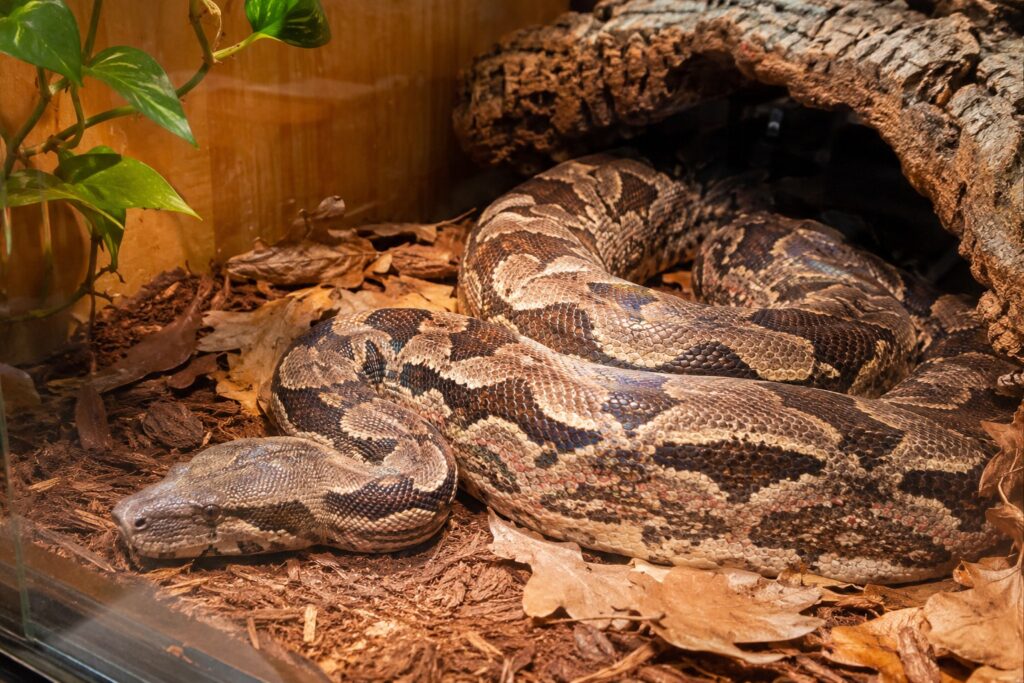
For substrate, use 3 to 4 inches of cypress mulch, coco husk, or a topsoil mix, and add a layer of dry leaf litter on top. Dumeril’s boas love to settle under loose leaves with just their head showing. Skip aspen if your humidity runs toward 60%, since it can mold, and never use cedar or pine.
Give it two big, snug hides, one on each end, plus a humid hide with damp sphagnum moss for shed time. Add a heavy water bowl big enough for the snake to soak in. Cork flats, a low log, and some fake plants make the rest of the floor feel covered.
Heat and Light
Heat is simple in Dumeril’s boa care, as long as you measure it. Aim for a warm spot of 86 to 90°F on the surface where the snake rests, warm side air of 80 to 84°F, and a cool end of 75 to 80°F. Nights can drop to 72 to 76°F. A radiant heat panel or a deep heat projector inside the enclosure works well, and a heat mat under a tub is fine for babies. Every heat source goes on a thermostat, and any bulb inside the enclosure needs a guard.
Measure with a digital probe on each end and an infrared temp gun on the warm spot. A heavy snake lying in one place can be burned by a surface that reads fine in the air.
UVB isn’t required, but a low output tube on a 12 hour timer gives a clear day and night rhythm, and a lot of keepers find their boas more active with one.
Feeding a Dumeril’s Boa
Feeding is where most Dumeril’s boa care mistakes happen, and they’re almost all overfeeding. Feed frozen thawed rodents. Because Dumeril’s boas get heavy so easily, pick prey at or slightly under the width of the widest part of the body, not bigger.
- Hatchlings: one hopper or small adult mouse every 7 to 10 days
- Juveniles: one adult mouse or rat pup every 10 to 14 days
- Subadults: one small rat every 2 to 3 weeks
- Adults: one medium rat every 3 to 4 weeks
Warm the prey in a sealed bag in hot water and offer it with tongs in the evening. Some Dumeril’s are slow, careful feeders that take a minute to decide. Leave the room rather than wiggling the prey in their face. Don’t handle for 48 hours after a meal.
Check the body shape every few weeks. A healthy adult is thick and muscular, but you should still see a gentle ridge along the spine. A body that’s round with no ridge, or skin showing between the scales, means you should stretch the gap between meals.
When Your Dumeril’s Boa Won’t Eat
This is the question every new keeper asks, usually in November. Work through it in order before you worry.
1. Check the season and the snake’s age. Many adult Dumeril’s boas fast from late fall through winter, even with normal temperatures. It’s the same winter fasting Kenyan sand boa males go through, just in a bigger snake. Some adults skip three or four months. If it’s an adult and it’s winter, that’s often all it is.
2. Check for shed. Cloudy blue eyes and dull skin mean a shed is coming, and most boas won’t eat until it’s finished. Offer again a few days after.
3. Measure the warm spot. Point a temp gun at the exact surface where the snake lies. If it reads under 84°F, digestion slows down and appetite drops with it. Fix the heat before trying anything else.
4. Make sure it feels hidden. A boa that can’t get fully covered, or that’s in a busy room, often refuses food. Add leaf litter and a tighter hide, and offer food with the room quiet and the lights low.
5. Weigh it, and keep weighing. A fasting adult that holds its weight is fine. Weigh every two to three weeks during a fast on a kitchen scale, and log every offer in the app along with the weight and whether it was taken. Exotic Reptile Care keeps the feeding and weight history together, so a flat line and a slow slide look very different after a couple of months. If an adult loses more than about 10% of its weight, or a juvenile refuses for more than six weeks, stop troubleshooting and find a reptile vet. The same goes for wheezing, bubbles at the nose, or regurgitation.
Handling and Temperament
Handling is the easy part of Dumeril’s boa care. Captive bred Dumeril’s boas are known for being calm, and most are slow and steady in the hand. Babies can hiss or give a quick nip at first, but they usually settle within a few months of short, regular handling.
Support the whole body. A big female is heavy, and dangling her by the middle is uncomfortable for both of you. Lift with two hands under the body and let her move through your hands at her own pace. Many adults are happy to drape over your arms for half an hour.
Common Health Problems
Obesity is the main one, and it comes from feeding too often or prey that’s too big. Respiratory infections show up as wheezing, clicking, or bubbles at the nose, usually from an enclosure that’s too cool and too damp. Stuck shed happens if the air gets very dry, especially in winter. And check for mites, tiny black dots around the eyes and under the chin. If you find them, treat them properly, since they spread fast to other snakes.
If you want a boa with a showier sheen and don’t mind managing much higher humidity, a Colombian rainbow boa is the other easygoing option worth comparing.
Frequently Asked Questions
Are Dumeril’s boas good for beginners?
Yes. Dumeril’s boa care suits beginners who have room for a 6 foot enclosure and patience for winter fasts. They’re calm, hardy, and need only moderate humidity.
How big do Dumeril’s boas get?
Most reach 5 to 7 feet. Females are larger and can be twice as heavy as males.
How long can a Dumeril’s boa go without eating?
A healthy adult can skip three or four months in winter if it holds its weight. Juveniles shouldn’t fast that long.
How often should I feed an adult Dumeril’s boa?
One appropriately sized rat every 3 to 4 weeks. They gain weight easily, so err on the longer side.
Do Dumeril’s boas climb?
Rarely. They’re ground boas, so give them floor space, deep substrate, and leaf litter instead of tall branches.
Good Dumeril’s boa care comes down to a wide enclosure, a measured warm spot, small meals spaced well apart, and a scale instead of a calendar when they stop eating. Get those right and you’ll have one of the calmest big snakes in the hobby for the next few decades.