Your bearded dragon has been sitting under the basking light with its mouth wide open for the last hour. Or maybe it’s avoiding the basking spot entirely and hiding on the cool side all day. Either way, something feels off. If your bearded dragon basking temperature too high is the problem, you’re not alone. This is one of the most common husbandry mistakes, and it’s especially easy to get wrong because the “right” temperature depends on your dragon’s age and the type of thermometer you’re using.
What Should the Basking Temperature Actually Be?
Before you can tell if the basking temp is too high, you need to know what it should be. The basking surface temperature for an adult bearded dragon should be between 100 and 110 degrees Fahrenheit. Juveniles can handle slightly warmer, around 105 to 110. Babies can tolerate up to 115, but that’s the ceiling.
The cool side of the enclosure should sit between 75 and 85 degrees. At night, temps can drop to 65 to 75 across the whole enclosure. That’s the gradient your dragon needs to thermoregulate properly.
Here’s where it gets tricky. A lot of keepers don’t realize their bearded dragon basking temperature too high is the issue because they’re measuring air temp instead of surface temp. It’s not. What matters is the surface temperature of the thing your dragon is sitting on. A basking rock directly under a lamp can easily be 120 degrees while the air two inches above it reads 105. Your dragon is sitting on that rock, not floating in the air. Use a temperature gun or infrared thermometer pointed directly at the basking surface. That’s the number you need.
6 Signs Your Bearded Dragon Basking Temperature Is Too High
Your dragon can’t tell you it’s too hot, but its behavior will. Here’s what to watch for.
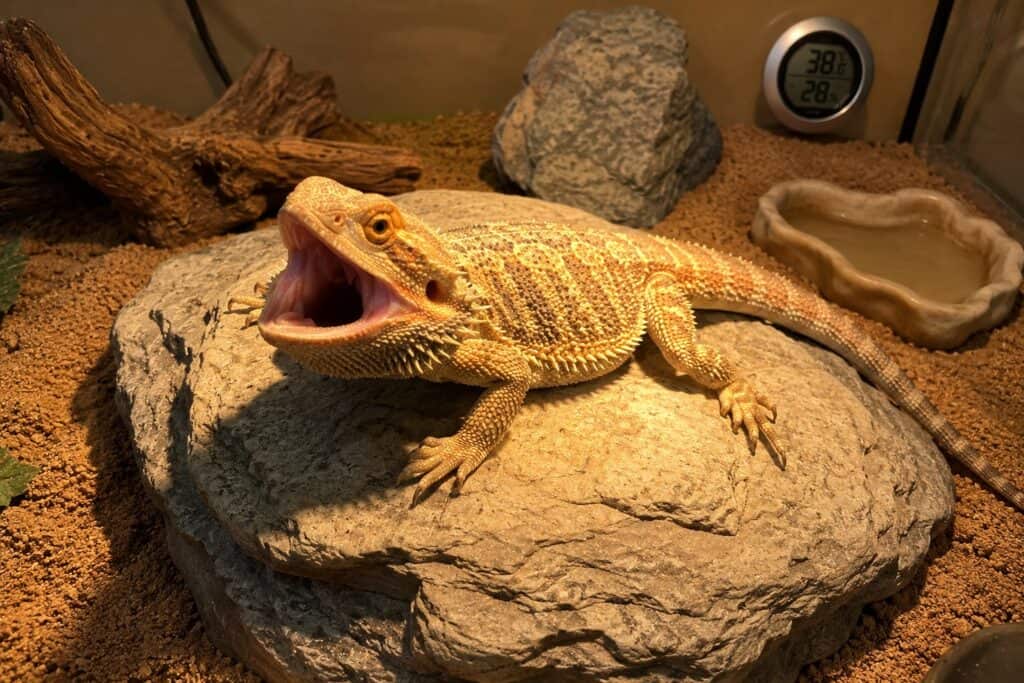
Constant gaping away from the basking spot. A bearded dragon opening its mouth while basking is normal. That’s called gaping and it’s how they release excess heat, like a built-in cooling system. But if your dragon is gaping even when it’s on the cool side or away from the lamp, the enclosure is probably too warm overall.
Avoiding the basking spot completely. A dragon that won’t go near its basking area is telling you something. If it spends all day pressed against the cool side glass or hiding in its cave, the warm side is likely uncomfortable. This is a problem because bearded dragons need basking time for digestion and vitamin D3 synthesis.
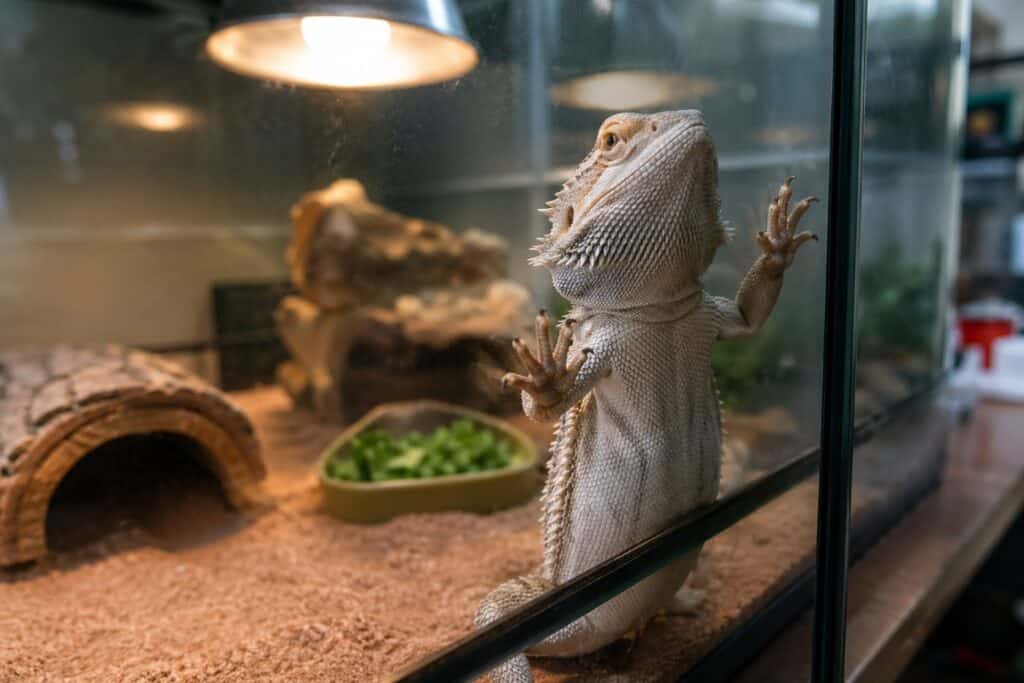
Glass surfing. You might already know this one from our article on bearded dragon glass surfing. When a dragon paws at the glass repeatedly, it’s often trying to escape something uncomfortable in the enclosure. Excessive heat is one of the most common triggers.
Excessive hiding. Some hiding is normal. But a bearded dragon that’s spending most of the day buried or tucked in a hide rather than basking and exploring is often too hot. The hide offers a slightly cooler microclimate and the dragon is using it as a refuge.
Darkening skin color. Bearded dragons can change their skin color slightly based on temperature. A dragon that’s getting darker than usual, especially on the belly, may be stressed from heat. Dark stress marks on the belly are a clear signal.
Loss of appetite and lethargy. An overheated dragon doesn’t want to eat. If your beardie has been refusing food and seems sluggish, check your temps before assuming it’s a health issue. Heat stress suppresses appetite and makes them lethargic.
Why Bearded Dragon Basking Temperature Gets Too High
The most common reason is simply the wrong wattage bulb. A 150-watt basking bulb in a 40-gallon tank with the lamp sitting six inches from the basking rock is going to cook that surface well beyond safe temps. Start with the lowest wattage you think you’ll need and work up from there.
Not using a thermostat or dimmer is another big one. A basking lamp plugged straight into the wall runs at full power all the time. Room temperature goes up five degrees in the afternoon and suddenly your basking spot is dangerously hot. A dimming thermostat lets you set a target temperature and the unit adjusts power to maintain it. That’s the single best investment you can make for temperature control.
Enclosure placement matters too. A tank next to a window getting direct afternoon sun can heat up dramatically. Same with tanks in small rooms that get warm, or enclosures placed near radiators or heating vents. Even seasonal changes can push temps higher than you’d expect. Your setup that was perfect in January might be running hot by June.
Lamp distance is the other overlooked factor. Moving the basking lamp up just a few inches can drop the surface temperature significantly. If you’re using an adjustable lamp stand, experiment with height until the surface reads in the right range.
How to Fix It
If you’ve confirmed your bearded dragon basking temperature too high is the problem, here’s what to do.
If you’ve confirmed your bearded dragon basking temperature too high is the real issue, start by measuring the surface with a temp gun. Not the air, not the glass wall, the actual surface your dragon sits on. If it’s above 110 for an adult or 115 for a baby, it’s too hot.
Try moving the lamp higher above the enclosure. Even two or three inches can make a noticeable difference. If you’re using a dome lamp sitting directly on a screen top, a lamp stand that raises it off the mesh gives you much more control.
Switch to a lower wattage bulb. Drop from a 100-watt to a 75-watt, or from 150 to 100, and remeasure. You might need to try a couple of options to find the sweet spot for your particular enclosure and room temperature.
Get a dimming thermostat if you don’t already have one. Plug the basking lamp into it, set your target temperature with the probe on the basking surface, and let it do the work. This is the most reliable long-term fix because it adjusts automatically as room conditions change throughout the day and across seasons.
Make sure the cool side is actually cool. If your cool side is reading above 85, the entire enclosure is too warm and your dragon has nowhere to escape the heat. Increase ventilation, remove any secondary heat sources on the cool side, and consider whether the room itself is too hot.
Track Temperatures to Catch Drift Early
A bearded dragon basking temperature too high doesn’t always start that way. Enclosure temperatures drift over time. They shift with seasons, room heating, bulb age, and even time of day. A setup that’s perfect in the morning might run five degrees hotter by mid-afternoon when the sun hits the room.
The Exotic Reptile Care app lets you set reminders to check temps at consistent times and log what you find. If you notice your dragon’s behavior changing, like suddenly avoiding the basking spot or glass surfing more, you can look back at your logs and see if temps crept up. It’s the kind of thing that’s hard to catch without a record because changes happen gradually.
What to Do If Your Dragon Is Overheating Right Now
If you think your bearded dragon is actively overheating, showing signs like extreme lethargy, limp body, closed eyes, or not responding normally, act immediately. Turn off the basking lamp. Move the dragon to a cooler area of the house, somewhere around 80 degrees. Do not put them in cold water or blast them with air conditioning. Rapid cooling is dangerous too.
Offer a shallow lukewarm bath and let them soak if they’re willing. Make sure fresh water is available. If the dragon doesn’t perk up within an hour, or if you notice signs like diarrhea or extreme weakness, that could be heat stroke and it needs a vet. The ARAV vet directory can help you find a reptile vet quickly.
Preventing a bearded dragon basking temperature too high situation is always easier than dealing with heat stroke. Check your basking temps weekly with a temp gun, use a thermostat, and pay attention to your dragon’s behavior. They’ll tell you when something’s off if you know what to look for.