Getting your ball python enclosure right from the start saves you months of troubleshooting feeding strikes, stuck sheds, and stressed behavior. Most ball python problems that new keepers run into, refusing food, sitting in the water bowl all day, constant hiding with no exploration, trace back to something wrong with the setup. The enclosure is the foundation. Get it dialed in and everything else gets easier.
This guide covers enclosure size by age, the best enclosure types, heating, humidity, substrate, hides, and all the details that actually matter when you’re putting it together.
What Size Ball Python Enclosure Do You Need?
There’s an old myth floating around that ball pythons prefer small, cramped spaces. That’s wrong. It came from breeders using rack systems to house hundreds of snakes efficiently, and it got repeated so many times that new keepers started thinking a 20 gallon tank was fine for an adult. It’s not.
Ball pythons need enough room to stretch out fully, move between temperature zones, and explore. Here’s what you should be working with at each stage:
Hatchlings up to 300 grams do well in a small enclosure around 20 by 11 by 13 inches. Something like a 10 gallon tank or a small tub works fine at this stage. Don’t put a baby in a 4 foot enclosure with two hides and nothing else. Too much open space with not enough cover will stress them out.
Juveniles under 3 feet should move into something around 36 by 18 by 18 inches. This gives them room to grow without feeling exposed, as long as you add enough hides and clutter.
Adults over 3 feet need a minimum of 48 by 24 by 24 inches. That’s the 4 by 2 by 2 foot size that’s become the modern standard among experienced keepers. If your snake is on the larger end, 5 feet or more, go bigger. The enclosure should be at least as long as the snake.
You can absolutely start a hatchling in an adult-sized ball python enclosure if you fill it with enough hides, branches, and cover. The key is clutter, not size restriction.
PVC vs Glass vs Tubs
The three main options for a ball python enclosure are PVC enclosures, glass terrariums, and plastic tubs. Each has tradeoffs.
PVC enclosures are the gold standard for adult ball pythons. They hold heat and humidity far better than glass, they’re lightweight, front-opening, and easy to clean. The downside is price. A quality 4 by 2 by 2 PVC enclosure isn’t cheap, and shipping can take weeks depending on the manufacturer. But if you can afford it, this is the move.
Glass terrariums are what most pet stores sell. They look nice and they’re easy to find. The problem is that screen tops bleed heat and moisture like crazy. You’ll spend way more effort maintaining humidity in a glass tank, and you’ll probably need to cover part of the screen lid with foil tape, acrylic, or plastic wrap to keep levels stable. It works, but it’s fighting the enclosure instead of working with it.
Plastic tubs are cheap and effective, especially for hatchlings and juveniles. They hold humidity well and are easy to stack if you keep multiple snakes. You’ll need to drill or melt ventilation holes and figure out a way to secure heating, but plenty of keepers raise healthy ball pythons in tubs for years. They’re just not as visually appealing.
For most keepers with one or two ball pythons, a PVC enclosure for the adult setup and a tub or small glass tank for the baby stage is the most practical combination.
Heating Your Ball Python Enclosure
Ball pythons need a temperature gradient so they can move between warmer and cooler areas to regulate their body temperature. You’re not heating the whole enclosure to one temperature. You’re creating zones.
Warm side basking spot: 88 to 92 degrees Fahrenheit. Warm side ambient: 80 to 85 degrees. Cool side: 75 to 80 degrees. Nighttime: can drop to around 72 to 75 degrees.
Overhead heating is the best way to create this gradient in a ball python enclosure. A halogen flood bulb or a deep heat projector mounted on the warm side mimics the way the sun heats things in nature, warming surfaces from above. Halogen bulbs produce infrared-A and infrared-B radiation, which penetrate deeper into tissue and warm your snake more effectively than heat mats.
Heat mats (under tank heaters) are the old school approach. They still work for tubs and some glass setups, but they only warm the belly of the snake and don’t heat the air. If you use a heat mat, it has to be on a thermostat. No exceptions.
Every heat source in your ball python enclosure needs to be on a thermostat. This is not optional. An unregulated heat source can spike to dangerous temperatures and cause thermal burns. A basic on/off thermostat works for heat mats. A dimming or proportional thermostat is better for overhead bulbs because it adjusts output smoothly instead of just cutting power.
Do not use heat rocks. They cause burns. Do not use red or blue bulbs. They’re not effective and may disrupt your snake’s day/night cycle.
Use a digital thermometer with probes on both the warm and cool sides to monitor temps. The stick-on analog thermometers that come with starter kits are unreliable. Toss them.
Getting Humidity Right
Humidity is where most ball python enclosure setups fall apart. Ball pythons need 60 to 80 percent humidity at all times, with temporary spikes up to 90 percent or higher during shedding.
When humidity stays too low for too long, you’ll see stuck sheds, respiratory infections, and dehydration. If your ball python is soaking in the water bowl constantly, that’s usually a sign humidity is too low, not that your snake just loves swimming.
We covered this problem in detail in our article on fixing low ball python humidity, but here’s the quick version for your enclosure setup:
Choose a moisture-holding substrate. Coconut fiber, cypress mulch, or a mix of organic topsoil and play sand (roughly 70/30) all work well. Avoid aspen shavings. Aspen molds at the humidity levels ball pythons need.
Use a large water bowl placed on the warm side. The evaporation from a warm-side water bowl contributes meaningfully to ambient humidity. Make sure the bowl is big enough for the snake to soak in if it wants to.
If you’re using a glass enclosure with a screen top, cover 60 to 80 percent of the screen with foil tape or a cut piece of acrylic. This is the single biggest thing you can do to fix humidity problems in a glass ball python enclosure.
Mist the substrate when humidity drops below 60 percent. Mist the substrate, not the snake directly.
Monitor with a digital hygrometer. Place the probe in the middle of the enclosure, away from the water bowl, to get an accurate ambient reading.
Choosing the Right Substrate
Substrate does more than line the bottom of your ball python enclosure. It holds humidity, cushions your snake, and allows for burrowing behavior. Picking the wrong substrate creates problems you’ll be fighting constantly.
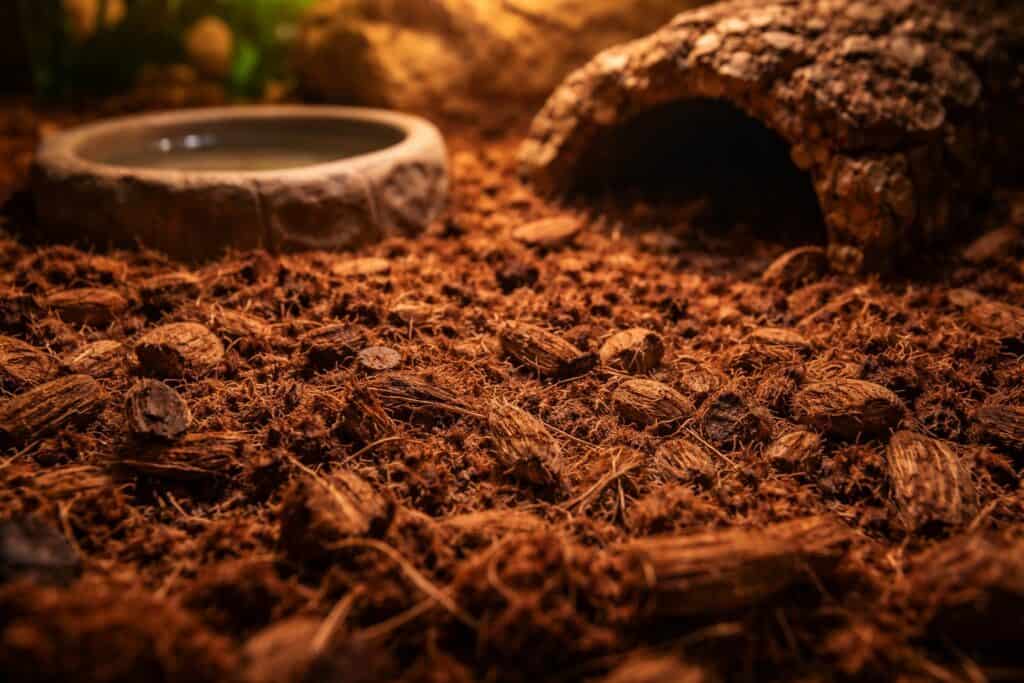
The best substrates for ball pythons are coconut fiber (coco husk or coco coir), cypress mulch, and a topsoil/play sand mix. Coconut fiber is probably the most popular. It holds moisture well, is easy to spot clean, and looks natural. Cypress mulch is another great option that resists mold and smells good. Some keepers mix the two.
We did a full breakdown of what actually works for ball python substrate if you want to go deeper on the pros and cons of each option.
Avoid aspen bedding for ball pythons. It’s fine for corn snakes and kingsnakes that need lower humidity, but it molds fast in the 60 to 80 percent range that ball pythons require. Also avoid sand by itself (too dusty, ingestion risk), cedar or pine shavings (toxic oils), and newspaper if you care about humidity retention.
Aim for 3 to 4 inches of substrate depth. This allows your snake to burrow partially and helps maintain stable humidity.
Hides, Water Bowl, and Clutter
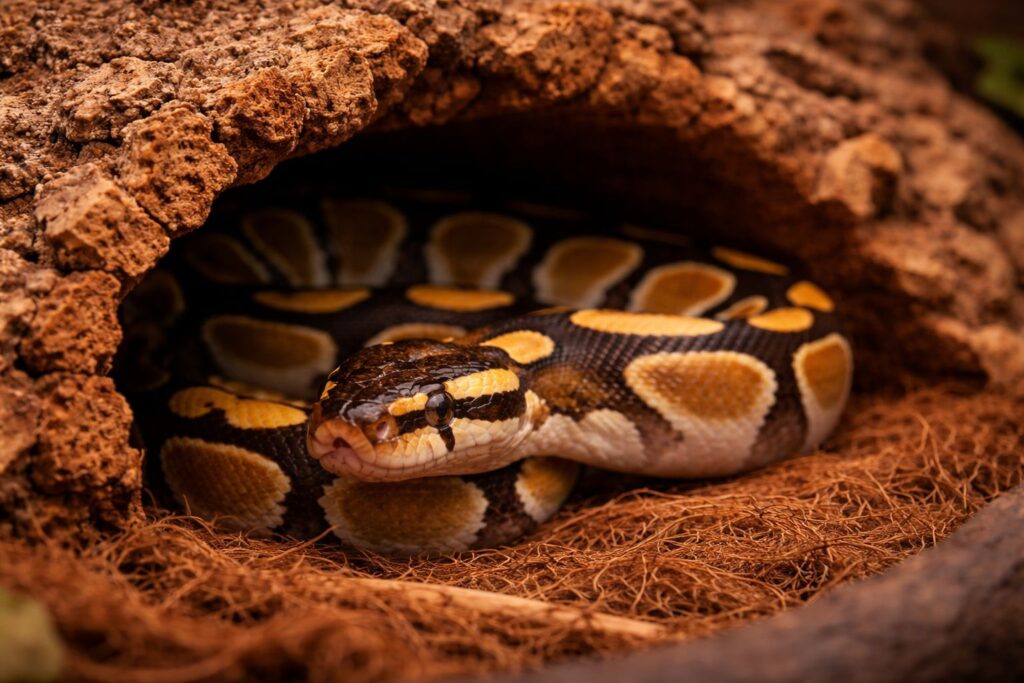
Ball pythons are secretive snakes. In the wild they spend most of their time hidden in termite mounds, burrows, and under debris. A ball python enclosure without adequate hiding spots will produce a stressed, defensive snake that refuses food.
You need at minimum two hides: one on the warm side and one on the cool side. Each hide should be snug. The snake should be able to coil up inside and touch the walls. If the hide is too big, it doesn’t feel secure. Cork bark, half logs, and plastic reptile hides all work. Just make sure each one fits your snake’s current size.
A third humid hide, a hide stuffed with damp sphagnum moss, is a great addition. Place it on the warm side. It gives your snake a spot to go when it’s about to shed, and it can help prevent stuck sheds without you needing to raise humidity in the entire enclosure.
Beyond hides, add clutter. Fake plants, branches, cork rounds, leaf litter, whatever breaks up the sight lines and makes the enclosure feel dense. Ball pythons are way more active and confident in a cluttered enclosure than in a bare one with just two hides and a water bowl.
The water bowl should be large enough for the snake to soak in and heavy enough not to tip over. Ceramic or stoneware bowls work well. Place it on the cool side or in the middle. Change the water daily, or immediately if the snake defecates in it (and they will, eventually).
Lighting
Ball pythons are crepuscular, most active at dawn and dusk. They don’t need intense lighting, but they do benefit from a consistent light cycle. About 12 hours of light and 12 hours of dark works for most of the year.
If your ball python enclosure is in a room with natural light from windows, that may be enough to establish a day/night cycle. If the room is dark, a low-wattage LED or the ambient light from your halogen basking bulb during the day handles it.
UVB is not strictly required for ball pythons, but there’s growing evidence that it benefits them. A low-output UVB like a ShadeDweller or a 5 to 7 percent T5 tube provides a source of vitamin D3 synthesis that supplements alone can’t fully replicate. If you’re using a PVC enclosure, you’ll want to mount the UVB inside since PVC blocks UV.
Putting Your Ball Python Enclosure Together
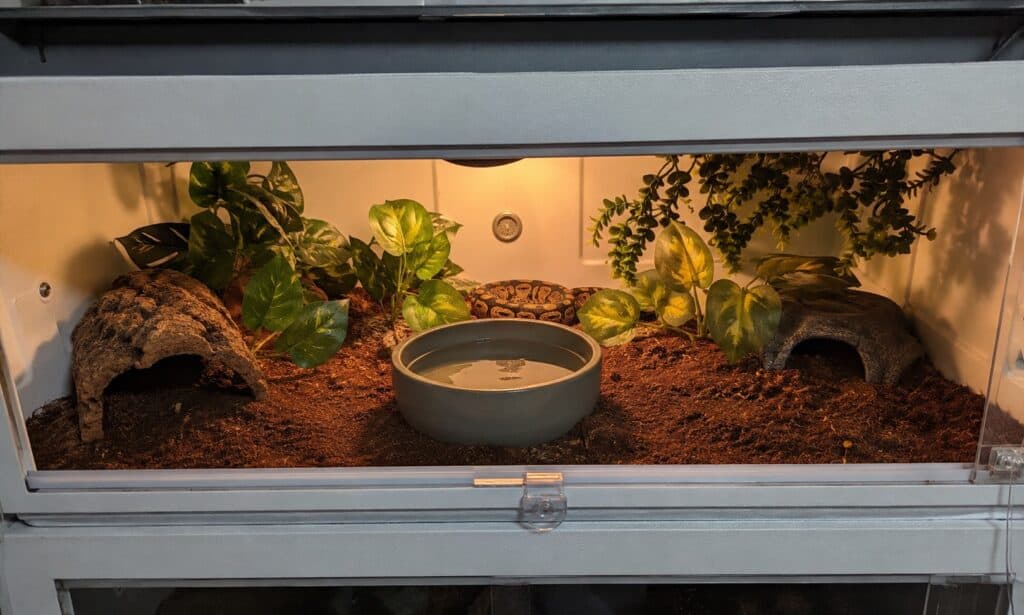
Here’s a practical setup checklist to bring it all together. Start with the enclosure. PVC for adults, tub or glass for babies. Add 3 to 4 inches of substrate. Place the warm hide on one end and the cool hide on the other. Mount your heat source above the warm side, connected to a thermostat. Add the water bowl on the cool side. Fill the open space between the hides with fake plants, branches, and cork pieces. Place your thermometer probes on the warm and cool sides, and your hygrometer probe in the middle.
Let everything run for 24 to 48 hours before adding your snake. Verify that the warm side sits around 88 to 90 degrees, the cool side around 76 to 78, and humidity is above 60 percent. Tweak as needed. Once it’s stable, put the snake in and leave it alone for at least a week before trying to feed or handle.
Track Your Setup and Catch Problems Early
Once your ball python enclosure is running, the biggest challenge is keeping conditions consistent. Temperatures drift when bulbs age. Humidity drops when seasons change. Substrate dries out between cleanings. Small shifts happen gradually and they’re easy to miss.
The Exotic Reptile Care app lets you set reminders for misting, substrate changes, and enclosure cleanings so nothing falls through the cracks. You can also log feedings and track weight, which is the fastest way to catch problems. If your ball python suddenly stops eating after a shed or starts losing weight, having that data already logged makes it much easier to figure out what changed.
Keep It Simple, Keep It Stable
The best ball python enclosure isn’t the most expensive one or the most Instagram-worthy one. It’s the one where temperatures stay consistent, humidity stays above 60 percent, and your snake has enough cover to feel secure. Nail those basics and your ball python will eat well, shed cleanly, and actually come out to explore instead of balling up every time you open the door.
For more detailed enclosure recommendations from a trusted source, ReptiFiles has a thorough ball python terrarium guide worth reading.