The corn snake is one of the best beginner snakes for a reason. They’re calm, they eat well, they tolerate handling, and they don’t need anything exotic in terms of care. But a bad corn snake enclosure will still cause problems. Feeding refusals, escape attempts, stuck sheds, and stressed behavior almost always trace back to something wrong with the setup. The good news is that getting it right isn’t complicated or expensive.
This guide covers corn snake enclosure sizing at every life stage, heating, substrate, hides, humidity, lighting, and everything else you need for a setup that actually works.
What Size Corn Snake Enclosure Do You Need?
Corn snakes can reach 3 to 5 feet as adults, with most landing in the 4 to 4.5 foot range. They need enough room to stretch out, move between temperature zones, and explore. The old advice of keeping an adult in a 20 gallon tank is outdated and too small.
For adult corn snakes, the minimum enclosure size is a 40 gallon breeder (36 by 18 by 18 inches). That gives enough floor space for a proper temperature gradient and room for hides, a water bowl, and climbing opportunities. If you can go bigger, a 4 by 2 by 2 foot enclosure is even better and gives you space to create a more enriched setup.
Hatchlings and juveniles under 18 inches can start in a smaller enclosure, around 10 to 20 gallons or an appropriately sized tub. Don’t put a tiny hatchling in a massive adult enclosure with only two hides and nothing else. Too much open space with not enough cover stresses small snakes out. Fill the space with clutter or start small and upgrade as the snake grows.
You can absolutely house a hatchling in an adult-sized corn snake enclosure if you pack it with enough hides, fake plants, and cover. The problem is never the size of the enclosure. It’s the amount of empty, exposed space.
Here’s the minimum corn snake enclosure size at each life stage before we get into enclosure types and heating.
| Life Stage | Length | Minimum Enclosure Size |
|---|---|---|
| Hatchling / juvenile | Under 18 in | 10 to 20 gal or sized tub |
| Adult | 3 to 5 ft | 40 gal breeder (36 x 18 x 18 in) |
| Adult (ideal) | 3 to 5 ft | 4 x 2 x 2 ft for an enriched setup |
Enclosure Types: Glass, PVC, or Tubs
Glass terrariums are the most common choice and they’re perfectly fine for corn snakes. Front-opening designs are ideal because approaching from above startles most snakes. A screen top provides ventilation, but you may need to cover part of it to maintain humidity during dry winter months.
PVC enclosures are the upgrade option. They hold heat better than glass, they’re lighter, they stack easily if you keep multiple snakes, and they look clean. The cost is higher but the long-term convenience is worth it for keepers who want minimal fuss with temperature management.
Plastic tubs are the budget option and they work surprisingly well. They hold heat and humidity naturally, they’re easy to clean, and they’re cheap to replace. You’ll need to drill or melt ventilation holes and secure the lid with clips, but many experienced corn snake breeders house their entire collections in tub systems. The tradeoff is aesthetics. A tub isn’t going to look as good as a planted glass vivarium, but functionally it does the job.
For most keepers with one corn snake as a pet, a front-opening glass terrarium or a PVC enclosure in the 36 by 18 inch footprint range is the sweet spot.
Heating a Corn Snake Enclosure
Corn snakes need a temperature gradient with a clear warm side and cool side. They’re ectotherms and rely on moving between temperature zones to regulate digestion, immune function, and activity levels.
Warm side basking surface: 85 to 90 degrees Fahrenheit. Cool side: 72 to 78 degrees. Nighttime temps can drop to the upper 60s to low 70s without issues.
Overhead heating is the modern standard. A halogen flood bulb or deep heat projector mounted above the warm side creates a natural gradient by warming surfaces from above. Halogen bulbs produce infrared-A and infrared-B wavelengths that penetrate tissue more effectively than heat mats, giving your corn snake better quality heat for digestion and thermoregulation.
Under tank heat mats still work, especially for tub setups where overhead heating isn’t practical. Place the mat under one third of the enclosure on the warm side. It must be on a thermostat. An unregulated heat mat can spike well past safe temperatures and burn your snake through the floor.
A thermostat is mandatory for every heat source, no exceptions. A basic on/off thermostat works for heat mats. A dimming thermostat is better for overhead bulbs since it adjusts output smoothly instead of just cutting power entirely.
Use digital thermometers with probes on both sides to monitor temperatures. An infrared temperature gun is useful for checking basking surface temps specifically. Don’t rely on stick-on analog gauges.
Do not use heat rocks. They cause burns. Do not use red or blue bulbs.
Substrate for a Corn Snake Enclosure
Corn snakes aren’t picky about substrate, but some options are clearly better than others.
Aspen shavings are the classic corn snake substrate. They’re cheap, widely available, easy to spot clean, and they allow burrowing. Aspen is also the standard for dedicated burrowers. A western hognose needs at least 4 inches of it, twice what most corn snake keepers use. Corn snakes love burrowing through aspen. The downside is that aspen molds if it gets too wet, so it works best in enclosures where humidity stays in the moderate range (40 to 60 percent).
Cypress mulch holds moisture better than aspen and resists mold. It’s a good choice if you live in a dry climate and need help maintaining humidity. It also looks more natural than aspen.
A topsoil and play sand mix (roughly 70/30) is the naturalistic option. It holds shape for burrows, looks great, and works well in bioactive setups. If you’re interested in going bioactive, our beginner guide to bioactive enclosures covers the setup process.
Coconut fiber works fine but tends to be dusty when dry and overly moist when wet. It’s acceptable but not the top choice for this species.
Avoid cedar and pine shavings. The aromatic oils are toxic to snakes. Avoid calcium sand and reptile carpet. Sand by itself is too loose and provides no structure for burrowing.
Aim for 3 to 4 inches of substrate depth regardless of which material you choose. This allows for natural burrowing behavior, which corn snakes engage in regularly.
Hides, Climbing, and Clutter
Corn snakes spend most of their time hidden. In the wild they use rodent burrows, rock crevices, leaf litter, and fallen logs as shelter. A corn snake enclosure without proper hides produces a stressed snake that refuses food and hides behind the water bowl because it has nowhere else to go.
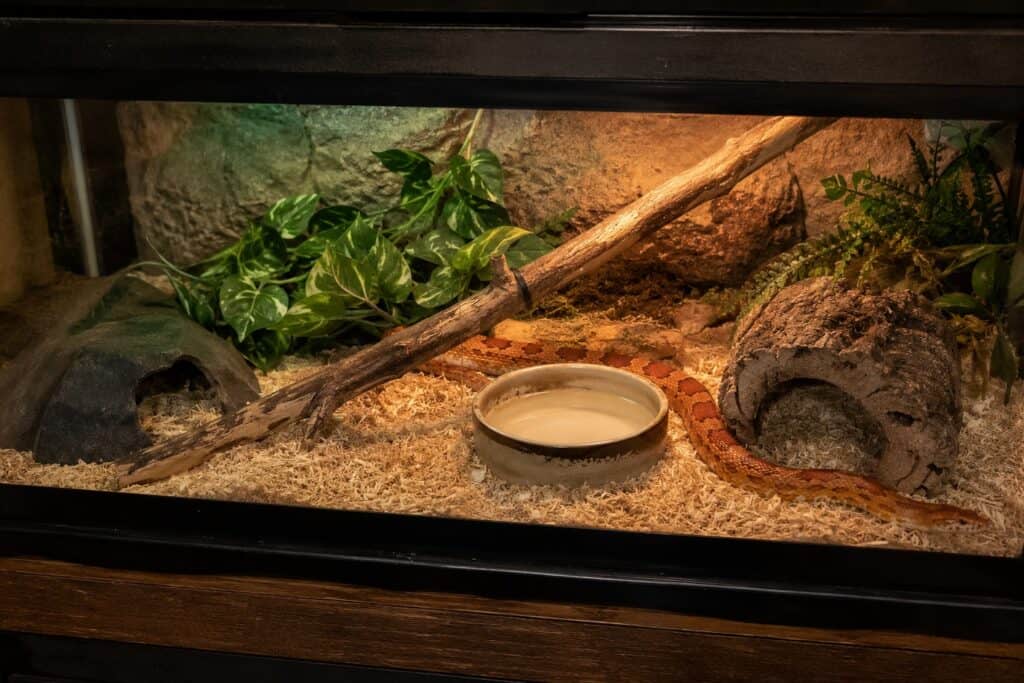
You need at minimum two hides: one on the warm side and one on the cool side. Each hide should be snug. The snake should fill most of the interior space when coiled up. Cork bark halves, commercial reptile hides, and coconut shells all work. Size them to match your snake and upgrade as it grows.
A third humid hide, stuffed with damp sphagnum moss and placed on the warm side, helps with clean sheds. Corn snakes shed every 4 to 8 weeks depending on age and growth rate, and access to a moist microclimate during the process prevents stuck shed.
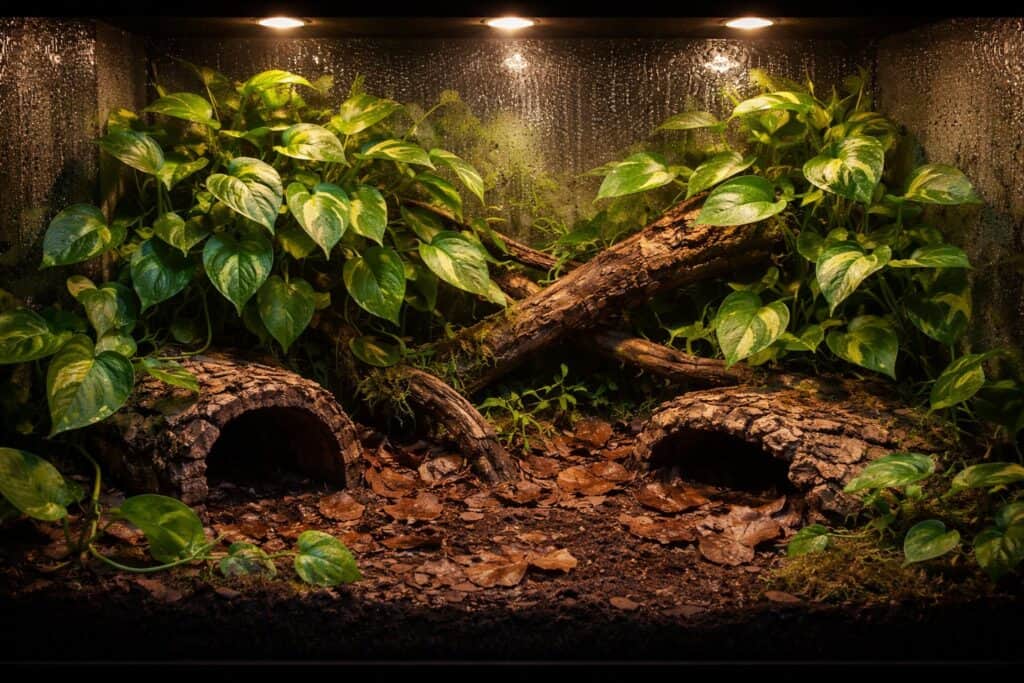
Here’s the part most people miss: corn snakes are semi-arboreal. They climb. A lot. Providing climbing branches, cork tubes, and elevated ledges adds enrichment that most corn snakes will actively use, especially at night. A diagonal branch from the substrate to the upper third of the enclosure gives your snake a reason to explore vertically.
Fill open spaces with fake plants, leaf litter, and additional cover. Corn snakes are more active and more visible in a cluttered enclosure than in a bare one, because they feel secure enough to move around.
Humidity and Water
Corn snakes need 40 to 60 percent ambient humidity, with temporary spikes to 70 percent or above during shedding. This is lower than tropical species like ball pythons but higher than many people assume.
A large water bowl is the single biggest contributor to enclosure humidity. Place it on the cool side or in the middle of the enclosure. The water should be deep enough for the snake to soak if it wants to, and the bowl should be heavy enough not to tip when a 4 foot snake climbs in. Change the water daily.
If humidity drops too low, especially during winter when indoor heating dries the air, mist the substrate lightly or place the water bowl closer to the warm side for increased evaporation. If you’re using a glass tank with a screen top, covering 30 to 50 percent of the screen with foil tape or acrylic helps retain moisture.
Monitor humidity with a digital hygrometer. Place the probe in the middle of the enclosure away from the water bowl for an accurate ambient reading.
For general guidance on enclosure cleaning schedules that apply to corn snakes and other species, check out our article on how often to clean a snake enclosure.
Lighting and UVB
Corn snakes are primarily crepuscular and nocturnal. They don’t need bright lighting but they benefit from a consistent 12 hours on, 12 hours off light cycle. Ambient room light or the light from an overhead halogen basking bulb usually provides enough of a day/night signal.
UVB isn’t strictly required for corn snakes, but recent research and keeper experience suggest it supports better health outcomes. A low-output UVB tube in the 5 to 7 percent range (like an Arcadia ShadeDweller or similar) provides vitamin D3 synthesis that supplementation alone can’t fully replicate. If you add UVB, mount it on the warm side so the snake can self-regulate its exposure by moving into shaded areas.
If you skip UVB, make sure feeder rodents are providing adequate nutrition and consider light calcium dusting on prey occasionally, though most frozen-thawed rodents already provide reasonable calcium levels.
Putting Your Corn Snake Enclosure Together
Start with the enclosure. Add 3 to 4 inches of substrate. Place the warm hide on one end over your heat source. Place the cool hide on the opposite end. Add a climbing branch diagonally across the enclosure. Place the water bowl on the cool side. Fill open spaces with fake plants, cork pieces, and additional cover. Mount your heat source on the warm side, connected to a thermostat. Place thermometer probes on both sides and a hygrometer probe in the middle.
Let the enclosure run for 24 to 48 hours before adding the snake. Verify warm side reads 85 to 90 degrees on the surface, cool side sits around 73 to 78, and humidity is in the 40 to 60 percent range. Once stable, add the snake and leave it completely alone for 5 to 7 days before attempting to feed.
Track Conditions and Catch Problems Early
The initial setup is the hard part. After that, maintaining a corn snake enclosure is about consistency. Check temperatures daily, refresh water daily, spot clean waste as it appears, and do a full substrate change every 4 to 6 weeks (longer with bioactive setups).
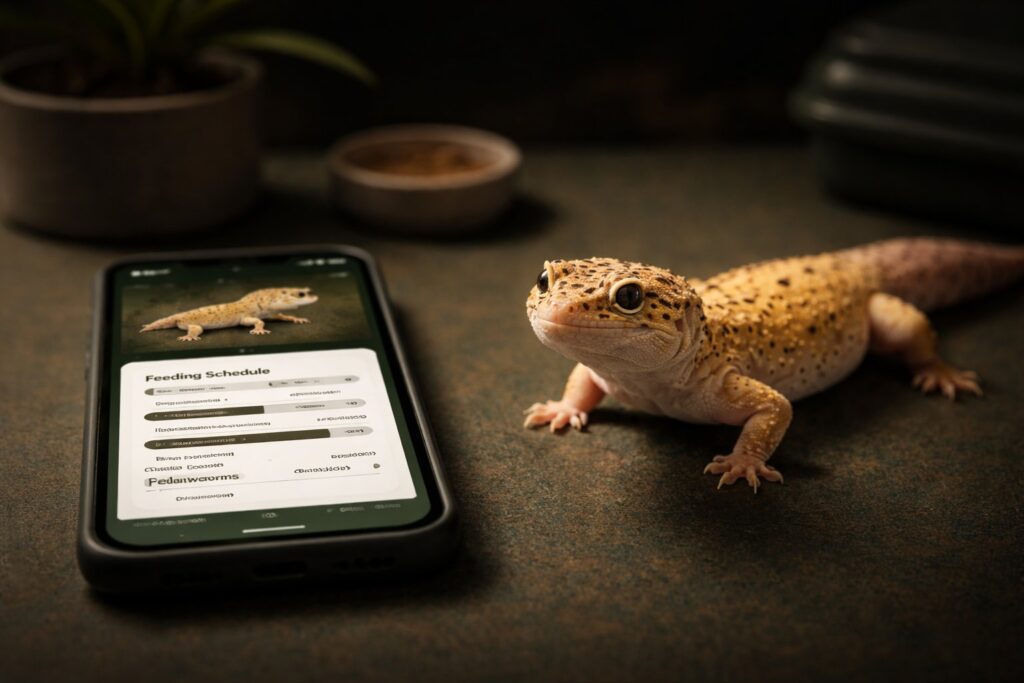
The Exotic Reptile Care app helps you stay on top of the routine by setting reminders for feeding days, substrate changes, and deep cleans. You can also log feedings and track weight, which is especially useful during the first year when growth should be steady. If your corn snake stops eating for weeks, having that feeding history logged helps you figure out whether it’s seasonal, stress-related, or a husbandry issue.
A good corn snake enclosure doesn’t require a big budget or complicated equipment. The right size, correct temperatures, proper hides, and consistent maintenance. That’s the formula. Get those basics right and your corn snake will eat reliably, shed cleanly, and live a healthy 15 to 20 year life.
Corn snake enclosure: frequently asked questions
What size enclosure does an adult corn snake need?
The minimum for an adult is a 40 gallon breeder, which is 36 by 18 by 18 inches. That gives room for a proper temperature gradient, multiple hides, a water bowl, and climbing space. A 4 by 2 by 2 foot enclosure is even better if you can manage it. The old 20 gallon advice is outdated and too cramped for a snake that reaches 4 to 5 feet.
Can a baby corn snake live in a large enclosure?
Yes, as long as you pack it with cover. The reason people warn against it is that too much open, exposed space stresses a hatchling and leads to hiding and food refusals, not the enclosure size itself. Fill a large corn snake enclosure with hides, fake plants, cork, and clutter so the snake never has to cross bare ground, and a baby will do fine.
What is the best substrate for a corn snake?
Aspen shavings are the classic choice because they’re cheap, easy to spot clean, and great for burrowing, as long as humidity stays moderate since aspen molds when wet. Cypress mulch holds moisture better for dry climates, and a 70/30 topsoil and play sand mix is the naturalistic and bioactive option. Avoid cedar and pine, which are toxic, plus calcium sand and reptile carpet.
Do corn snakes need a heat lamp or a heat mat?
Either works with a thermostat. Overhead halogen or a deep heat projector is the modern standard because it warms surfaces from above and gives better quality heat for digestion. Heat mats still work well, especially in tubs where overhead heating isn’t practical. Aim for a warm side of 85 to 90°F and a cool side of 72 to 78°F, and never run any heat source without a thermostat.
Do corn snakes need to climb?
Yes, more than most people realize. Corn snakes are semi-arboreal and climb regularly, especially at night. Adding diagonal branches, cork tubes, and elevated ledges gives real enrichment they’ll actively use. A branch running from the substrate to the upper third of the enclosure encourages natural vertical exploration and makes for a more active, confident snake.
What humidity does a corn snake enclosure need?
Keep ambient humidity at 40 to 60 percent, with temporary spikes to 70 percent or higher during shedding. That’s lower than tropical species like ball pythons but higher than many keepers assume. A large water bowl is your biggest humidity contributor. In dry winter months, lightly mist the substrate or cover part of a screen top with foil tape to hold moisture, and monitor with a probe hygrometer in the middle.
How do I keep enclosure conditions stable long term?
Setup is the hard part, then it’s all consistency, checking temps daily, refreshing water, spot cleaning, and doing a full substrate change every four to six weeks. Digital probes on both sides plus a hygrometer give the readings, and logging them reveals drift early. The Exotic Reptile Care app sets reminders for feeding, substrate changes, and cleans, and tracks weight, which pairs naturally with a consistent care routine.