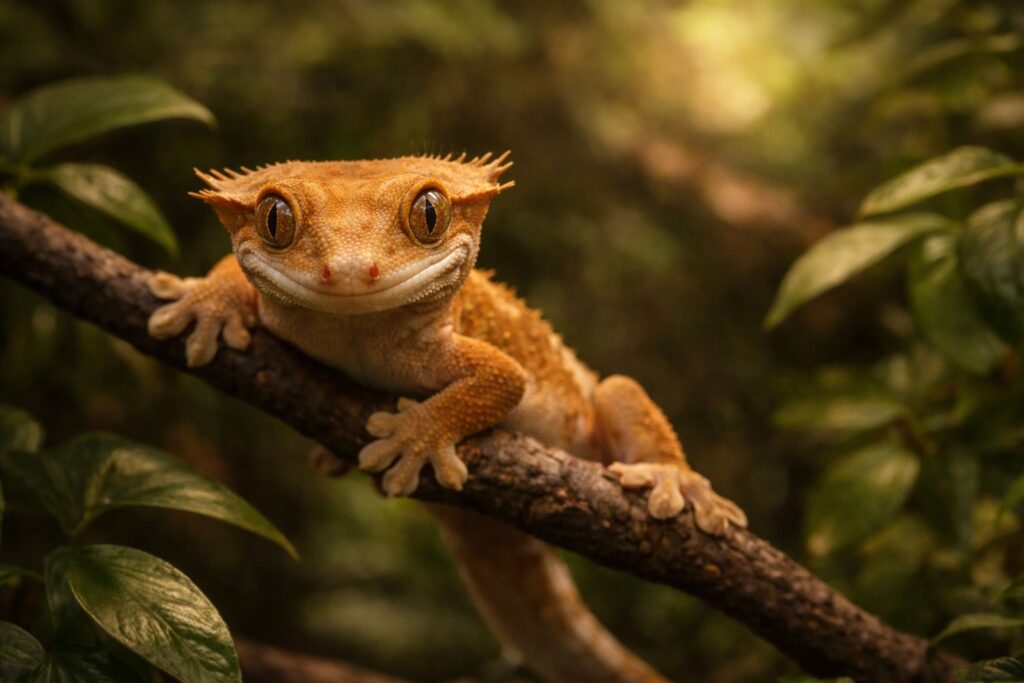
Crested geckos are one of the most forgiving reptiles you can keep, but that doesn’t mean their enclosure doesn’t matter. In fact, most of the common problems people run into with cresties, things like not eating, stress firing, tail dropping, and weight loss, trace back to something wrong with the enclosure. Get your crested gecko enclosure right and everything else gets easier. The good news is it’s not complicated. These geckos don’t need the intense heating or UVB setups that bearded dragons do. But they do have specific needs around height, humidity, and temperature that you can’t skip. If you are still deciding whether a crestie is right for you, start with our full crested gecko care guide and come back here for the enclosure details.
Crested Gecko Enclosure at a Glance
| Component | Recommendation |
|---|---|
| Tank Size (Adult) | 18″ x 18″ x 24″ minimum |
| Tank Size (Juvenile) | 12″ x 12″ x 18″ |
| Daytime Temp | 72 to 78°F |
| Nighttime Temp | 65 to 72°F |
| Humidity | 60 to 80%, with dry periods |
| Lighting | Low-output UVB (optional but recommended) |
| Substrate | Paper towel (juvenile), ABG mix or coco fiber (adult) |
What Size Crested Gecko Enclosure Do You Need
Height matters more than floor space for crested geckos. They’re arboreal, meaning they spend almost all their time climbing and hanging off vertical surfaces. A long, shallow tank is the wrong shape entirely.
For an adult crested gecko, the minimum is an 18 x 18 x 24 inch front-opening terrarium. This is the most commonly recommended size and it works well for a single gecko. “Single” matters more with the close relatives. Keeping a gargoyle gecko works in essentially the same build, but gargoyles bite tails and can’t share an enclosure at all. The gargoyle-specific details are in our gargoyle gecko enclosure guide. If you want to give them more room, and you should if your budget allows, a 24 x 18 x 36 is even better. Taller is always the right direction with cresties.
For juveniles under about 15 grams, a smaller enclosure actually works better. A 12 x 12 x 18 terrarium keeps them close to their food and water, which makes it easier for them to find meals. Baby crested geckos in a full-sized adult enclosure sometimes struggle to locate their food dish, and that’s one of those quiet problems that leads to slow weight loss over weeks. If you notice your crestie dropping weight, our guide on crested gecko losing weight covers what to look for and how to fix it.
Front-opening enclosures are strongly preferred over top-opening ones. Crested geckos instinctively flee upward when startled. If you’re opening a screen top to reach in, you’re going to have escape attempts. A front-opening door lets you access the enclosure without triggering that panic response. Glass terrariums with screen tops work but need modification to hold humidity. More on that below.
Temperature and Why Crested Geckos Don’t Need Much Heat
This is where crested geckos are genuinely easy compared to most reptiles. They do best at room temperature. Daytime temps should be between 72 and 78 degrees Fahrenheit, and nighttime can drop to 65 to 72. That’s it.
The critical thing to understand is that crested geckos are sensitive to heat. Sustained temperatures above 82 degrees can cause serious stress, and anything above 85 can be fatal. Summer is when this goes wrong, and our crested gecko temperature guide covers heat waves and what to do on the hottest week of the year. This is the opposite of bearded dragons and ball pythons, where the challenge is getting temps high enough. With cresties, the challenge is making sure temps don’t climb too high.
Most homes sit in the right range without any supplemental heating. If your room runs cold in winter, a low-wattage heat lamp on a thermostat or a small ceramic heat emitter can bump temps up a few degrees. Never use a heat mat on the side of a crested gecko enclosure. They stick to the glass and can sit directly on a warm patch without realizing it’s too hot.
If your house runs warm in summer, keeping the enclosure away from windows and out of direct sunlight is usually enough. A small fan in the room helps too, just don’t point it directly at the enclosure.
Humidity in Your Crested Gecko Enclosure
Humidity is the one thing you have to actively manage. Crested geckos need 60 to 80% humidity, but they also need it to cycle. You don’t want a constant 80% with no dry period, because stagnant high humidity leads to respiratory infections and bacterial skin issues.
The best approach is to mist heavily once or twice a day and let the enclosure dry out between mistings. Morning and evening misting works well. After misting, humidity should spike up to 80 to 90%, then gradually drop down to around 50 to 60% before the next misting. This wet-dry cycle mimics their natural environment in New Caledonia, where they experience rain followed by drying periods.
A screen top on a glass tank makes humidity management harder because moisture escapes fast. You can cover 50 to 75% of the screen with aluminum foil, HVAC tape, or a cut piece of acrylic to trap more moisture. Don’t cover the entire top or you’ll kill airflow, which is just as bad as low humidity.
Use a digital hygrometer, not the analog stick-on kind. Place it at mid-level in the enclosure where your gecko actually spends time, not at the top or bottom. A combo thermometer/hygrometer with a probe works best.
Lighting and UVB for Crested Geckos
This is a topic where keeper opinions have shifted in recent years. The old advice was that crested geckos are nocturnal and don’t need UVB at all. The current consensus among experienced keepers is that low-level UVB is beneficial even if not strictly required.
A low-output UVB fixture like the Arcadia ShadeDweller or a similar T5 HO 7% tube works well. It supports vitamin D3 synthesis, which helps with calcium absorption, immune function, and overall health. If you provide UVB, you can reduce or eliminate D3 supplementation on feeder insects, since the gecko can produce its own.
If you choose not to use UVB, you need to supplement every insect feeding with calcium plus D3. Either approach works, but UVB is the more natural option and most keepers who’ve switched report better appetite and activity levels.
For general lighting, a 12-hour day/night cycle keeps their internal clock on track. A simple LED light on a timer gives them a day/night rhythm without adding unwanted heat. Crested geckos are crepuscular, most active at dawn and dusk, so don’t expect to see them basking under the light during the day.
Setting Up the Inside of Your Crested Gecko Enclosure
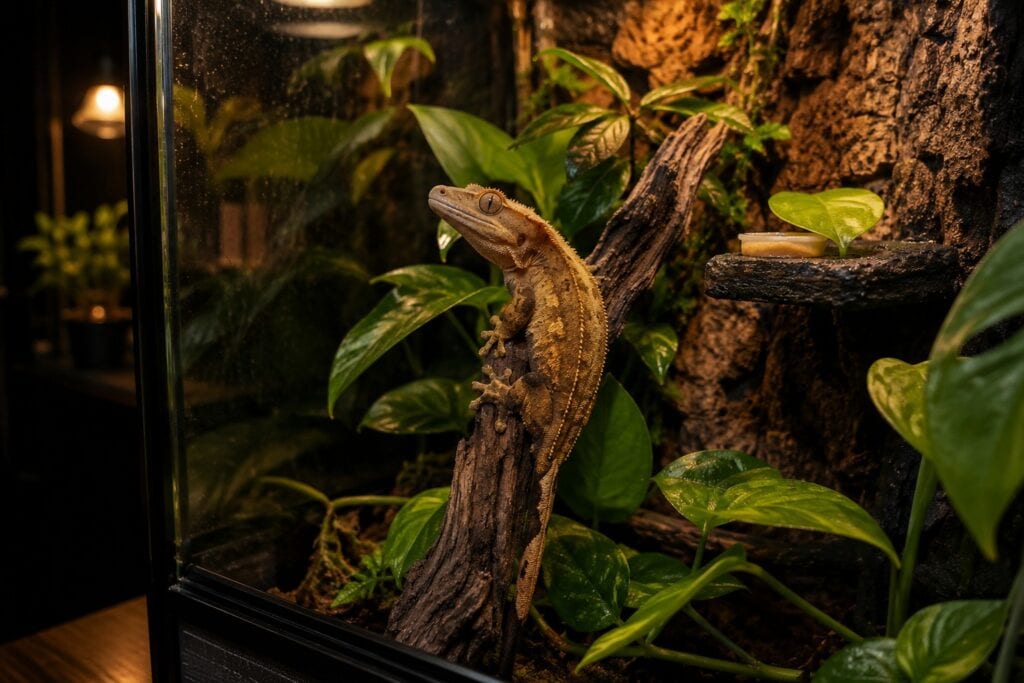
The inside of the enclosure matters as much as the enclosure itself. Crested geckos need vertical climbing surfaces, hiding spots, and elevated feeding stations.
Branches and vines should run diagonally and vertically through the enclosure. Cork bark tubes and flats are perfect because they’re lightweight, natural-looking, and give your gecko textured surfaces to grip. Bendable vines add more climbing routes without taking up much space. Aim for enough coverage that your gecko can move from bottom to top without touching the glass, but don’t pack it so tight that there’s no open space to jump through.
Live plants are a big plus in a crested gecko enclosure. Pothos, bromeliads, and ficus are all safe choices that thrive in the humidity range cresties need. They add cover, hold water droplets for drinking, and look great. If you’re considering live plants, a bioactive setup is worth exploring. Our bioactive enclosure guide covers the full process including drainage layers, substrate, and cleanup crew.
For substrate, juveniles do best on paper towel. It’s easy to clean and eliminates any impaction risk. Adults can go on a tropical substrate mix like ABG (a blend of tree fern fiber, charcoal, sphagnum moss, peat, and orchid bark) or plain coconut fiber. Both hold humidity well and support live plants if you go bioactive.
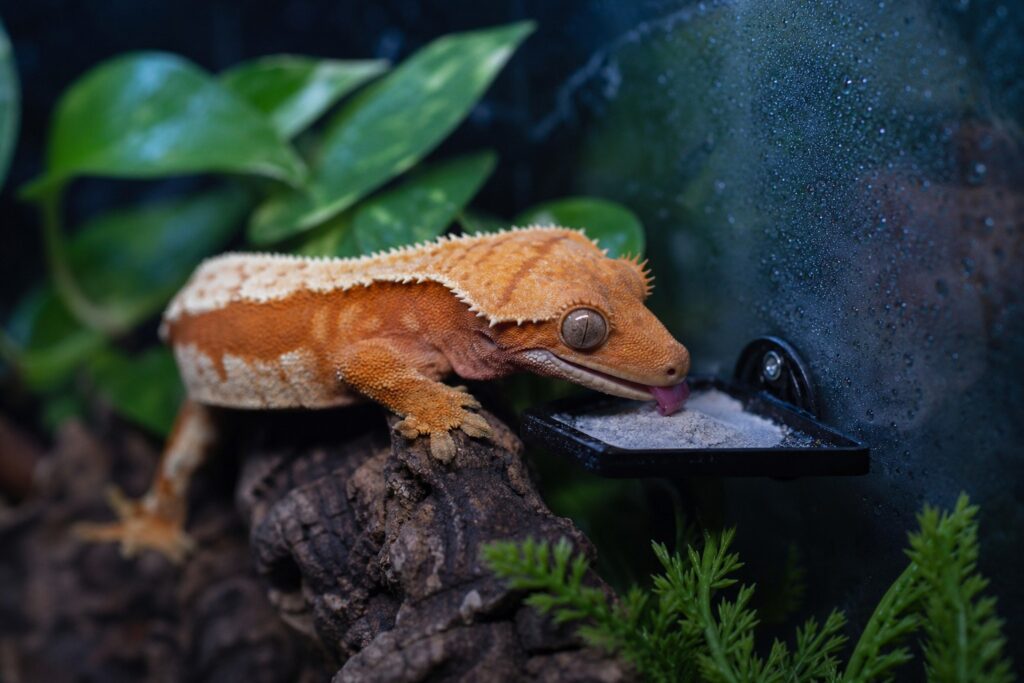
Place the feeding ledge high in the enclosure, about two thirds of the way up. Crested geckos rarely come down to the floor to eat. A magnetic feeding ledge stuck to the glass is the standard setup. If your gecko isn’t eating consistently, placement might be the issue. Our crested gecko diet schedule covers feeding routines, MRP recommendations, and how to tell if your gecko is actually eating enough.
At least two hides should be available, one higher up and one lower. Cork bark tubes work as hides and climbing surfaces at the same time.
Tracking Conditions Over Time
The tricky part of crested gecko care isn’t the initial setup. It’s maintaining conditions week after week, especially humidity. Seasons change, room temperatures shift, and misting schedules get inconsistent. A gecko that was doing great in winter might start having shed issues in summer when the room dries out faster.
Keeping a log of temperatures, humidity, feeding response, and weight helps you catch trends before they become real problems. The Exotic Reptile Care app is built for exactly this. You can log feedings, track weight over time with growth charts, and set reminders for misting, cleaning, and UVB bulb replacement so nothing gets forgotten during busy weeks.
Common Crested Gecko Enclosure Mistakes
A few mistakes come up constantly in crested gecko groups online.
Enclosure too hot. This is the most dangerous one. If your gecko is spending all its time at the bottom of the enclosure, it might be trying to escape heat. Check temps at the top of the enclosure where heat accumulates.
No humidity cycling. Keeping humidity locked at 80% all day leads to skin infections. Let it drop between mistings.
Feeding dish on the floor. Crested geckos are arboreal feeders. A dish on the substrate will get ignored. Mount it high.
No hides. Some keepers fill the enclosure with branches and plants but forget actual hiding spots. Cresties need places where they feel completely concealed, especially during the day.
Screen top without modification. A fully open screen top in a dry room means you’ll be misting four times a day and still fighting low humidity. Cover part of the screen.
Crested Gecko Enclosure FAQ
Can I use a fish tank for a crested gecko?
You can, but it’s not ideal. Fish tanks are wider than they are tall, which is the wrong orientation for an arboreal species. They also open from the top, which causes escape risks and stresses the gecko. If it’s all you have, stand a 20 gallon tall tank on its end and modify the opening, but a purpose-built front-opening terrarium is the better investment.
Do crested geckos need a heat lamp?
Most don’t. If your room stays between 72 and 78 degrees, no supplemental heat is needed. If your house drops below 68 regularly, a low-wattage ceramic heat emitter on a thermostat can help. Never use a high-output basking lamp.
Can I keep two crested geckos together?
Two females can sometimes cohabitate in a larger enclosure (24 x 18 x 36 minimum), but watch closely for bullying. Never house two males together. A male-female pair will breed whether you want them to or not.
How often should I mist the enclosure?
Once or twice daily. Mist heavily in the evening and optionally again in the morning. Let humidity drop to 50 to 60% between sessions. Your gecko will drink water droplets off leaves and glass after misting.
Do crested geckos need live plants?
No, but they benefit from them. Live plants hold water droplets, add cover, and help stabilize humidity. If you don’t want live plants, use high-quality artificial plants that provide similar coverage.
A Simple Setup That Works for Years
Crested geckos can live 15 to 20 years in captivity. The enclosure you set up today is going to be their home for a long time. Start with the right size, keep the temperature cool, cycle the humidity, and give them plenty to climb on. It doesn’t need to be complicated or expensive. It just needs to be consistent. A well-maintained crested gecko enclosure is one of the easiest setups in the reptile hobby to keep running once it’s dialed in.