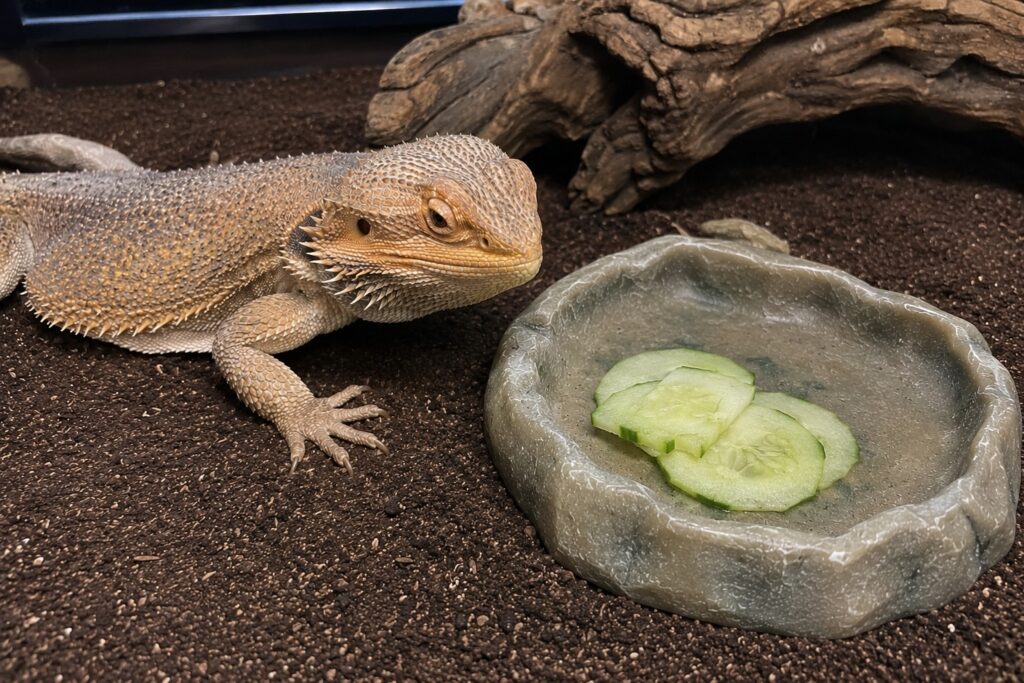
Can bearded dragons eat cucumbers? Yes, but only as an occasional food, and mostly for hydration rather than nutrition. Cucumbers are safe and non-toxic, and a few thin slices now and then are a fine treat, especially for a dragon that needs a little extra water. The catch is that cucumbers are almost entirely water with very little actual nutrition, so they can never be a staple. Fed too often, that high water content leads to runny stool. So the honest answer is a relaxed yes, with the understanding that cucumber is a light snack, not a real part of the diet.
Are Cucumbers Good for Bearded Dragons?
Cucumbers are more “harmless” than “beneficial,” and it helps to be clear-eyed about that. They are roughly 95 percent water, which is exactly why they are useful in one specific situation: hydration. If your dragon is a bit dehydrated, has just come out of brumation, or is recovering from something, a little cucumber is an easy way to sneak in some moisture. They also contain trace amounts of vitamin K, vitamin C, and potassium, plus a bit of fiber.
But that is about where the upside ends. Because cucumbers are so watery, they are very low in the things bearded dragons actually need from vegetables, calcium, protein, and dense nutrients. They also have a slightly poor calcium to phosphorus ratio, meaning a touch more phosphorus than calcium, which is not ideal since phosphorus interferes with calcium absorption. None of this makes cucumber bad. It just makes it filler, a watery, low-value snack rather than a nutritious green.
How Often Can Bearded Dragons Eat Cucumbers?
Offer cucumber occasionally, roughly once a week or every couple of weeks, and only a small amount when you do. It rides along in the salad as a bit of variety and hydration, never as the base of it.
The daily foundation of a bearded dragon’s plant intake should be nutrient-dense leafy greens with a good calcium ratio, like collard, mustard, turnip, and dandelion greens. Cucumber is a supporting extra on top of that, in the same “occasional” tier as the other watery or vitamin-heavy vegetables. This matches the guidance in our full bearded dragon food guide, where staple greens do the heavy lifting and everything else is a rotation of occasional add-ins.
Age changes the picture a little. Adults eat a mostly plant diet, so cucumber shows up in their salad. Babies and juveniles eat far more insects than greens, and their limited plant intake is better spent on calcium-rich greens than on watery cucumber, so keep it to a rare taste at most for them.
How to Prepare Cucumbers for Your Bearded Dragon
Prep is quick and simple. Peel the cucumber. The skin is tough, harder to digest, and where most pesticide residue and any wax coating sits, so peeling it removes the main downsides in one step. Wash it first anyway, and go organic if that is easy.
Slice thin and then chop small. Thin half-moons or small diced pieces are easy to eat and mix nicely into the greens. As always, no piece should be larger than the space between your dragon’s eyes, which for soft cucumber is more about avoiding a big mouthful than any real choking risk. If your cucumber has large, tough seeds, scoop them out, though the small soft seeds in most varieties are fine.
Serve it raw and plain. There is no reason to cook cucumber, and nothing should be added, no seasoning, no dressing. Plain, peeled, raw, and chopped small is the entire method. Remove any uneaten cucumber within a few hours, since watery vegetables spoil fast and can foul the enclosure.
Can Bearded Dragons Eat Cucumbers Every Day?
No. Daily cucumber is the one thing to avoid here, and the reason is that same high water content. Fed too much, too often, cucumber causes loose, watery stool and can contribute to dehydration through diarrhea, which is the opposite of the hydration benefit you were after. Overreliance on a near-zero-nutrition vegetable also crowds out the calcium-rich greens your dragon actually needs, which over time works against bone health.
None of that happens from a small weekly serving. It happens when cucumber becomes a daily habit or the bulk of the salad. Keep it occasional and it stays a harmless, hydrating little snack. If you ever notice runny stool, cut back on the watery vegetables first, cucumber is one of the usual culprits, and things normally settle quickly.
Keeping Track of the Occasional Foods
The tricky part of “occasional” foods is honestly remembering how occasional they have been. Cucumber is easy to over-feed because it is cheap, sits in most fridges, and dragons happily eat it, so it quietly creeps into the salad more days than you intended. Over a few weeks that adds up to a much wetter, lower-nutrition diet than you planned.
Logging what your dragon actually eats removes the guesswork, and that is where the Exotic Reptile Care app helps. You can record each feeding, so the occasional extras stay occasional instead of becoming staples, and track weight and stool consistency over time to catch problems early. Seeing “cucumber four times this week” written down makes it obvious when it is time to swap back to proper greens.
The Bottom Line on Cucumbers
Can bearded dragons eat cucumbers? Yes, as an occasional, hydrating snack, a few thin slices of peeled, chopped cucumber mixed into a salad built on real leafy greens, about once a week. Just remember it is mostly water with little nutrition, so it can never replace staple greens, and daily servings cause runny stool. Used lightly, cucumber is a handy way to add a bit of moisture and variety, especially for a dragon that needs the hydration. For the full picture on building a healthy diet around good staples, our complete bearded dragon food guide covers every food group, and if your beardie is turning its nose up at vegetables, our guide on getting a bearded dragon to eat greens has strategies that work.
Can Bearded Dragons Eat Cucumbers: Frequently Asked Questions
Can bearded dragons eat cucumbers every day?
No. Cucumbers are an occasional food, about once a week, because they are almost all water with very little nutrition. Fed daily they cause loose, watery stool and can crowd out the calcium-rich greens your dragon actually needs. A few thin slices once a week is the safe amount.
Can bearded dragons eat cucumber skin?
It is best to peel it. The skin is tough, harder to digest, and holds most of the pesticide residue or wax coating. Peeling removes those downsides, and the soft flesh is easier for your dragon to eat.
Can baby bearded dragons eat cucumbers?
Only rarely, if at all. Babies eat mostly insects and need their small amount of plant intake to be nutrient-dense greens, not watery cucumber. Save cucumber for adult dragons as an occasional hydrating treat.
Are cucumbers good for a dehydrated bearded dragon?
Yes, this is cucumber’s main strength. Because it is about 95 percent water, a little cucumber is a gentle way to add moisture for a dragon that is mildly dehydrated or coming out of brumation. For serious dehydration, though, see a reptile vet rather than relying on food.
What happens if a bearded dragon eats too much cucumber?
The most common result is loose, watery stool or mild diarrhea from the high water content, which can actually lead to dehydration. Cut back on cucumber and other watery vegetables and the stool usually firms up within a day or two. If it does not, consult a reptile vet.