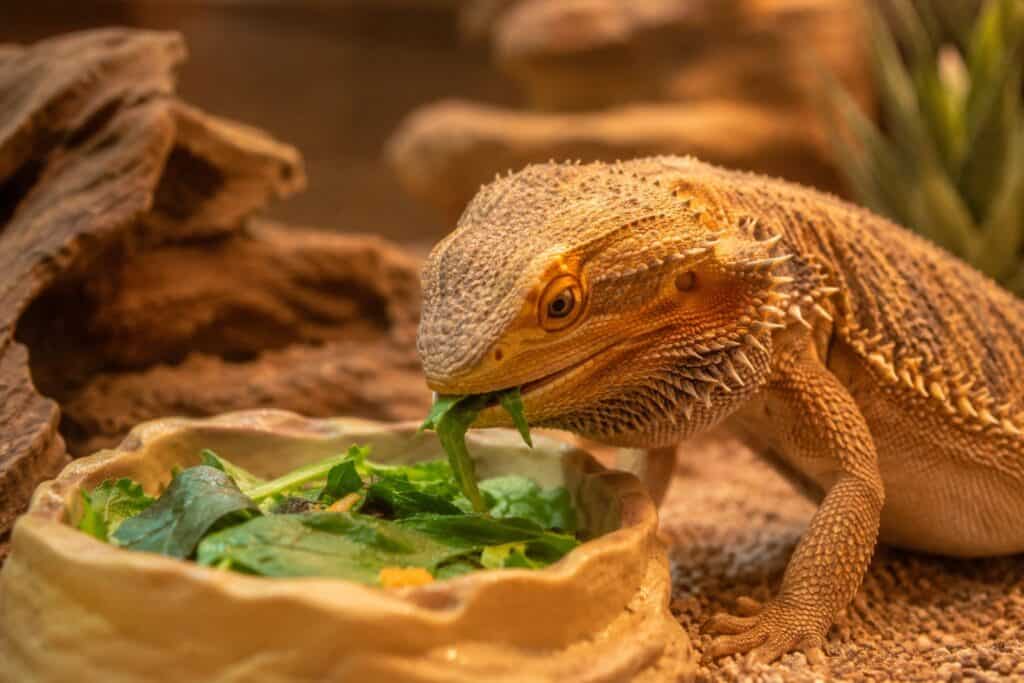

Can bearded dragons eat celery? Yes, in small finely chopped amounts about once a week. It won’t hurt them and it isn’t going to do much for them either, which puts it in the same drawer as cucumber and iceberg lettuce. Fine as filler, useless as a staple.
The part almost nobody mentions is that you’ve probably been feeding the wrong half of it. The leaves are better than the stalk, and most people throw the leaves away.
| Celery Part | Verdict |
|---|---|
| Leaves | Best part, more calcium and vitamin A |
| Stalk | Fine chopped small, strings removed |
| Base and core | Skip, too dense and fibrous |
| Celery seed or salt | Never |
| Frequency | Once a week at most |
Can Bearded Dragons Eat Celery Safely?
Yes. There’s nothing toxic in it, no oxalate problem worth worrying about, and no goitrogens like you get in the brassica family. On paper the calcium to phosphorus ratio sits around 1.6:1, which is on the right side of neutral even if it doesn’t reach the 2:1 you want from a staple green.
The issue isn’t safety, it’s that celery is roughly 95 percent water. A dragon that fills up on celery has eaten a lot of volume and taken in almost no calcium, protein, or vitamins. Do that regularly and you’re quietly displacing food that would have done something.
So the honest answer to whether bearded dragons can eat celery is yes, as a small rotational item mixed into a proper salad. Never as the salad itself.
The Leaves Are the Good Part
Celery leaves carry noticeably more calcium and vitamin A than the stalks do, and they’re softer, easier to chew, and easier to mix through a salad. If your bunch comes with leaves attached, tear those in and use them first.
This is one of those things that separates keepers who’ve been doing it a while from people following a supermarket-shelf mental model of vegetables. The leafy tops of celery, carrot, and beet are all more useful to a dragon than the parts humans eat.
Wash them well, since leafy tops hold more residue than a smooth stalk does.
The Strings Are the Actual Risk
Here’s what to be careful about. Celery stalks contain tough fibrous strings that run the whole length, and they don’t break down in a bearded dragon’s gut the way soft plant matter does.
A long string can wrap, tangle, or sit in the digestive tract, and in a small dragon that’s an impaction risk. It’s not a common emergency, but it’s the one real hazard here and it’s entirely avoidable.
Two steps solve it. Peel the outer strings off with a vegetable peeler or run a knife down the back of the stalk and pull them away. Then chop into pieces no wider than the space between your dragon’s eyes, which is the standard sizing rule and applies to everything you put in the bowl.
Chop across the stalk rather than lengthways. Cutting across shortens the fibres. Cutting along the stalk leaves them full length, which is exactly what you’re trying to avoid.
How to Serve It
Raw and finely chopped. Cooking softens the fibres a little but strips what few nutrients are there, and it isn’t worth it for a weekly food.
Mix it into a salad built on real staples. Collard greens, mustard greens, turnip greens, dandelion greens, endive, and escarole do the actual nutritional work, and our bearded dragon food guide lays out the full daily versus weekly breakdown.
Dust the whole bowl with calcium as normal. Celery isn’t contributing much of its own.
Never add salt, oil, dressing, or anything from a jar labelled celery salt. That’s a sodium load a reptile has no way to process.
Where Celery Fits Against Other Vegetables
It sits with the watery low-value items. Cucumber is its closest relative in the rotation, and both get the same verdict for the same reason: mostly water, harmless, occasionally useful.
That’s a different category from something like kale, which has real nutrition attached to a real caveat about goitrogens. Celery has neither. There’s no compound to be careful about and no benefit to chase.
Practically speaking, celery earns its slot for two reasons only. It adds hydration for a dragon that doesn’t drink much, and it adds crunch and texture variety to a bowl that’s gone stale.
When Celery Is Genuinely Useful
That texture point matters more than it sounds. Dragons get bored of the same salad and start ignoring greens completely, which is one of the most common frustrations in the hobby. A dragon that’s gone off soft leafy greens will often take something with a crunch to it, and celery is one of the few options in that shape.
If you’re in that situation, our guide on a bearded dragon not eating greens covers the fuller set of tricks, but adding a different texture is usually the first thing to try.
The hydration angle is real too, particularly for a dragon that never uses its water dish. Just don’t lean on it. Watery vegetables that make up too much of a diet cause loose stools, and chronic runny stools are their own problem.
Keeping the Rotation Honest
The trouble with “once a week” foods is that nobody remembers accurately. Between celery, cucumber, squash, bell pepper, and whatever else made it into the bowl, most keepers substantially overestimate how varied the week actually was and underestimate how often the low-value items showed up.
Logging what goes in fixes that. The Exotic Reptile Care app records daily feeding alongside weight, so you can look back at a real week rather than a remembered one. Weight is the backstop here, since a dragon quietly filling up on water-heavy vegetables tends to show it on the chart before it shows anywhere else.
Signs to Watch For
Loose or watery stools for a day after a celery meal usually just means the portion was too big. Cut it back and move on.
The things that need attention are lethargy, unexplained weight loss, a soft or swollen jaw, trembling limbs, or straining without producing anything. That last one points at impaction, and combined with a recent meal of long fibrous strings it’s worth taking seriously.
For any of those, find a reptile-experienced vet through the ARAV vet directory. General small animal practices miss early metabolic bone disease more often than they catch it.
FAQ: Celery for Bearded Dragons
Can bearded dragons eat celery every day?
No. Once a week at most. It’s mostly water, so daily celery displaces greens that actually carry calcium and vitamins.
Can baby bearded dragons eat celery?
Sparingly, and only chopped very small with the strings removed. Juveniles have the highest calcium demand of any life stage, so their plant intake should be almost entirely staple greens.
Can bearded dragons eat celery leaves?
Yes, and the leaves are the better part. They contain more calcium and vitamin A than the stalk and they’re softer to eat. Wash them thoroughly first.
Do I need to remove the strings from celery?
Yes. The fibrous strings don’t break down properly and can contribute to impaction. Peel them off and chop across the stalk rather than lengthways.
Is celery good for hydration?
It helps, particularly for a dragon that ignores its water dish. Just don’t overdo it, since too much watery vegetable matter causes loose stools.
Can bearded dragons eat cooked celery?
Stick to raw. Cooking removes what little nutrition is there and softens the food more than a dragon needs.
The short version: can bearded dragons eat celery, yes, weekly, chopped small and strung. Use the leaves, skip the dense base, and treat it as texture rather than nutrition. Your staples are still doing all the real work.