Sulcata tortoise care is straightforward in principle and brutal in practice, and the gap between those two things is why rescues across the country are full of them. The husbandry itself is not complicated. Grass, heat, sun, space, dry shelter. The problem is scale. You are agreeing to house an animal that will weigh more than your dog, live longer than you probably will, and treat your fence as a suggestion.
None of that means don’t get one. It means know what you’re signing up for before the hatchling is cute enough to override your judgment.
| Sulcata Tortoise Basics | What to Expect |
|---|---|
| Adult size | 24 to 36 inch shell, 70 to 150+ pounds |
| Lifespan | 50 to 80 years in captivity, often longer |
| Space needed | Yard-scale outdoor pen, 100 sq ft minimum |
| Diet | Grasses and hay, very high fiber, very low protein |
| Basking temp | 95 to 100F |
| Night minimum | 65 to 70F in a heated shelter |
| Handling tolerance | Good, but they are heavy and not cuddly |
| Best for | Warm climates, yard owners, long-term planners |
What Makes Sulcata Tortoise Care So Demanding
Three things: size, speed, and lifespan.
Sulcatas are the third largest tortoise species on earth and the largest mainland one. A hatchling fits in your palm. Within five years it can be the size of a serving platter, and it keeps going. They are also the fastest-growing tortoise, which means the setup you build is obsolete faster than you expect.
Then there’s the timeline. Fifty to eighty years is normal, and there are records well past that. Proper sulcata tortoise care means genuinely thinking about who inherits this animal. Plenty of keepers write it into a will, which sounds dramatic until you do the arithmetic on a tortoise you bought at thirty.
Worth saying plainly: adoption is the better route here. There is a surplus of surrendered adult sulcatas in the US, and taking on a five-year-old from a rescue skips the fragile hatchling stage and tells you exactly what you’re housing.
Space and Housing
The single biggest failure point in sulcata tortoise care is space. Indoor housing works for the first year or two and then stops being adequate permanently. An adult needs a yard, not a room, and if you live somewhere with real winters it needs a heated outbuilding for the cold months.
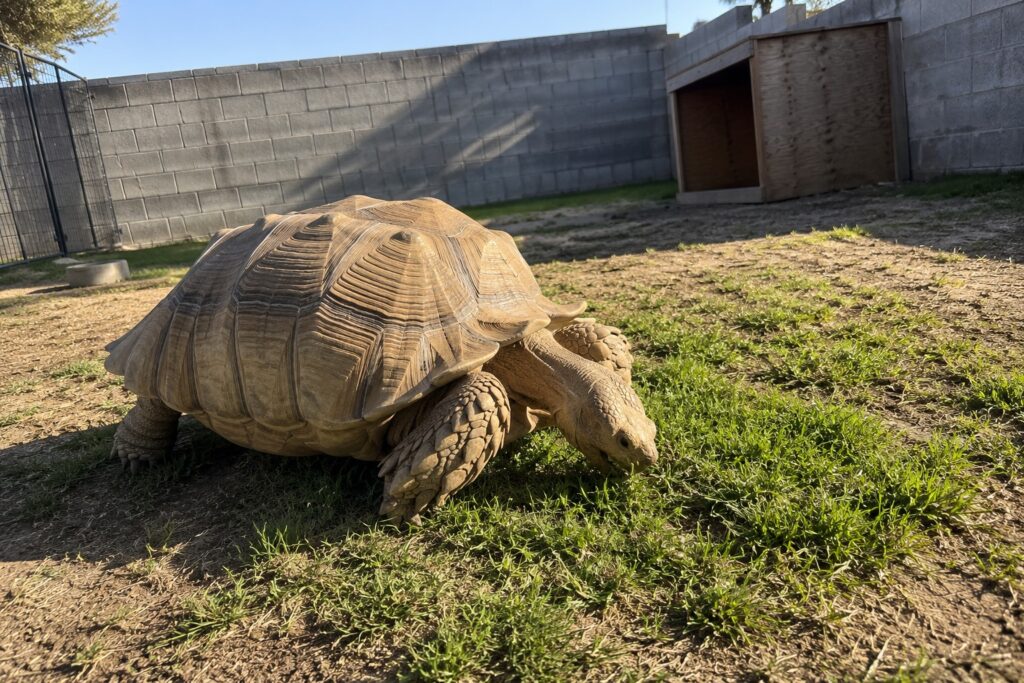
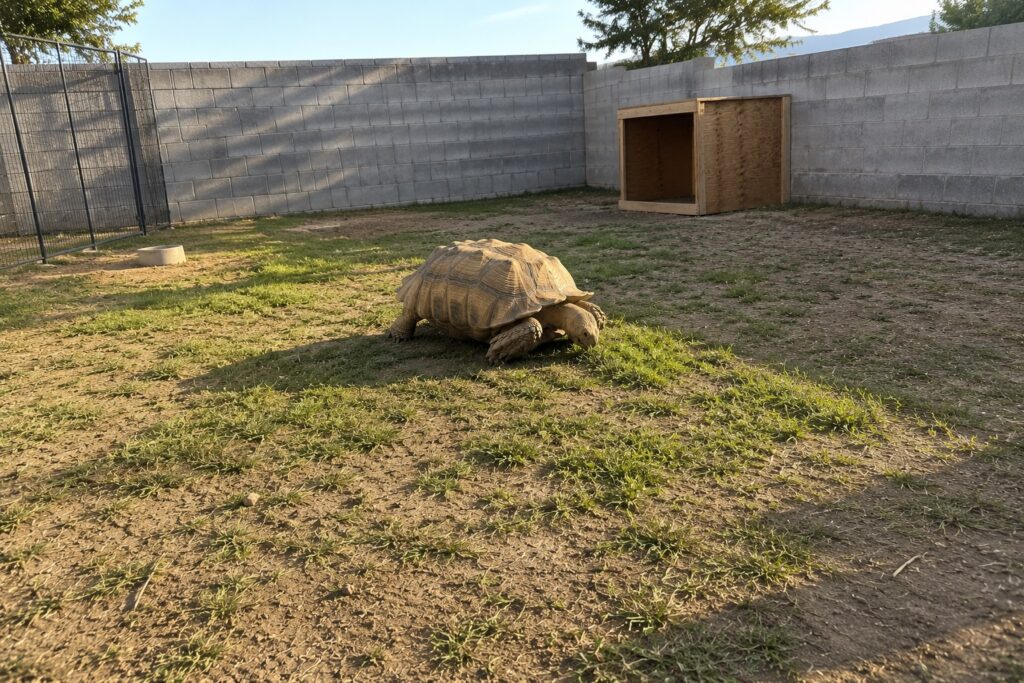
The specifics matter more than most people realize. Walls need to be solid rather than see-through, since sulcatas walk straight into anything they can see past. Barriers need to be buried, since they tunnel. Shelters need to be insulated and heated. Our sulcata tortoise enclosure guide covers the build in detail, including pen sizes, buried barrier depth, and night box construction.
One note if you’ve read about self-sustaining setups: bioactive is a poor fit here. Sulcatas eat the plants, compact the substrate, and out-produce any cleanup crew within months. Our bioactive enclosure guide explains what the approach is actually good for, and it’s smaller, humid, planted setups.
Diet: High Fiber, Low Protein, No Shortcuts
Sulcatas evolved in the Sahel eating coarse, nutrient-poor dry grasses. Their whole digestive system is built to ferment fiber slowly. Feed them like a lizard and you get pyramiding, kidney damage, and bladder stones.
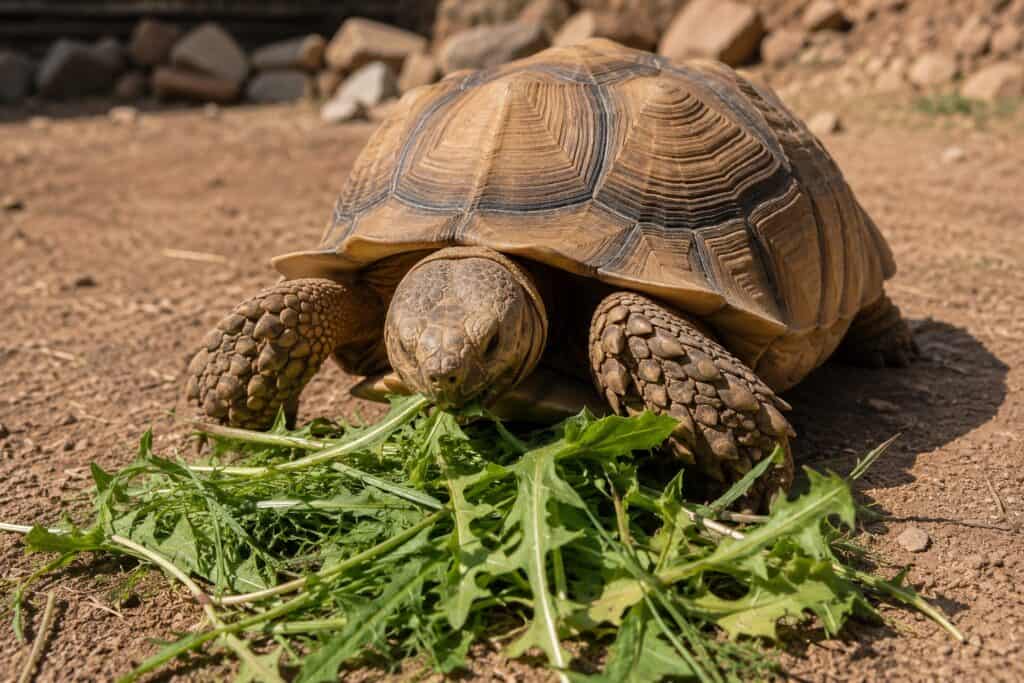
The core rules: grasses and grass hays make up the large majority of the diet, protein stays very low, fruit is essentially off the menu, and never feed animal protein of any kind. Timothy, orchard grass, Bermuda, and meadow hay are staples. Dandelion, clover, plantain, and hibiscus are good additions. Alfalfa gets avoided as a staple because of its protein and oxalate load.
Vegetables are a small side item at most, not the base. This trips people up because so much general reptile advice pushes leafy greens as the foundation. For a sulcata, greens are a garnish. The full breakdown is in our sulcata tortoise diet guide, including what to avoid and how to build a grazing area that feeds them passively.
Temperature, Light, and Humidity
Basking should reach 95 to 100F, with warm ambient around 80 to 85F and cooler shaded space to escape to. Nights should not drop below 65 to 70F, which is why the heated shelter is non-negotiable outside of genuinely warm climates. Cold, damp nights are the fastest route to a respiratory infection, and respiratory infections in sulcatas are serious.
Outdoors, natural sunlight covers UVB completely and does it better than any bulb. Indoors you need a linear T5 HO UVB fixture running a good stretch of the enclosure, swapped roughly yearly. Glass filters UVB out, so sun through a window does nothing useful.
Humidity is age-dependent and this is where a lot of sulcata tortoise care goes quietly wrong. Hatchlings and juveniles need 70 to 80% with a humid hide. Raised too dry, they pyramid, and pyramiding is permanent. Adults are comfortable in the 40 to 55% range.
Handling and Temperament
Sulcatas have a deserved reputation for being personable. They recognize their keepers, come over at feeding time, and many will tolerate having their shell scratched. They are not skittish animals.
That said, they aren’t a handling pet in the way a bearded dragon is. An adult is too heavy to lift safely, and picking one up incorrectly stresses it. Interaction mostly means being in the pen with them, offering food by hand, and letting them investigate you.
Two safety points. Never house two males together, they ram each other and a flipped tortoise in the sun can die within hours. And keep the pen free of slopes, steps, and objects they can climb and topple off, for the same reason.
Health Problems to Watch For
Pyramiding is the most visible issue and mostly reflects juvenile humidity and diet. It doesn’t reverse, but it can be stopped from worsening. Respiratory infections show up as wheezing, nasal bubbling, or puffy eyes, and need veterinary treatment rather than a heat lamp and hope. Bladder stones are common in tortoises fed too much protein or oxalate-heavy food. Shell rot appears as soft, discolored, or weeping patches, usually from a pen that stays wet.
For any of these, find a vet who actually works with chelonians through the ARAV vet directory. A general small animal practice will often be improvising with a species this size, and tortoises hide illness until it’s advanced.
Keeping Track Over Decades
Good sulcata tortoise care is mostly about noticing slow changes, and slow changes are exactly what human memory is worst at. Weight is the clearest early signal. Growth that stalls means something is wrong, and growth that’s too rapid, especially paired with dry conditions, is what drives pyramiding.
Weigh monthly and log it so you have a curve rather than a vague impression. The Exotic Reptile Care app does weight tracking with growth charts, and the reminder system is useful for the maintenance items that are easy to forget on an outdoor setup, like the yearly UVB bulb swap, seasonal shelter checks, and routine soaks for juveniles.
Is a Sulcata Right for You?
Say yes if you own your home, live somewhere warm or can build a heated shelter, have real yard space to give up, and are comfortable with a pet that may outlive you.
Say no if you rent, live in an apartment, expect to move often, or are drawn in mainly by how manageable a hatchling looks. Nothing about that is a moral failing. A Russian tortoise or a box turtle gives you most of the same appeal in a fraction of the footprint, and you’ll enjoy the animal more than you’d enjoy a sulcata you can’t properly house. If that’s where you’re landing, our box turtle enclosure guide shows what the setup actually looks like, and it fits in a spare room or a corner of the yard rather than taking over the whole thing.
FAQ: Sulcata Tortoise Care Questions
How long do sulcata tortoises live?
Fifty to eighty years is typical in captivity, and longer is well documented. Plan for the animal to outlive your current living situation, and ideally arrange who takes it if it outlives you.
How big do sulcata tortoises get?
Adults commonly reach 24 to 36 inches of shell length and 70 to 150 pounds, with large males going past 200 pounds. Photos of adults regularly look fake to people who’ve only seen hatchlings.
Can sulcata tortoises live in cold climates?
They can, but only with a heated, insulated indoor shelter for the cold months. They are a semi-arid African species and sustained cold and damp causes respiratory illness quickly.
Do sulcata tortoises need a companion?
No. They’re fine alone and often better off. Two males will fight, and even mixed pairs need substantial space with multiple shelters to avoid conflict.
What do sulcata tortoises eat?
Grasses and grass hays make up the bulk of the diet, supplemented with edible weeds and flowers. Protein stays very low, fruit is avoided, and animal protein is never appropriate.
If you take one thing from this: sulcata tortoise care isn’t hard, it’s just big. The daily routine is simpler than most reptiles. It’s the decade-scale planning that separates the keepers whose tortoises thrive from the ones making a call to a rescue three years in.