Most box turtle enclosure problems come from one wrong assumption: that a box turtle is a small tortoise. It isn’t. Box turtles are woodland animals from humid forest floors, and they need moisture levels that would give a Russian tortoise a respiratory infection. Keep one in a dry setup with a heat lamp and shallow substrate and it will slowly decline for years before anything obvious goes wrong.
Get the humidity and the substrate depth right and box turtles are hardy, long-lived, and genuinely rewarding animals. Those two things do most of the work. This guide is the enclosure half of the job. Temperature, diet, brumation, and the health problems that show up in year three are covered in our box turtle care guide.
| Requirement | Indoor | Outdoor |
|---|---|---|
| Minimum size (one adult) | 4×2 feet | 4×4 feet |
| Recommended size | 6×3 feet or larger | 8×8 feet or larger |
| Substrate depth | 4 to 6 inches | Natural soil, dug over |
| Humidity | 60 to 80% | Ambient, plus misting |
| Basking surface | 85 to 90F | Natural sun with shade |
| Wall height | Solid sides | 12 to 18 inches with overhang |
| Buried barrier | Not applicable | 6 to 12 inches down |
Outdoor Is Better, and It Isn’t Close
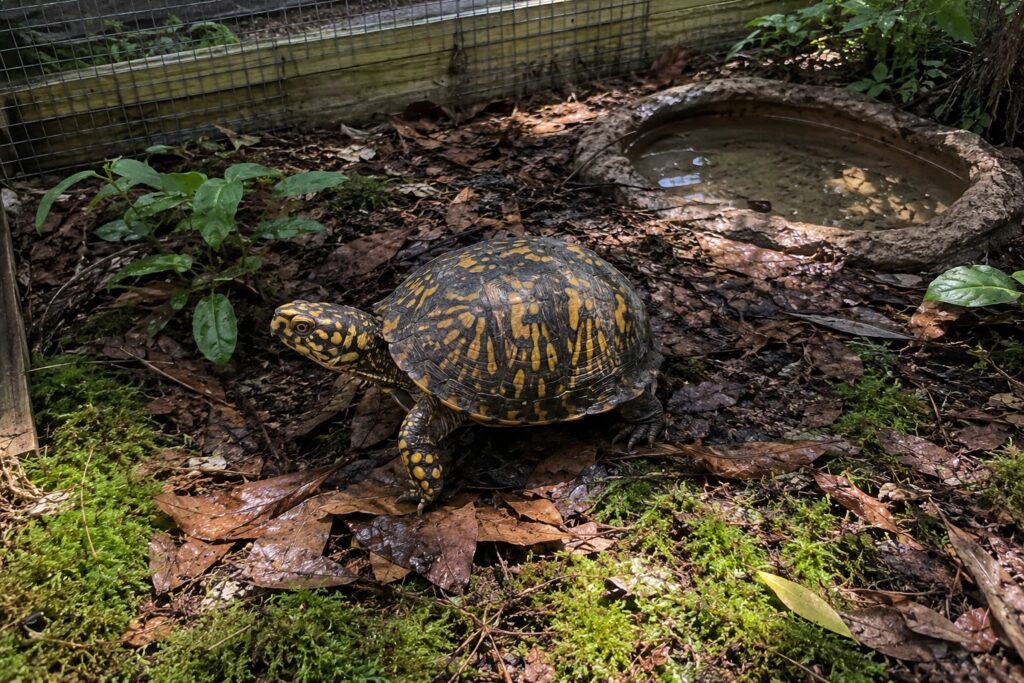
If you live anywhere with a climate remotely similar to the box turtle’s native range, an outdoor pen beats any indoor setup you can build. Natural sunlight provides better UVB than any bulb, natural rainfall and soil hold humidity without effort, and the space lets a turtle behave like a turtle.
A minimum outdoor box turtle enclosure is 4 by 4 feet for a single adult, and that’s genuinely minimal. Eight by eight gives you room for planting, shade, and a proper water feature. There’s no upper limit that’s too generous.
Walls need to be solid and 12 to 18 inches tall, with an inward-facing lip along the top. Box turtles climb better than people expect, and a smooth wall with no overhang gets scaled eventually. Sink the barrier 6 to 12 inches into the ground, since they dig.
The part people forget is the top. Raccoons, dogs, rats, and large birds all kill box turtles, and raccoons in particular will reach through wire and take limbs. Cover the pen with sturdy mesh. This is the same principle as the buried-barrier and solid-wall approach in our sulcata tortoise enclosure guide, scaled down and with predators as the bigger concern rather than escape.
Plant it heavily. Low shrubs, hostas, ferns, and tall grasses give cover and shade. Add a thick layer of leaf litter, which is where box turtles spend a surprising amount of their time. Sink a shallow water dish flush with the ground, deep enough to soak in and shallow enough to climb out of easily.
Indoor Box Turtle Enclosure Size and Materials
For winter housing or year-round indoor keeping, four by two feet is the floor for one adult and six by three is much better. Floor space is what matters. These animals walk.
Skip glass aquariums. Box turtles pace transparent walls relentlessly, wearing down their beak and the front of their shell trying to walk through. If you must use glass, back three sides with an opaque material.
Better options are a wooden tortoise table, a plastic stock tank, a large storage tub, or a purpose-built plywood box sealed with a safe waterproof finish. All of them hold humidity better than glass with a screen top, which is the setup that dries out fastest.
Open topped is fine indoors as long as the sides are tall enough, roughly 16 inches. Box turtles can’t climb smooth vertical walls, but they will climb a hide placed too close to the edge, so watch your layout.
Substrate and Humidity
Deep and damp. Four to six inches minimum, and more is better.
A good mix is organic topsoil with coconut coir, plus sphagnum moss and a layer of dry leaf litter on top. One consequence of substrate that deep: don’t feed on it. Box turtles take a mouthful of whatever sits under the food, and repeated soil or bark going down is an impaction risk. Use a slate tile or flat slab, and our guide to what box turtles eat covers what belongs on it. The turtle should be able to bury itself completely. Burrowing is normal behavior, not a sign something is wrong, and a turtle with nowhere to dig is a stressed turtle, Arid tortoises dig just as hard for the opposite reason, so the substrate looks similar and behaves completely differently – the enclosure a Russian tortoise needs is deep but dry, with one damp corner rather than damp all the way through.
Humidity should sit at 60 to 80 percent for eastern, three-toed, Gulf Coast, and Florida box turtles. Mist daily, keep a large water dish, and let the substrate stay damp underneath while the top layer dries slightly. Ornate and desert box turtles are the exception, coming from drier grassland and preferring 40 to 60 percent.
Chronic low humidity causes shell pyramiding, eye problems, and kidney damage. It’s the single most common failure in box turtle keeping and it’s invisible until it isn’t. If you keep multiple species, our reptile temperature and humidity guide lists the correct ranges side by side.
Box turtles are also one of the better candidates for a bioactive setup, since they want exactly the deep, damp, planted substrate that a cleanup crew thrives in. Our bioactive enclosure guide covers how to build one, with the caveat that a box turtle will eat your isopods, which is fine.
Heat and Lighting
Basking surface should read 85 to 90F. That’s cooler than most reptile setups, and it matters, because box turtles overheat easily and a lamp sized for a bearded dragon will cook one. Ambient should sit at 70 to 80F with a genuine cool retreat around 70. Nights can drop to 65 to 75F with no supplemental heat needed in most homes.
Use an overhead halogen or incandescent flood on a dimming thermostat, positioned over one end. Measure the surface with an infrared temp gun rather than trusting a dial thermometer.
UVB is required indoors. A linear T5 HO tube at 5 or 6 percent, running across a good portion of the enclosure length, replaced every 12 months. Outdoors in real sun you need nothing, since unfiltered sunlight beats any bulb and glass blocks UVB entirely.
Water
Box turtles need more water than tortoises. Provide a shallow dish large enough for the turtle to sit in completely, with water reaching about chin height when it’s standing. Too deep is a drowning risk, since box turtles are poor swimmers.
Change it daily. They defecate in water routinely, and a fouled dish becomes a bacterial problem fast. Sink it flush with the substrate so the turtle can walk in rather than climb.
Many keepers also soak their turtles in shallow lukewarm water a couple of times a week, which helps hydration and encourages defecation outside the enclosure.
Health Problems That Trace Back to the Enclosure
Most box turtle illness is a husbandry symptom. Respiratory infections come from temperatures that are too cool, showing as wheezing, bubbling from the nose, and open-mouth breathing. Shell rot appears as soft, discolored, or weeping patches, usually from substrate that stays soaking wet rather than merely damp. Ear abscesses, visible as a swelling on the side of the head, are strongly associated with vitamin A deficiency and poor conditions. And metabolic bone disease follows missing UVB.
Any of those need a vet who works with chelonians. Use the ARAV vet directory rather than a general small animal practice, since turtle medicine is a specialty and problems are usually advanced by the time they’re visible.
One legal note. Box turtles are native North American species and most US states protect them. Collecting a wild box turtle is illegal in many places, and releasing a captive one back into the wild is both illegal and harmful, since it can introduce disease into wild populations. Buy captive bred.
Keeping the Setup on Track
The maintenance items that slip on a box turtle enclosure are predictable: the annual UVB replacement, checking substrate moisture below the surface rather than on top, and the outdoor perimeter check for fresh digging.
Weight is the early warning system here. Box turtles hide illness well, and a turtle that’s dropping weight over two months looks identical to one that isn’t. The Exotic Reptile Care app logs weight with growth charts and handles custom reminders for the maintenance tasks, which is more reliable than intending to remember when you last replaced the bulb.
If you came here from researching larger chelonians and are reconsidering, that’s a reasonable outcome. Box turtles give you a lot of what makes a sulcata tortoise appealing in an animal that fits a normal yard.
FAQ: Box Turtle Enclosure Questions
How big should a box turtle enclosure be?
Indoors, 4 by 2 feet is the minimum for one adult and 6 by 3 is better. Outdoors, 4 by 4 feet minimum with 8 by 8 or larger recommended.
Can box turtles live in a glass tank?
Not well. They pace transparent walls constantly, which causes stress and physical wear on the beak and shell. Use a tortoise table, stock tank, or opaque-sided enclosure instead.
What humidity do box turtles need?
Sixty to eighty percent for eastern, three-toed, Gulf Coast, and Florida box turtles. Ornate and desert box turtles prefer a drier 40 to 60 percent.
Do box turtles need a heat lamp?
Indoors yes, with a basking surface of 85 to 90F. That’s cooler than most reptiles, and overheating is a real risk with a lamp sized for a desert species.
Can box turtles live outside year round?
In climates similar to their native range, yes, with a properly built pen and a place to brumate. In colder regions they need indoor housing for winter.
How deep should box turtle substrate be?
Four to six inches minimum, deeper if you can. The turtle should be able to bury itself completely, since burrowing is normal daily behavior.
If you build only one thing well, make it the substrate. Deep, damp, and planted solves humidity, gives the turtle somewhere to burrow, and prevents most of the chronic problems that show up years later in a box turtle enclosure that looked fine the whole time.