Russian tortoise care is the most beginner-friendly entry point in the tortoise world, and it’s the species I recommend to anyone who wants a tortoise but doesn’t have a yard to hand over. They stay small, they’re active and curious, they eat weeds you can pull out of the ground for free, and they’ll outlive most of the furniture in your house.
The catch is that a lot of what gets sold as beginner-friendly advice is wrong for this species. Fruit, commercial pellets, glass tanks, and shallow substrate are all common recommendations and all cause problems. Get the diet and the digging space right and the rest is genuinely simple.
| Russian Tortoise Basics | What to Expect |
|---|---|
| Adult size | 6 to 10 inches, females larger |
| Lifespan | 40 to 50 years, often longer |
| Indoor enclosure | 4×2 feet minimum, 6×3 better |
| Outdoor pen | 4×8 feet minimum |
| Basking surface | 95 to 100F |
| Cool end | 70 to 75F |
| Humidity | 40 to 60% |
| Diet | Weeds and leafy greens, no fruit, no protein |
| Housing | One per enclosure, especially males |
What You’re Actually Getting
Russian tortoises come from the dry steppe and semi-desert of Central Asia, across Uzbekistan, Kazakhstan, Afghanistan, and neighboring regions. That environment shapes everything about their care: they’re built for arid conditions, extreme temperature swings, sparse high-fiber vegetation, and long periods underground.
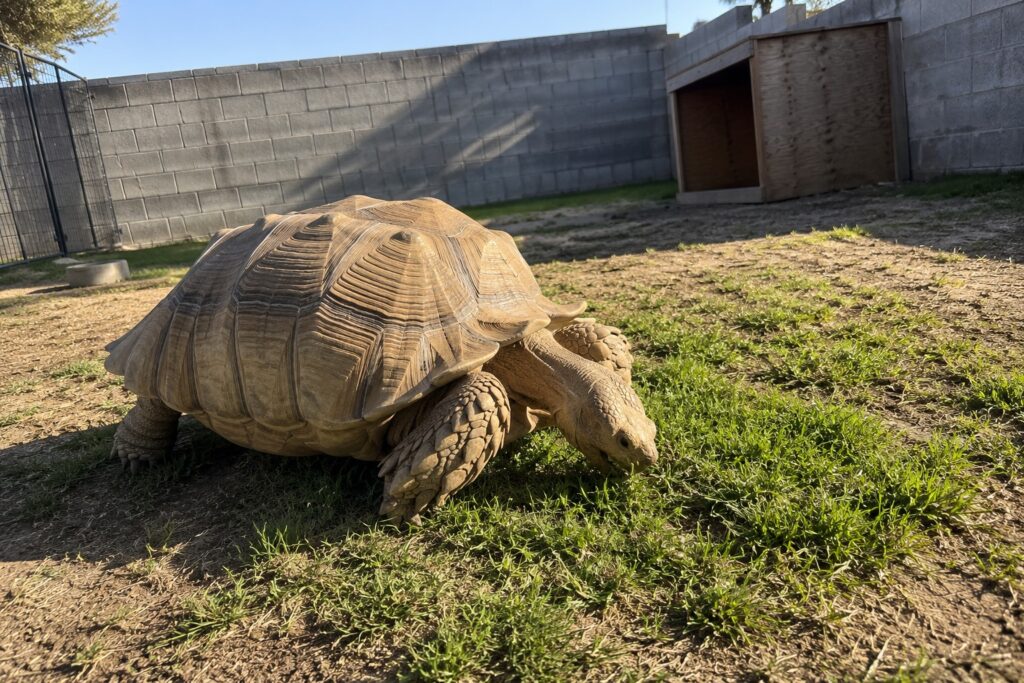
They’re small, topping out around 6 to 10 inches, with females larger than males. Compared to the sulcata tortoise, which reaches 24 to 36 inches and over 100 pounds, this is an animal that fits a normal home. Box turtles get suggested in the same breath and they’re a different animal entirely. They want damp substrate and 60 to 80 percent humidity, which is close to the opposite of what a Russian tortoise needs, and they routinely pass fifty years. Worth reading what keeping a box turtle actually involves before deciding between the two.
They’re also personable in a way that surprises people. Russian tortoises are active, food-motivated, and will follow you around a room. They’re not a handling pet, but they’re a genuinely engaging one to watch.
Lifespan is 40 to 50 years minimum, with well-kept animals going considerably longer. That’s a smaller commitment than a sulcata and still a serious one.
The Wild-Caught Problem
This deserves saying up front because it affects a large share of Russian tortoises in the pet trade. Many imported animals are wild caught rather than captive bred, and they arrive dehydrated, stressed, carrying heavy parasite loads, and frequently with respiratory infections.
Signs to watch for: sunken eyes, visible weight for size, nasal discharge, wheezing, closed or crusted eyes, and a tortoise that shows no interest in food. A cheap adult Russian tortoise at a chain store is often an import.
Buy captive bred from a breeder if you possibly can. If you already have a wild-caught animal or want to take one on, budget for a vet visit with a fecal exam in the first week. Use the ARAV vet directory to find someone who treats chelonians, since parasite loads need proper identification rather than guesswork.
Enclosure Setup
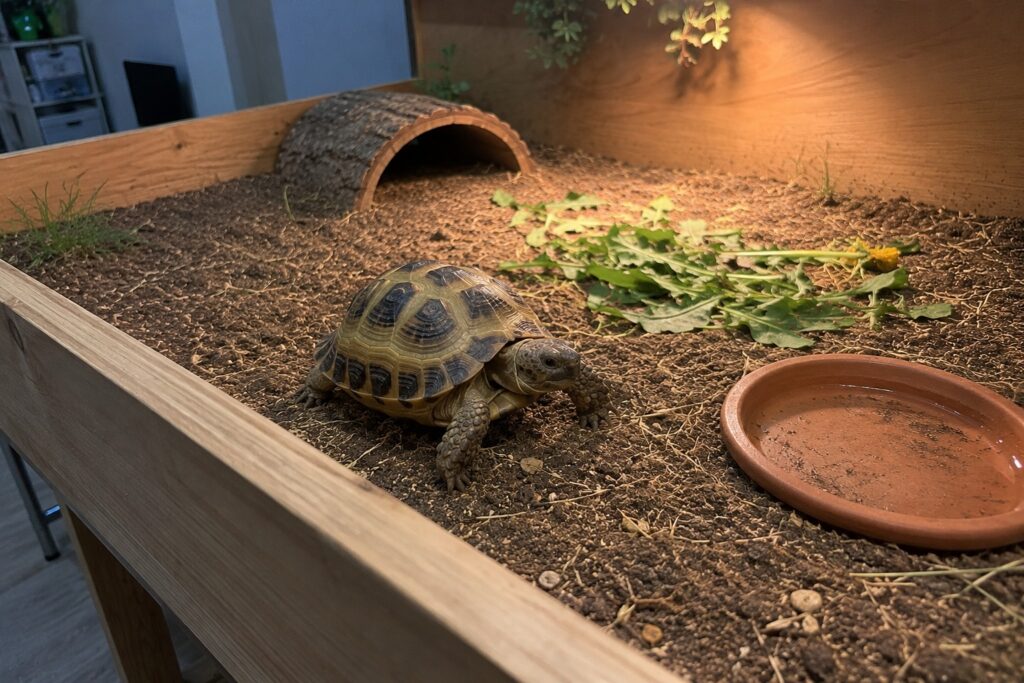
Indoors, four by two feet is the minimum for one adult and six by three is meaningfully better. An open-topped tortoise table beats a glass tank every time. Russian tortoises walk into glass repeatedly trying to get through it, which causes stress and wears down the front of the shell and beak. The same logic applies here as in our box turtle enclosure guide, though the humidity requirements between the two species are opposite.
Substrate should be four to six inches deep, minimum. This is not optional with Russian tortoises. They are exceptional diggers, arguably the most dedicated burrowers of any commonly kept tortoise, and a tortoise with nowhere to dig will pace and stress. Use a mix of organic topsoil and play sand, roughly 70:30, or add coconut coir.
Outdoors is excellent if your climate allows, with a minimum pen of 4 by 8 feet. Walls should be solid rather than see-through and at least 12 inches high. Sink a barrier 12 inches into the ground, because they will tunnel out, and check the perimeter regularly for fresh digging.
Add a hide, some flat rocks, and low plants for cover. Keep the layout away from anything climbable near a wall, since a tortoise that climbs and flips onto its back can die if it happens in direct sun.
Housing deserves more detail than fits here. Our Russian tortoise enclosure guide covers sizing, substrate depth, and escape-proofing.
Temperature, Light, and Humidity
Basking surface should read 95 to 100F, measured on the surface with an infrared temp gun rather than in the air. Ambient warm end sits at 75 to 85F, cool end at 70 to 75F. Nights can drop to 65 to 75F with no supplemental heat in most homes.
Use an overhead halogen flood on one end. Skip heat rocks entirely, since tortoises sit still long enough to get burned badly.
UVB is essential indoors. Use a linear T5 HO tube at 10 to 12 percent, appropriate for a desert species, running across a good portion of the enclosure. Replace it yearly even while it still lights up. Without it, calcium absorption fails and you get metabolic bone disease, which veterinary references describe as the most common bone disorder in pet reptiles.
Humidity should sit around 40 to 60 percent, which is drier than most reptiles and much drier than a box turtle. Hatchlings are the exception and benefit from a humid hide to prevent shell pyramiding during their fastest growth. If you keep several species, our reptile temperature and humidity guide has the ranges side by side.
Russian Tortoise Care: Diet
Strictly herbivorous, high fiber, low protein, essentially no fruit. This is where most keepers go wrong.
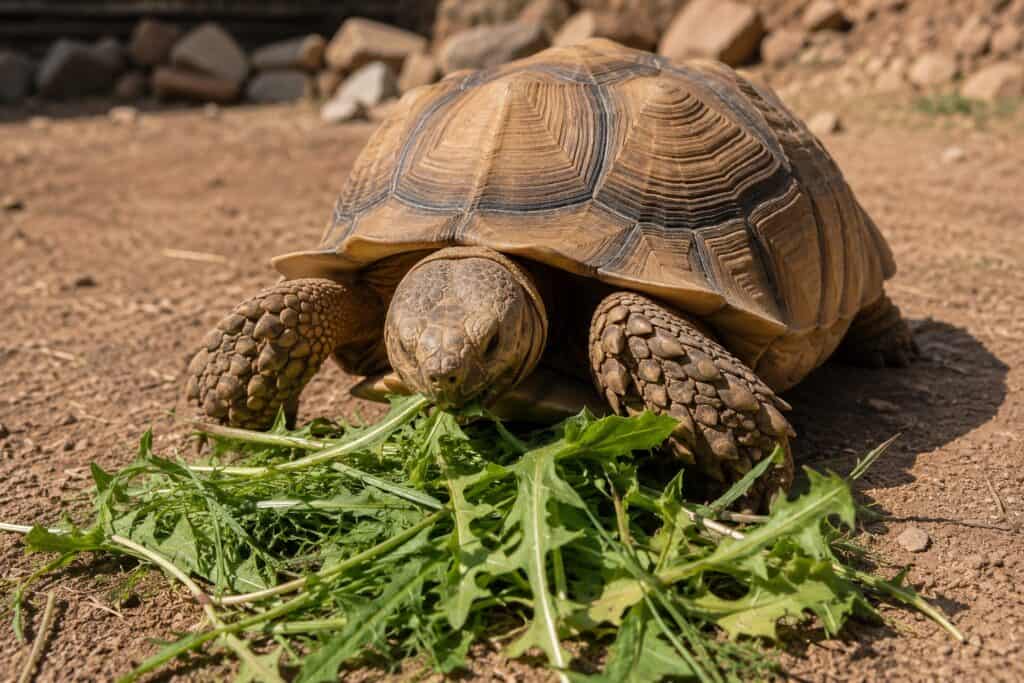
Build the diet on weeds and leafy greens. Dandelion, plantain weed, clover, chicory, sow thistle, and hibiscus flowers and leaves are all excellent and mostly free. For store-bought, use endive, escarole, collard greens, mustard greens, turnip greens, and radicchio.
Avoid iceberg lettuce, which has no nutritional value. Go easy on spinach and kale for oxalate and goitrogen reasons. Skip fruit entirely or offer it maybe twice a year, since the sugar disrupts gut flora in a species that never encounters it naturally. Never feed animal protein of any kind, and don’t use commercial pellets as a staple.
The reasoning is the same high-fiber, slow-fermentation logic covered in our sulcata tortoise diet guide. Too much protein and sugar produces rapid, lumpy growth, pyramiding, and eventually kidney and bladder problems.
Feed juveniles daily. Adults do well on food five or six days a week with a fasting day. Dust with calcium powder a few times a week and a multivitamin weekly.
Keep a shallow water dish available, no deeper than the bridge of the shell, changed daily. For the full weed list, portion sizes, and how to wean a tortoise off lettuce or fruit, see our Russian tortoise diet guide. Soak juveniles in shallow lukewarm water once or twice a week.
Brumation
Russian tortoises brumate naturally, typically for 8 to 12 weeks. Healthy adults benefit from it, and many keepers report better long-term health and breeding behavior in animals that brumate.
It’s not something to improvise. A tortoise going into brumation needs to be at a good weight, free of illness, and fully cleared of food in the gut, which means fasting and warm soaks for a couple of weeks beforehand. Temperatures need to hold steady around 40 to 50F. A vet check before the first brumation is worth doing.
If you’re not confident, keeping a Russian tortoise awake year round with consistent heat and light is a perfectly acceptable alternative. Skipping brumation is far safer than doing it badly.
Tracking a Forty Year Commitment
Russian tortoise care problems develop over months and years, not days. Pyramiding, slow weight loss from parasites, and gradual overfeeding are all invisible at daily scale.
Weigh monthly and log it. A tortoise losing weight over eight weeks has something wrong that’s worth investigating before it becomes visible. This matters most in the first year with a wild-caught animal, when parasite loads are working against them. The Exotic Reptile Care app plots weight over time and handles reminders for the things that slip, like the annual UVB replacement and weekly multivitamin dusting.
FAQ: Russian Tortoise Care Questions
How big do Russian tortoises get?
Six to ten inches, with females larger than males. They’re one of the smallest commonly kept tortoise species.
How long do Russian tortoises live?
Forty to fifty years is typical, and well-kept animals can exceed that considerably. Plan for it to outlast most of your major life changes.
What do Russian tortoises eat?
Weeds and leafy greens, high in fiber and low in protein. Dandelion, plantain, clover, endive, escarole, and collard greens are staples. No fruit, no animal protein, no pellets as a main food. Box turtles are the opposite case and often get fed on the same advice by mistake, they need protein and real fruit, laid out in our box turtle feeding guide.
Can Russian tortoises live together?
House them singly. Males are territorial and will ram and bite each other, and a male kept with a female will often harass her constantly. Multiple animals need substantial space and multiple hides.
Do Russian tortoises need to brumate?
Not strictly. Healthy adults benefit from it, but keeping one awake year round with stable heat and light is safe. Don’t attempt brumation with an underweight or unwell tortoise.
What size enclosure does a Russian tortoise need?
Indoors, 4 by 2 feet minimum with 6 by 3 preferred. Outdoors, at least 4 by 8 feet with a buried barrier, since they dig persistently.
The two things that decide how well russian tortoise care goes are substrate depth and what’s in the food dish. Give them somewhere to dig and feed them like the weed-eating steppe animals they are, and you’ll have a tortoise in good shape decades from now.