You set up a nice tall tank, put the new gargoyle in, and then you basically never see it again. Food disappears slowly or not at all, and you’re left guessing. That’s usually not a shy gecko. It’s a gargoyle gecko enclosure that’s slightly off, often too big for a juvenile, too bare, or a few degrees too warm. The good news is that the fixes are simple, and once the setup is right these geckos come out every evening and use the whole space.
This guide covers the right size at each age, the numbers to hit, how to furnish it, and five signs your gargoyle gecko enclosure is causing problems.
Gargoyle Gecko Enclosure Quick Specs
An adult gargoyle gecko needs a front opening enclosure of at least 18 x 18 x 24 inches, temperatures of 72 to 78°F that never go above 82°F for long, 60 to 80% humidity with a daily dry-down, and dense climbing cover from floor to ceiling.
| Parameter | Target |
|---|---|
| Adult enclosure | 18 x 18 x 24 inch minimum, taller is better |
| Juvenile enclosure | 12 x 12 x 18 inches until about 15 g |
| Day temperature | 72 to 78°F |
| Night temperature | 65 to 72°F |
| Upper limit | Nothing above 82°F for long |
| Humidity | 60 to 80%, dry-down between mistings |
| UVB | Optional, low output T5 5 to 6% |
| Substrate | Coco coir, cypress mulch, or bioactive soil |
| Housing | One gecko per enclosure |
What Size Gargoyle Gecko Enclosure Do You Need?
Height matters more than floor space, because gargoyles are arboreal and spend the night climbing. But bigger isn’t automatically better for young geckos.
| Stage | Weight | Enclosure |
|---|---|---|
| Hatchling and juvenile | Under about 15 g | 12 x 12 x 18 inches or a ventilated tub |
| Subadult | 15 to 35 g | 18 x 18 x 24 inches |
| Adult | 45 to 65 g | 18 x 18 x 24 minimum, 18 x 18 x 36 better |
A hatchling dropped into an adult-sized gargoyle gecko enclosure struggles to find its food dish and hides constantly, and that’s how juveniles quietly lose weight. Start small and move up once the gecko passes about 15 grams and is eating reliably.
For an adult, 18 x 18 x 24 works, but I’d go for 18 x 18 x 36 if your room and budget allow. Gargoyles are more active than they get credit for, and they jump. Extra height gives them space to move without bouncing off the glass. A 20 gallon tall tank can work as a fallback for a small adult, the same as for crested geckos, but a purpose-built front opening terrarium is the better buy.
If you’re interested in the family’s giant, the leachie gecko, it needs the same layout at roughly double the size.
Glass, PVC, or Screen?
Front opening glass terrariums are the standard gargoyle gecko enclosure, and they work well. Front doors let you reach in at the gecko’s level instead of from above, which matters for an animal that bolts upward when startled. Glass also holds humidity without much effort.
PVC enclosures hold humidity even better and keep the room temperature out, which helps in a warm house. They cost more and you’ll need to mount any lighting inside.
Skip full screen cages. They dry out too fast for a gargoyle and you’ll be fighting humidity every day. If you’re using a glass tank with a screen top, cover about half to three quarters of the screen to hold moisture in.
Heat, Light, and Humidity Inside the Enclosure
Gargoyles are cool-climate geckos, so the job of the enclosure is to stay cool, not warm. Keep it at 72 to 78°F by day and let it drop to 65 to 72°F at night. Sustained temperatures above 82°F cause heat stress, and 85°F and up can be fatal. Most homes already sit in the right range with no heating at all.
Only add heat if your room stays below about 68°F. A low wattage ceramic heat emitter or deep heat projector on a thermostat is the safe choice. Don’t use a heat mat, since a climbing gecko barely touches the floor. The opposite problem is more common, though. A tank near a sunny window or in a hot upstairs room can climb into the mid 80s on a summer afternoon, and that’s the real danger. Put a digital thermometer probe up near the top, where the gecko sleeps, not just at the bottom.
UVB isn’t strictly required with a good powdered diet, but a low output 5 to 6% T5 tube across the top supports calcium absorption and gives a clear day and night cycle. Run it on a 12 hour timer, and make sure there are shaded spots so the gecko can move out of it.
Humidity should cycle. Mist heavily in the evening so the enclosure jumps up toward 80%, then let it dry down during the day toward 60%. That wet night and drier day is what keeps sheds clean without letting the substrate turn sour. A digital hygrometer at mid height gives you a reading that actually means something.
Furnishing a Gargoyle Gecko Enclosure
A bare enclosure is the fastest way to get a gecko that hides all day. Fill the space so the gecko can cross from top to bottom without ever being out in the open.
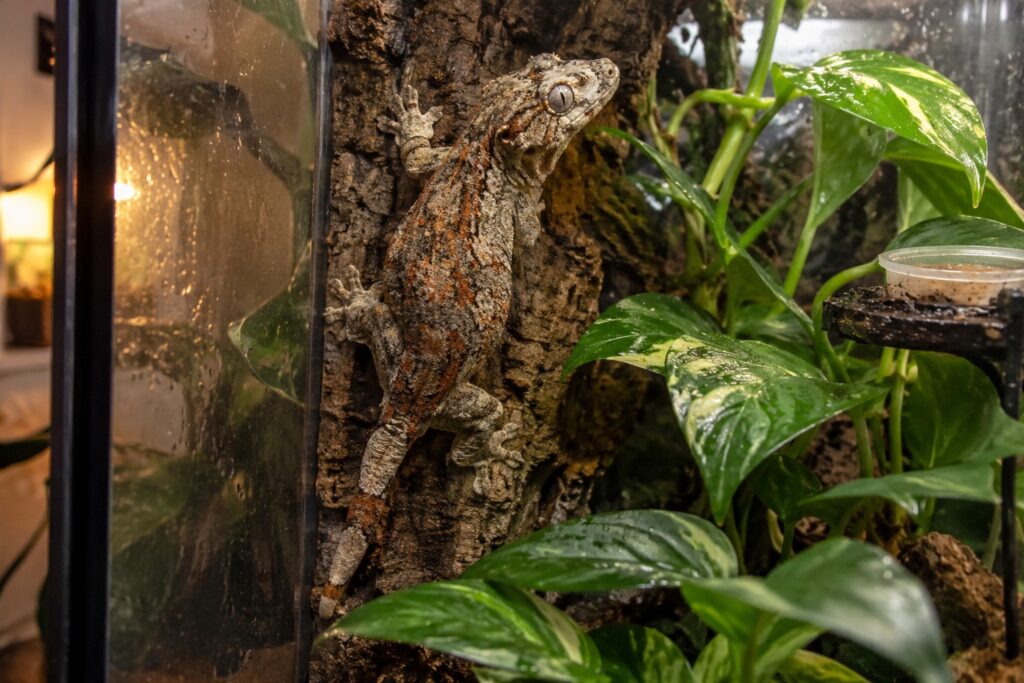
Start with cork. Cork bark rounds mounted vertically and cork flats on the back wall give gargoyles their favorite grip surface. Add sturdy branches running diagonally and horizontally at several heights, and plenty of foliage. Pothos, dracaena, and bromeliads all handle a chunky gecko climbing on them, and artificial vines fill gaps while live plants grow in.
Give it at least two hides, one up high and one lower down. A cork tube wedged near the top is often where a gargoyle spends the day. Mount a feeding ledge about two thirds of the way up, since gargoyles rarely come to the floor to eat. A shallow water dish on the floor is still worth having, even though most drinking happens from misted droplets.
For substrate, use 2 to 3 inches of coco coir, cypress mulch, or a soil mix that holds moisture without staying soggy. Gargoyles do very well in a bioactive setup with a proper drainage layer, live plants, and a cleanup crew of springtails and isopods. It holds humidity more steadily and breaks down waste you’d otherwise miss. Paper towel is fine for quarantine or for a new gecko you’re watching closely.
One Gecko Per Enclosure
This isn’t negotiable. Gargoyles are more aggressive toward each other than crested geckos, and shared enclosures end in bitten tails, missing toes, and open wounds, usually at night while you’re asleep. Even a big, densely planted tank doesn’t stop it. If you have two, they need two enclosures. Our gargoyle gecko care guide covers why mixed pairs are a problem too.
5 Signs Your Gargoyle Gecko Enclosure Is Wrong
A gargoyle can’t tell you the setup is off, but it shows you. If something here sounds familiar, work through it in this order.
1. You never see the gecko. Some hiding by day is normal. A gargoyle that never comes out, even an hour after lights out, usually feels exposed. Add more cover, especially across the front half of the enclosure. If it’s a juvenile in an adult-sized gargoyle gecko enclosure, move it into something smaller until it’s past 15 grams.
2. Food is barely touched and weight is dropping. Check the temperature at the top of the enclosure first. A gecko sitting at 80°F or more stops eating long before it shows other signs. Then check the ledge. A dish on the floor or tucked behind a plant may never be found. The only honest way to judge this is weighing, since powdered diet dries out and looks half eaten either way. Weigh once a week on a gram scale and record it in the weight log in the Exotic Reptile Care app, and a slow slide shows up as a line long before you’d notice it by eye.
3. Stuck shed on the toes or tail tip. That’s a dry-down that’s too harsh or a misting schedule that’s slipping. Mist more heavily in the evening, add a damp moss patch or humid hide, and check the hygrometer reading after the overnight spike. Stuck shed on toes can cut off blood flow, so don’t leave it.
4. Mold, a musty smell, or clicking breath. The enclosure is staying too wet. Cut back to one heavier misting a day, open part of the screen for more airflow, and replace any soggy substrate. Wheezing, clicking, or bubbles at the nose point to a respiratory infection, which needs a reptile vet rather than more fiddling with the setup.
5. Nipped toes or tail on a gecko that lives alone. Look at the feeders. Crickets left in overnight chew on sleeping geckos, and gargoyles get bitten more than you’d think. Offer insects in a dish or with tongs, and remove any that aren’t eaten within a few hours.
Frequently Asked Questions
What size enclosure does a gargoyle gecko need?
An adult needs at least 18 x 18 x 24 inches, front opening, and 18 x 18 x 36 is better. Juveniles under about 15 grams do better in 12 x 12 x 18 inches or a ventilated tub.
Do gargoyle geckos need a heat lamp?
Usually not. They do best at 72 to 78°F, which most homes hold naturally. Only add a low wattage ceramic heat emitter on a thermostat if your room stays below about 68°F.
Do gargoyle geckos need UVB?
It isn’t strictly required with a complete powdered diet, but a low output 5 to 6% T5 tube is worth adding. It helps calcium absorption and gives a steady day and night rhythm.
Can two gargoyle geckos live in the same enclosure?
No. They bite each other’s tails and toes, often badly. Keep one gecko per enclosure.
Is a bioactive enclosure good for gargoyle geckos?
Yes. A planted bioactive setup holds humidity steadily, handles waste, and gives a gargoyle plenty of cover. Just make sure it has a drainage layer so the substrate doesn’t stay soggy.
Get the size right for the gecko’s age, keep the top of the tank cool, cycle the humidity, and pack in more cover than you think you need. A good gargoyle gecko enclosure doesn’t have to be fancy, and when it’s right you’ll see your gecko out on the cork every evening instead of wondering if it’s still in there.