African house snake care is about as easy as snake keeping gets, with one catch. These snakes never say no to food. A house snake will hit a mouse the day after its last meal, come to the glass every time you walk past, and look convinced it’s starving. New keepers take that as a sign to feed more, and that’s how a slim, active snake turns into an obese one within a year or two.
This guide covers the setup numbers, feeding by age and sex, and four signs you’re overfeeding.
African House Snake Care Quick Specs
An African house snake needs a secure enclosure, a warm spot of 86 to 90°F, a cool end of 72 to 78°F, humidity of 40 to 60%, and one appropriately sized mouse every 7 to 14 days as an adult.
| Parameter | Male | Female |
|---|---|---|
| Adult length | 2 to 2.5 feet | 3 to 4 feet |
| Minimum enclosure | 24 x 12 x 12 inches | 36 x 18 x 12 inches |
| Warm spot | 86 to 90°F | 86 to 90°F |
| Cool end | 72 to 78°F | 72 to 78°F |
| Night | 70 to 74°F | 70 to 74°F |
| Humidity | 40 to 60% | 40 to 60% |
| Adult prey | Hopper or small adult mouse | Adult mouse or rat pup |
| Adult feeding | Every 7 to 10 days | Every 10 to 14 days |
| Lifespan | 15 to 20 years | 15 to 20 years |
Like Kenyan sand boas, females are much bigger than males. A male stays thin and under about 2.5 feet for life, while a female can reach 4 feet and weigh several times as much. If you don’t know the sex of a hatchling, plan the enclosure for a female.
Setting Up an African House Snake Enclosure
House snakes are ground dwelling and active at night. They don’t need height, but they do need security and a lid that actually locks. This is a slim, strong, curious snake, and hatchlings are tiny enough to slip through cable holes, sliding door gaps, and loose screen tops. More house snakes are lost to escapes than to anything else, so check every gap before the snake goes in.
A male does fine in a 24 x 12 inch footprint. A female needs about 36 x 18. Hatchlings should start in a small, escape proof tub with ventilation holes smaller than the snake’s head.
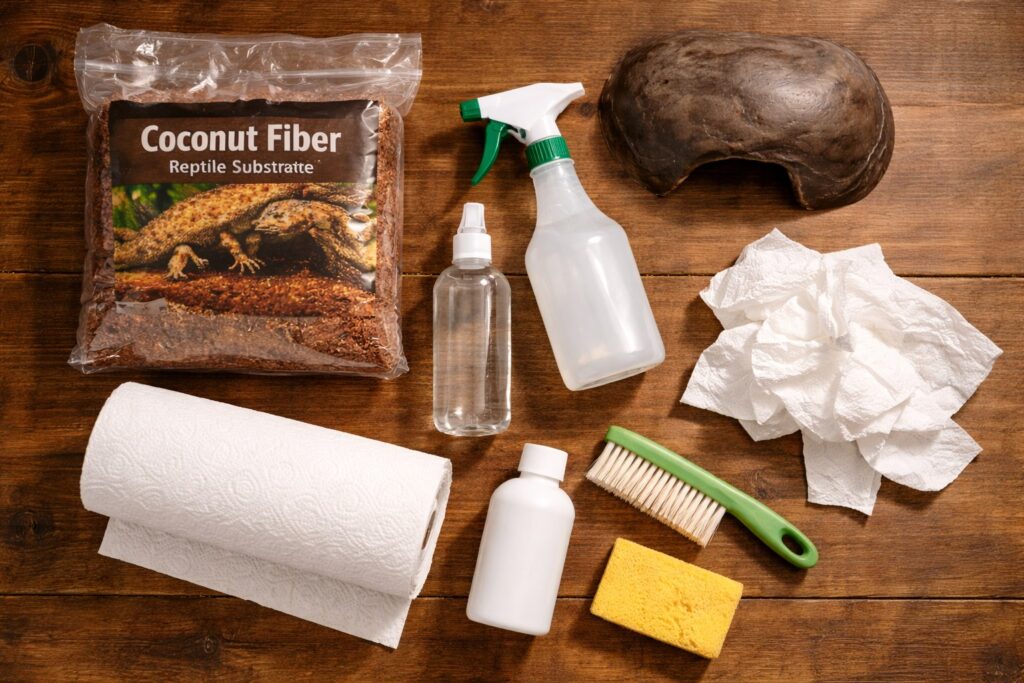
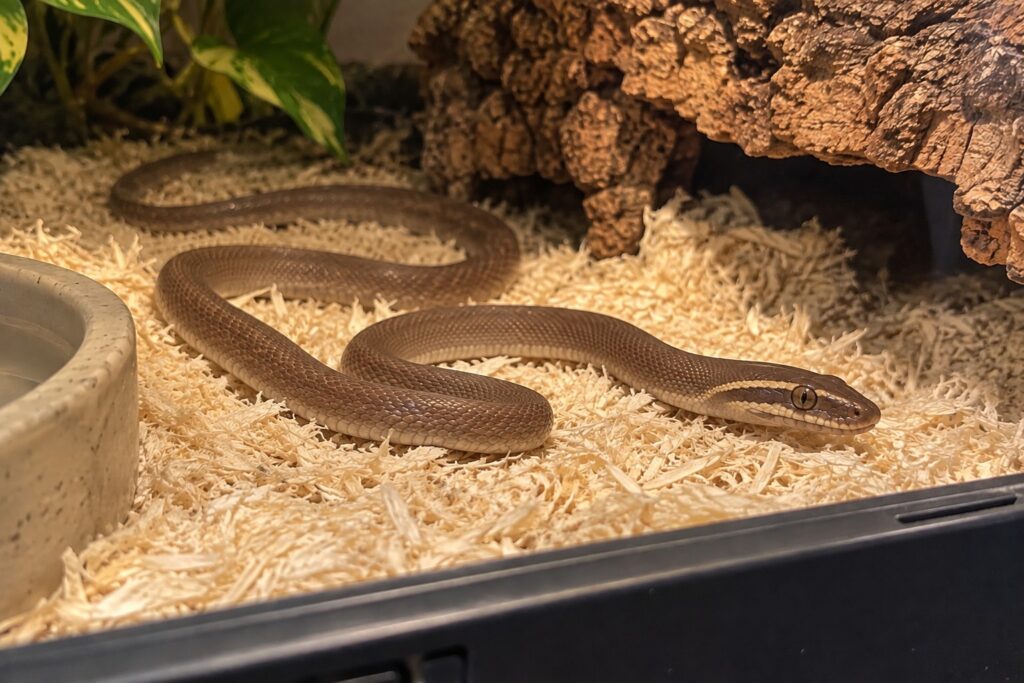
Use two snug hides, one on each end, plus a humid hide with damp sphagnum moss for shedding. Add a water bowl big enough to soak in, and some cork bark or fake plants for cover. Aspen, coconut husk, or a soil mix all work as substrate, about 2 inches deep so the snake can push under it.
Temperature and Humidity for African House Snake Care
Aim for a warm spot of 86 to 90°F and a cool end of 72 to 78°F, with nights dropping to 70 to 74°F. A heat mat under one end or a low wattage overhead bulb both work, as long as the heat source runs on a thermostat. Measure the surface where the snake rests with a digital probe or an infrared temp gun.
Humidity of 40 to 60% suits them, which is normal room humidity in most homes. The humid hide covers shedding. Lighting is optional, though a simple day and night cycle from a low output light or a nearby window helps keep their rhythm steady.
Feeding an African House Snake
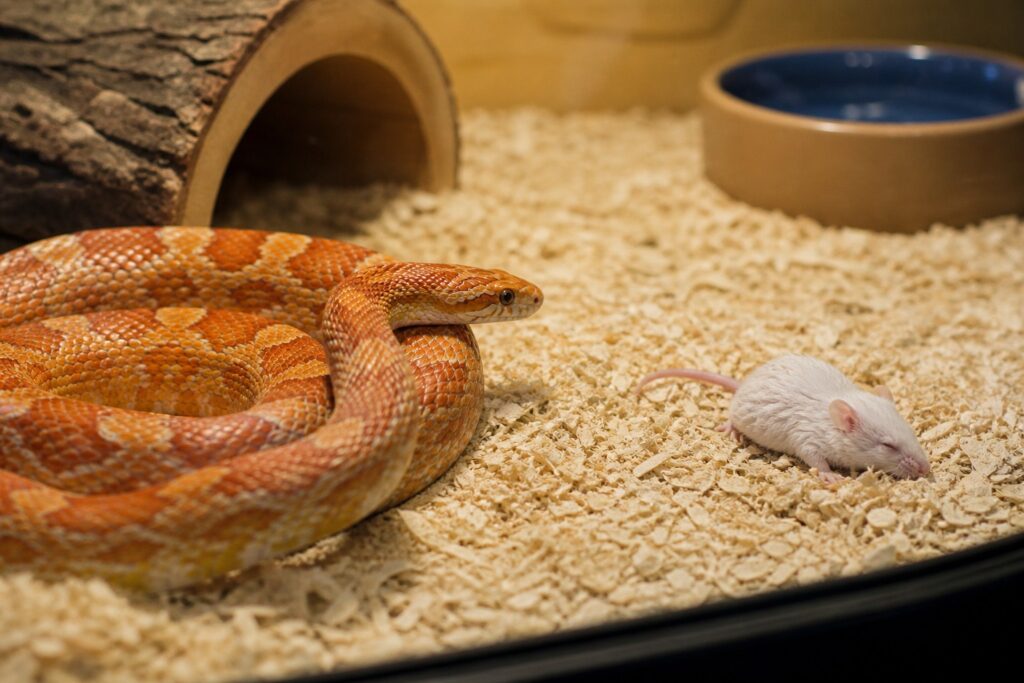
Feeding is the easy part of African house snake care. Feed frozen thawed mice, about as wide as the widest part of the snake’s body.
- Hatchlings: one pinky mouse every 5 to 7 days
- Juveniles: one fuzzy or hopper mouse every 7 days
- Adult males: one hopper or small adult mouse every 7 to 10 days
- Adult females: one adult mouse or rat pup every 10 to 14 days
Some hatchlings are so small that a whole pinky is too big. Ask the breeder what yours has been eating, and buy from someone who can show feeding records.
House snakes strike hard and fast at feeding time, so use long tongs and keep your fingers back. Most house snake bites are feeding mistakes. Tapping the snake gently with a hook before you pick it up tells it food isn’t coming. Don’t handle for 48 hours after a meal.
4 Signs You’re Overfeeding
This is the part of African house snake care that most keepers get wrong. Appetite tells you nothing with this species, because a house snake will eat until it’s obese. Judge by the body, not the begging.
1. The body is round instead of slightly triangular. Look at your snake from the front as it moves. A healthy house snake has a gently rounded triangle shape, with a faint ridge along the spine. A body that’s round like a tube, or flat and wide on top, is carrying too much fat.
2. You can see skin between the scales. When the snake is at rest and hasn’t just eaten, the scales should overlap and cover the skin. Visible skin between scales along the sides means the body is stretched.
3. There are folds or bulges when it bends. Fat rolls where the body curves, a thick bulge just before the tail, or a tail that looks short and stubby next to the body are all clear signs.
4. The weight keeps climbing after it’s fully grown. Males are done growing at about 18 months, females at about two to three years. An adult’s weight should hold steady after that. A slow, constant rise means too much food.
If you see any of these, don’t cut meals out suddenly. Keep the prey size the same and stretch the gap, moving a male from 7 days to 10, or a female from 10 days to 14. It’s very easy to feed early when a snake is begging at the glass, so check the last feed date in the app before you thaw anything. Exotic Reptile Care logs feeds and weight together, which makes the trend obvious. The same habit is the core of tracking a reptile feeding schedule for any species.
Handling and Temperament
House snakes are usually calm and curious in the hand once they’re out of the enclosure. They move a lot, so support the body and let the snake travel through your hands. Hatchlings can be jumpy and may musk or nip at first, but they settle quickly with short, regular sessions.
Keep Them Separate
Don’t house African house snakes together. Females can store sperm and lay several clutches a year from a single pairing, which wears them out and leaves you with dozens of hatchlings. There are also reports of house snakes eating smaller snakes, including each other. One snake per enclosure is the rule.
Common Health Problems
Obesity is the main one, and it’s covered above. Beyond that, watch for stuck shed if the air is very dry, respiratory infections if the enclosure is cool and damp, and mites, which look like tiny black dots around the eyes and chin. Wheezing, bubbles at the nostrils, or a snake that suddenly refuses food are worth a visit to a reptile vet, since a house snake turning down a meal is unusual.
Frequently Asked Questions
Are African house snakes good for beginners?
Yes. African house snake care is simple, and they’re small, hardy, reliable feeders. If you’d like a small snake with more personality and don’t mind a picky eater, a western hognose is the usual alternative.
How big do African house snakes get?
Males reach about 2 to 2.5 feet. Females are much larger at 3 to 4 feet.
How often should I feed an African house snake?
Adult males every 7 to 10 days and adult females every 10 to 14 days. Hatchlings eat every 5 to 7 days.
Do African house snakes bite?
Rarely in defense. Most bites happen at feeding time, when the snake mistakes a hand for food. Use tongs and tap the snake with a hook before handling.
Can African house snakes live together?
No. Keep them one per enclosure. Females can lay repeated clutches from one pairing, and house snakes are known to eat other snakes.
Good African house snake care comes down to a secure lid, a simple warm and cool setup, and feeding on a schedule instead of on demand. Ignore the begging, watch the body shape, and your house snake will stay slim and active for 15 years or more.