The first time a western hognose flattens its neck, hisses like a leaking tire, and then flips belly up with its tongue hanging out, most new keepers genuinely think they have killed it. They haven’t. That’s just a hognose being a hognose. Western hognose snake care is simple in most ways, but these snakes come with a personality, a picky streak, and a couple of habits nobody warns you about.
This guide covers the numbers first, then the stuff that actually worries people: the theatrics, the mild venom question, and a hatchling that won’t eat.
Western Hognose Snake Care Quick Specs
A western hognose needs a basking surface of 90 to 95°F, a cool end around 75 to 80°F, dry air, and at least 4 inches of bedding to dig in. Adults eat one appropriately sized mouse every 7 to 14 days.
| Parameter | Target |
|---|---|
| Adult length | Males 15 to 20 inches, females 24 to 30+ inches |
| Adult weight | Males 60 to 120 g, females 200 to 500 g |
| Minimum enclosure | 24 x 12 inch floor (male), 36 x 18 inch floor (female) |
| Basking surface | 90 to 95°F |
| Cool end | 75 to 80°F |
| Night | Down to 68 to 72°F |
| Humidity | 30 to 50% |
| Bedding depth | 4 inches minimum |
| Adult feeding | One mouse every 7 to 14 days |
| Lifespan | 15 to 20 years |
Like a lot of small snakes, females are much bigger than males. A male stays a pocket-sized snake his whole life, while a big female can outgrow a starter tank in her second year.
The Hognose Drama: What’s Normal and What Isn’t
Western hognoses bluff. They have almost no real defenses, so they put on a show instead. The sequence usually goes like this: flatten the neck into a hood, hiss loudly, then strike with the mouth closed. That strike is basically a head-butt. If you keep pushing, some will roll over, go limp, open their mouth, and sometimes release a foul musk. That’s death feigning, and it’s completely normal.
Don’t flip your snake back over or poke it. Just back off, leave the room for a few minutes, and it will quietly right itself and go about its business. Most hatchlings do this a lot and grow out of it with calm, regular handling. An adult that still plays dead every single time is usually telling you something in the setup stresses it, most often too little bedding or too few hides.
What isn’t normal is lethargy that doesn’t switch off, a snake lying stretched out and unresponsive for hours, or any wheezing, bubbles at the nose, or open-mouth breathing while it’s upright. That’s illness, not theater.
Are Western Hognoses Venomous?
Technically yes, practically not in the way people fear. Western hognoses are rear-fanged and have a mild secretion that helps them subdue toads, their main prey in the wild. To get any of it into you, a hognose has to bite and then chew for a while with those back teeth. A quick bluff strike does nothing.
Most keepers are never bitten in a way that matters. When it does happen, it’s almost always a feeding response, the snake smells mouse on your hand and holds on. The usual result is some local swelling and itching for a day or two. A small number of people react more strongly, so if you get a real bite, wash it well, watch it, and see a doctor if swelling spreads. Wash your hands after touching feeders and before handling, and this is rarely an issue.
One more thing worth checking before you buy: some states and countries regulate hognoses, either as native wildlife or because of the venom. Look up your local rules first.
Setting Up a Western Hognose Enclosure
In western hognose snake care, floor space and bedding depth matter more than height. A hognose barely climbs, so 12 to 18 inches of height is plenty. A male is fine in a 24 x 12 inch footprint, roughly a 20 gallon long. Females need at least 36 x 18. If you don’t know the sex of a hatchling, set up for a female.
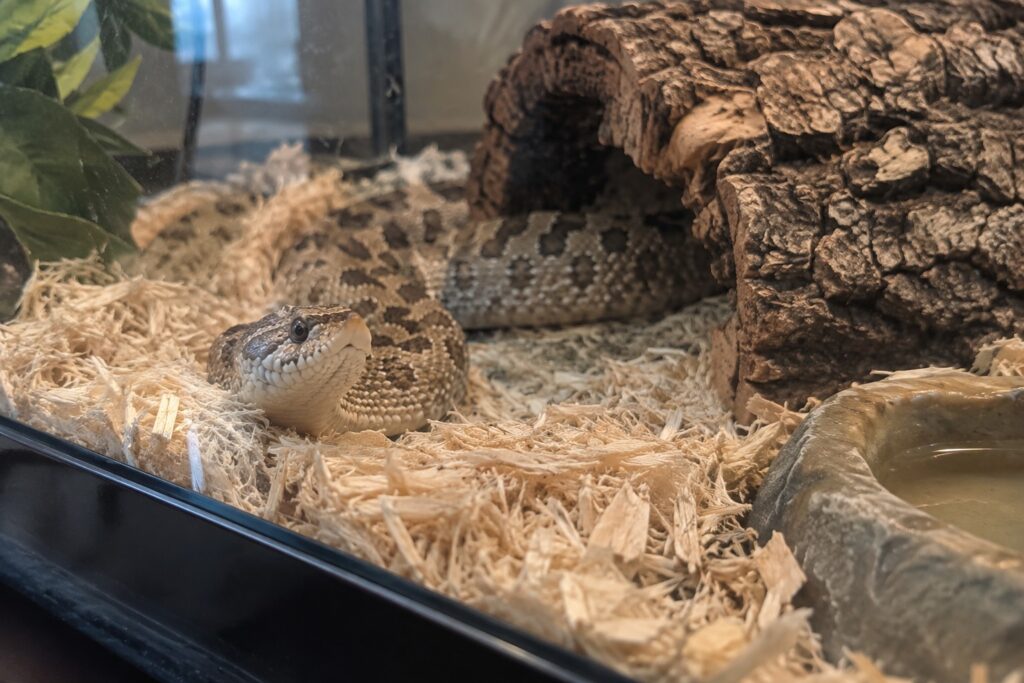
These snakes are burrowers. The upturned snout is a shovel, and they spend a lot of time under the bedding. Give them at least 4 inches, and more is better. Aspen shavings are my go-to for hognoses because they hold tunnel shape well, stay dry, and make spot cleaning easy. A sand and topsoil mix also works well if you want a more natural look. Avoid anything that stays damp, and avoid cedar or pine shavings entirely.
Add two hides, one on each end, even though your hognose will often skip them and dig in. A shallow, heavy water dish on the cool side, a flat piece of cork bark or slate, and some fake plants for cover are all you really need. Burrowers bury their mess, so sift the top layer every few days. Deep cleans follow a full cleaning schedule for snake enclosures.
Lock the lid. Hognoses are small and determined, and escapes are common with loose screen tops.
Heating and Lighting
The heating rule in western hognose snake care is simple: heat the surface where the snake rests, not the air above it. The basking spot should read 90 to 95°F on the surface under the heat, with the cool end around 75 to 80°F. An overhead halogen bulb over a flat stone works best with deep bedding. A heat mat under the tank also works, but deep aspen insulates it, so thin the bedding over the mat and measure the surface, not the glass.
Whatever you use goes on a thermostat. Measure with a digital probe thermometer and an infrared temp gun, never the stick-on dial gauges. If you’re not sure your numbers are accurate, here’s how to check your readings properly.
Nights can drop to 68 to 72°F, and in most homes the heat can go off with the lights. Humidity should stay dry, 30 to 50%. A low output UVB tube over the warm half, on a 12 hour timer, is worth adding. They survive without it, but they tend to be more active and hold better color with it.
Feeding a Western Hognose
Frozen thawed mice are the staple of western hognose snake care. Hatchlings eat pinkies every 5 to 7 days, juveniles move up to fuzzies around 3 to 6 months, and adults eat every 7 to 14 days. Males usually top out on hoppers or small adult mice, females on adult mice. Pick prey about as wide as the widest part of the snake’s body.
Warm the mouse in a sealed bag in hot water, then offer it with tongs or drop it in front of the snake in the evening. Hognoses eat with a lot of enthusiasm once they get going, which is why obesity is the most common health problem in captive adults. If your hognose looks round like a sausage with no taper toward the tail, stretch the gap between meals and keep prey size where it is.
Don’t feed wild-caught toads or frogs. They carry parasites and some are toxic, and there’s no need for it once a snake is eating mice.
5 Fixes When Your Western Hognose Won’t Eat
Picky eating is the number one headache in western hognose snake care, especially with hatchlings. Work through these in order.
1. Check the date and the snake’s age. A new hatchling often refuses for its first two or three offers, and a newly bought snake of any age can skip meals for a week or two while it settles. Adults, especially males, commonly fast from late fall into winter, even in a heated enclosure. If the weight is holding steady, that’s not an emergency.
2. Fix the temperatures and the hides. Probe the basking surface. A bulb that’s lost output or a heat mat under too much bedding can drop things into the low 80s, which quietly kills appetite. Make sure there’s enough bedding to feel secure in. A hognose with nowhere to hide won’t eat.
3. Scent the pinky. This is the classic hognose trick. Rub the thawed pinky with something that smells like amphibian or fish: a commercial toad scent, the water from canned tuna or salmon, or a bit of thawed fish. Many stubborn hatchlings take a scented pinky on the first try. Once it’s eating reliably, scent less each time until it takes plain mice.
4. Change the presentation. Some hognoses want the prey left in front of their hide overnight. Others only eat in a small deli cup with a few air holes, where there’s nothing else to focus on. Try braining the pinky, a small cut to the skull to release scent, and offer at dusk.
5. Track it before you panic. Weigh your snake on a gram scale every week or two while it’s refusing, and write down every offer, what was used, and whether it was taken. The Exotic Reptile Care app has the feeding tracker and a weight log built in, and this is where the feeding tracker really earns its place. After a month of logged refusals you’ll know whether you’re looking at a slow slide or a flat line, which is much harder to tell from memory. If you want the method behind this, here’s why keeping a proper feeding record makes these calls easier.
If a hatchling has refused for six weeks or more and is losing weight, or an adult drops more than about 10% of its body weight, stop troubleshooting at home and find an experienced reptile vet. Same goes for any regurgitation, mucus, or swelling.
Handling Your Western Hognose
Give a new snake a week or two to settle and wait until it has eaten at least twice before you start handling. Scoop it up from underneath rather than grabbing from above, which looks like a predator. Let it move through your hands and keep the first few sessions to five minutes or so.
Two habits cut down on feeding bites. Wash your hands before handling so you don’t smell like mouse, and touch the snake gently with a snake hook first so it knows it’s not dinner time. Skip handling for 48 hours after a meal. Most hognoses calm down a lot within a few months and become one of the most entertaining small snakes you can keep.
Common Health Problems
Obesity is the big one, and it’s entirely down to how much and how often you feed. After that, watch for respiratory infections, usually from damp bedding combined with a cool enclosure, which show up as wheezing, clicking, or bubbles at the nose. Stuck shed happens if the air is very dry, and a short lukewarm soak usually loosens it. Mites show up as tiny black dots around the eyes and chin, or in the water bowl.
Western hognose snake care really comes down to three things: deep dry bedding, a warm surface you’ve actually measured, and patience at feeding time. Get those right, keep a written log of every meal, and don’t take the dramatics personally.
Frequently Asked Questions
How big do western hognose snakes get?
Males usually reach 15 to 20 inches and stay under about 120 grams. Females are much larger at 24 to 30 inches or more and 200 to 500 grams. Plan the enclosure around the female size if you don’t know the sex.
Is a western hognose good for beginners?
Yes. Western hognose snake care is simple as long as you’re ready for some picky eating early on. They stay small, need a simple setup, and tolerate beginner mistakes well. The theatrics look scary but are harmless.
Why does my hognose play dead?
It’s a defense display. When a hognose feels threatened and hissing and hooding don’t work, it rolls over and goes limp. Leave it alone for a few minutes and it will recover on its own.
Can western hognoses live together?
No. House one per enclosure. Keeping them together causes stress and competition, and a feeding response can end with one snake grabbing the other.
Do western hognoses need UVB?
It isn’t strictly required, but a low output UVB tube over the warm half of the enclosure on a 12 hour timer is worth adding. Most keepers see more activity and better color with it.