You bought a panther chameleon because of the colors, and fair enough. Nothing else in the hobby looks like a fired up male Ambilobe. But panther chameleon care has one catch that surprises people: these animals hide illness until it’s already serious. By the time a panther looks sick, it has usually been sick for weeks.
So this guide does two things. It gives you the setup numbers, and then it gives you a six-point check you can run in under a minute a day that catches problems while they’re still easy to fix.
Panther Chameleon Care Quick Specs
A panther chameleon needs a screen cage of at least 24 x 24 x 48 inches, a basking branch at 80 to 85°F, ambient temperatures of 72 to 78°F, strong UVB, and water delivered as droplets on leaves, never in a bowl.
| Parameter | Target |
|---|---|
| Adult size | Males 15 to 20 inches, females 10 to 13 inches (including tail) |
| Lifespan | Males 5 to 7 years, females 2 to 5 years |
| Enclosure | Screen, 24 x 24 x 48 inch minimum for adults |
| Basking branch | 80 to 85°F |
| Ambient | 72 to 78°F |
| Night | 65 to 70°F |
| Humidity | 50 to 70% by day, higher overnight |
| UVB | T5 HO 5 to 6% linear tube, replace yearly |
| Diet | Gut loaded, dusted insects |
| Housing | Always alone |
Panthers run a bit cooler at the basking spot than veileds. That surprises people who assume the more colorful chameleon needs more heat. It doesn’t, and an overpowered basking bulb is one of the easiest ways to burn one.
Locales, Colors, and Choosing One
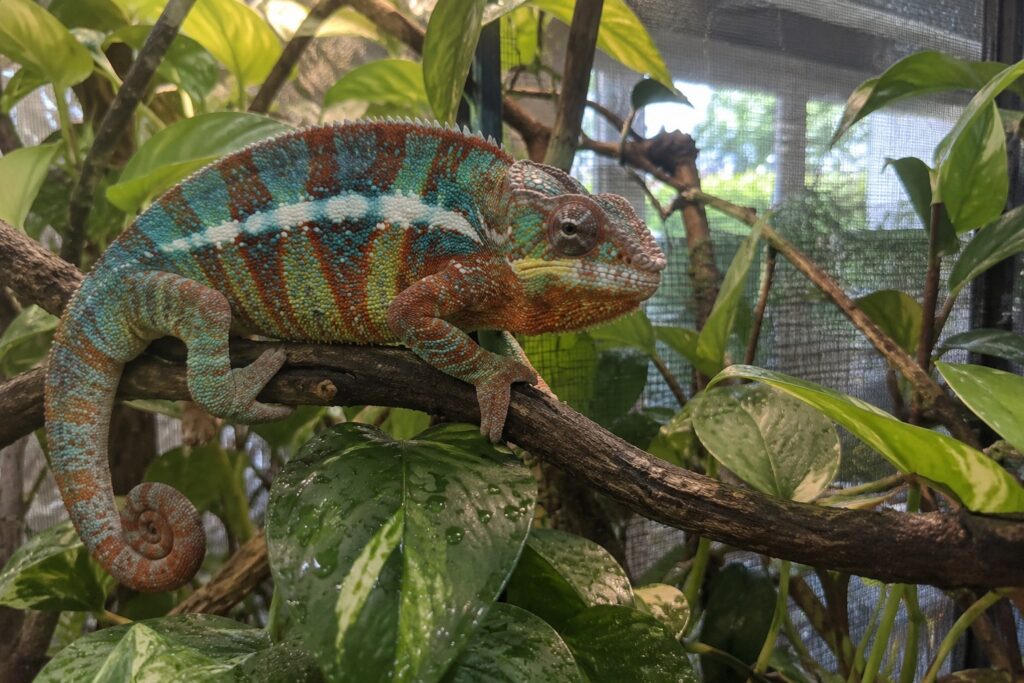
Panther chameleons come from Madagascar, and they’re sold by locale, the region their bloodline came from. Ambilobe males tend toward red and orange bars on a green or turquoise base. Nosy Be males are often mostly turquoise or blue. Ambanja, Sambava, and Tamatave all have their own typical colors. Panther chameleon care is the same across locales, so pick the look you like.
Only males carry those colors. Females of every locale look much alike, mostly tan, peach, or pink, and they turn dark with orange or black patches when gravid or stressed. If you want the colors, you want a male.
Buy captive bred, from a breeder who can tell you the locale and hatch date. A panther around 4 to 6 months old is a much safer start than a tiny hatchling, because the first few months are when most losses happen.
Enclosure Setup
Screen, not glass. Good panther chameleon care starts with airflow. Stagnant humid air is how respiratory infections start. An adult needs a 24 x 24 x 48 inch screen cage at minimum. A juvenile can start in a 16 x 16 x 30 inch cage but should move up by 4 to 5 months old. The full build, including drainage and plant choices, is in our chameleon enclosure build guide, so here are just the panther-specific points.
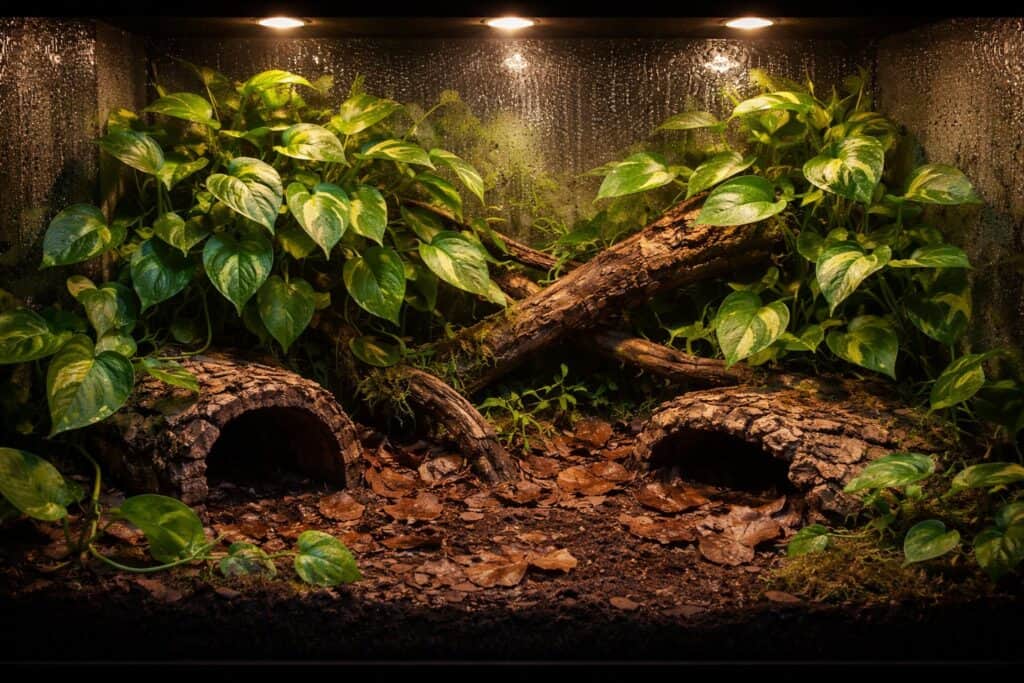
Fill the cage densely with live plants like pothos, schefflera, and ficus. If you can see your chameleon clearly from everywhere, there isn’t enough cover. Run horizontal branches of different thicknesses at several heights, with the basking branch 6 to 8 inches below the screen top.
Keep the cage somewhere with no view of other chameleons, pets, or a busy doorway. Panthers are calmer than veileds, but a chameleon that feels watched all day stays stressed, and stress shows up as a refusal to eat long before anything else.
Heat, UVB, and Water for Panther Chameleon Care
The basking branch surface should read 80 to 85°F on an infrared temp gun, with ambient around 72 to 78°F and a drop to 65 to 70°F at night. All lights and heat go off at night unless your room falls below 60°F. Put the basking bulb on a dimming thermostat or use a low wattage bulb, and make sure the chameleon can’t climb close enough to the mesh to touch hot screen.
UVB is not optional. Use a T5 HO linear tube at 5 or 6%, laid across the screen top on the same side as the basking bulb, and replace it every 12 months. Output fades long before the light looks dim.
Panthers come from humid coastal forest, so they want more moisture than veileds. Aim for 50 to 70% humidity by day with a clear dry-down between mistings, then let it rise higher overnight. A misting system running two or three times a day, plus a dripper onto a leaf, covers both drinking and humidity. A cool mist humidifier on a timer for a few hours before dawn is a nice upgrade that matches the heavy morning dew they drink in the wild. If you keep other species too, here are the temperature and humidity ranges for other species side by side.
Feeding and Supplements
Feeding is the simplest part of panther chameleon care. They eat insects only. Good staples are dubia or discoid roaches, crickets, black soldier fly larvae, and silkworms. Hornworms are great for hydration and variety. Superworms and waxworms are treats, not meals. Nothing should be longer than the space between the chameleon’s eyes.
Juveniles eat daily, as much as they’ll take in a session. Adult males do well on 5 to 8 insects every other day. Adult females need less, about 3 to 5 every other day or even every third day, because a heavily fed female grows bigger clutches of eggs, and big clutches are what wear females out.
Gut load feeders for 24 to 48 hours before offering them. Dust with calcium without D3 at most feedings, calcium with D3 about twice a month, and a multivitamin with preformed vitamin A about twice a month. Chameleons are sensitive in both directions, so more is not better.
Female Panthers and Egg Laying
Females produce eggs whether or not they’ve met a male. This is the biggest reason female panthers live shorter lives, and it’s the part new keepers most often miss.
From about 6 months old, a female needs a laying bin: a container at least 12 inches deep, filled with sand and soil damp enough to hold a tunnel shape. Put it on the cage floor. When she’s gravid, you’ll see her body swell, her colors turn dark with orange or black spots, and her appetite drop. When she starts wandering the floor or digging, she’s looking for a place to lay. Leave her alone and cover the cage front with a towel if needed so she feels private.
If she stops eating, keeps digging for days without laying, or looks weak and sunken, that’s egg binding, and it’s an emergency. Go straight to a vet.
6 Panther Chameleon Care Checks That Catch Problems Early
This is the part that actually keeps panthers alive. None of it takes long, and you can do most of it without touching the chameleon.
1. Urate color, daily. Look at the droppings on the cage floor. The white part is urates. White is good. Yellow or orange means the chameleon is short on water, even if you saw it drinking. Increase misting length and check the dripper before you change anything else.
2. Eyes, daily. Healthy eyes are round, full, and tracking you. Sunken eyes usually mean dehydration. Eyes that stay closed during the day, when the chameleon isn’t sleeping, are one of the earliest signs something is wrong and should never be ignored.
3. Grip and posture, daily. A healthy panther grips the branch firmly and walks with a steady rocking step. Weak grip, trembling, missing the branch, or sliding down are classic early signs of metabolic bone disease. Check the UVB tube’s age and your supplement routine straight away.
4. Color at the wrong time, daily. Dark colors when a chameleon is cold in the morning or basking are normal. Dark or dull colors in the middle of the day while it sits away from the basking spot are not. That’s stress or illness talking.
5. Appetite, every feeding. Count how many insects go in. A panther that normally takes eight roaches and suddenly takes three is telling you something, often a day or two before any other sign shows up.
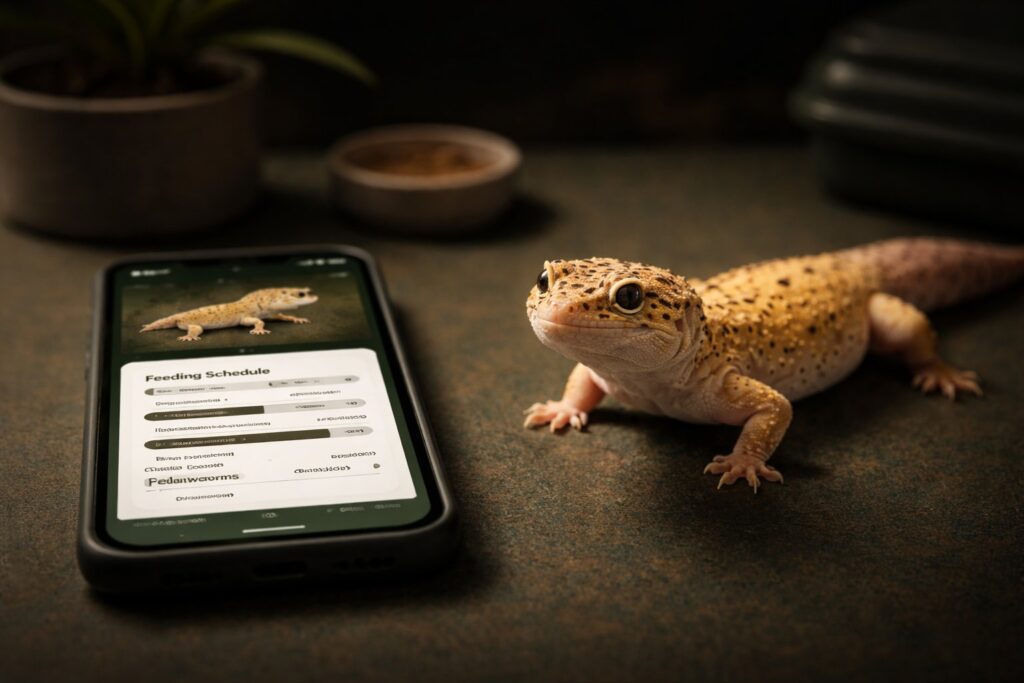
6. Weight, weekly. This is the single most honest number you have. Weigh your panther on a gram scale once a week, same day and time. The Exotic Reptile Care app logs every weigh-in and plots it for you, and the app’s growth charts make a slow decline obvious in a way memory never does. A panther that loses weight three weeks running needs attention even if it’s still climbing and eating normally.
If any of these checks turn up open-mouth breathing, bubbles at the nose, a swollen jaw, or eyes that stay shut, don’t wait. Find a vet who sees chameleons, since many reptile vets don’t treat them regularly.
Handling and Temperament
Panthers are usually calmer than veileds and many will hand-walk, but they’re still display animals, not pets to cuddle. Let the chameleon walk onto your hand from below rather than grabbing from above, and keep sessions short. If you want to compare the two species before choosing, here’s how veiled chameleon care differs in practice.
Always house them alone. Two panthers in one cage, or in view of each other, means permanent stress for both.
Frequently Asked Questions
How long do panther chameleons live?
Males usually live 5 to 7 years with good care. Females typically live 2 to 5 years, mostly because producing eggs takes a heavy toll on their bodies.
Are panther chameleons good for beginners?
They’re a reasonable first chameleon if you’re willing to build the cage properly and do the daily checks. They’re calmer than veileds but need more humidity and have less room for husbandry mistakes.
Do panther chameleons need a water bowl?
No. They drink droplets from leaves and will ignore a bowl until they’re dehydrated. Use a misting system, a dripper, or both.
Why is my panther chameleon dark?
Dark colors are normal first thing in the morning or when basking to warm up. Dark colors in the middle of the day, away from the basking spot, usually mean stress, illness, or in females, that she’s gravid.
How often should I feed an adult panther chameleon?
Every other day works for most adults. Males take around 5 to 8 insects per feeding, females around 3 to 5, and females can go to every third day to keep egg clutches smaller.
Good panther chameleon care comes down to three things: an airy cage that stays at the right numbers, water on leaves every day, and a habit of looking closely. Build the six checks into your routine and you’ll catch almost every problem while it’s still small.