Can leopard geckos eat fruit? No. Not as a treat, not in small amounts, not once in a while. Leopard geckos are strict insectivores and their digestive system has no way to process plant matter. This trips up a lot of new keepers, usually because they’ve seen crested gecko owners mixing up fruit-based meal replacement powders and assumed all geckos work the same way. They don’t.
| Question | Answer |
|---|---|
| Can leopard geckos eat fruit? | No, they are obligate insectivores |
| Any fruit that’s safe? | None, including berries, banana, and melon |
| What if mine already ate some? | A single small piece is unlikely to be an emergency |
| Common symptoms after fruit | Loose stools, refusing food, lethargy |
| What they should eat | Live insects, gut loaded and dusted |
| Why the confusion | Crested and gargoyle geckos do eat fruit, leopard geckos don’t |
Why Leopard Geckos Can’t Eat Fruit
It comes down to anatomy. Leopard geckos evolved in the dry rocky grasslands of Afghanistan, Pakistan, and northwest India, eating insects and the occasional small vertebrate. Their gut is short and built to break down chitin and animal protein quickly. They don’t have the fermentation chamber or the enzyme profile that plant-eating reptiles rely on to get anything out of sugars and fiber.
So fruit passes through mostly undigested. Best case, it does nothing. Worst case, the sugar disrupts their gut flora and you get diarrhea, which in a small lizard means dehydration faster than you’d think.
There’s a broader principle behind this. Veterinary nutrition guidance for reptiles stresses matching captive diets to what the species actually eats in the wild, because reptile digestive systems are highly specialized by feeding strategy. A leopard gecko is about as specialized as they come.
Can Leopard Geckos Eat Fruit as an Occasional Treat?
This is the version of the question I get most, and the answer is still no. “Occasional treat” logic works for animals that can digest the food but shouldn’t overdo it. It doesn’t apply here, because there’s no amount of fruit that provides your gecko with anything useful.
Compare that to waxworms, which are genuinely a treat. They’re too fatty for regular feeding but they’re still insects, still digestible, still nutritionally real. Fruit isn’t a less-good food for a leopard gecko. It’s a non-food.
The other issue is sugar around the mouth. Leopard geckos have small teeth and gums that are already prone to problems, and sticky sugary residue is not something you want sitting there.
What About Fruit Baby Food or Fruit-Based Gecko Diets?
Those crested gecko diet powders you see at every reptile shop are formulated for fruit-eating species like crested, gargoyle, and day geckos. They’re excellent products for those animals and completely wrong for a leopard gecko.
Same goes for the old advice about offering fruit baby food to a sick or refusing gecko. It doesn’t help, and a gecko that’s stopped eating needs an actual diagnosis rather than a sugar hit. Our guide to a leopard gecko not eating but still active walks through the real causes, which are usually temperature, shedding, impaction, or stress.
My Leopard Gecko Ate Fruit, What Now?
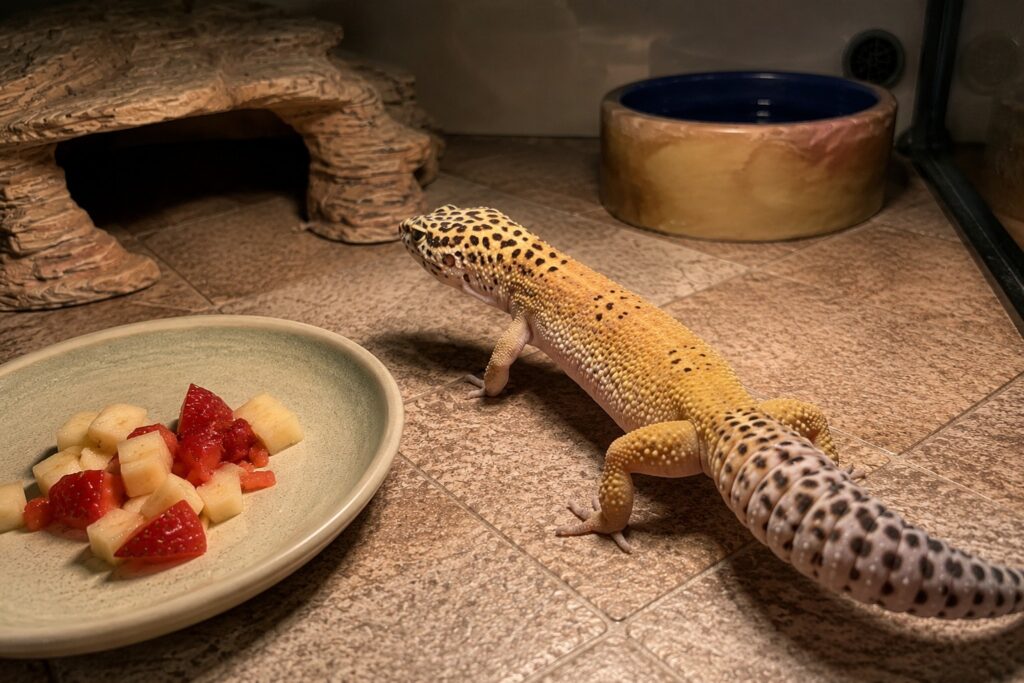
Don’t panic. One small piece of banana or a lick of strawberry is not going to kill a healthy adult gecko. Remove whatever’s left, make sure fresh water is available, and watch the next couple of days.
Expect possibly loose or runny stools. That should clear up on its own. What you’re watching for is anything that persists: continued diarrhea past two or three days, refusal to eat, visible lethargy, or a gecko that stops using its normal basking spot. Any of those means a vet visit.
The bigger risk is repeat exposure. A gecko that gets offered fruit regularly may start preferring it over insects, and an insectivore that fills up on sugar and skips its dusted feeders heads toward calcium deficiency fast. That’s the pathway to metabolic bone disease, and it’s why our leopard gecko calcium schedule guide is worth reading alongside this one.
What Leopard Geckos Should Actually Eat
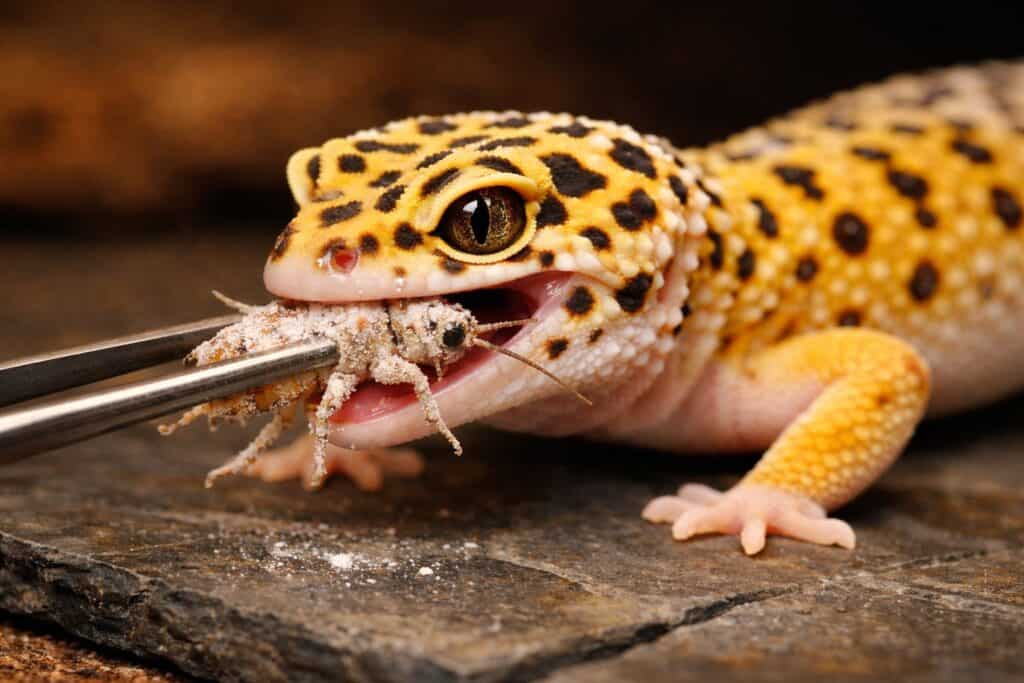
Live insects, varied, gut loaded, and dusted. That’s the whole diet.
Staples: dubia roaches, crickets, and black soldier fly larvae. Dubias are the easiest to keep and don’t smell or escape the way crickets do. Black soldier fly larvae are naturally high in calcium, which takes some pressure off your dusting routine.
Rotation and treats: hornworms and silkworms are great for variety and hydration. Mealworms and superworms are fine in moderation but they’re fattier and have more chitin. Waxworms and butterworms are dessert, once a week at most for a healthy adult, less for one that’s already carrying weight.
Gut load your feeders for 24 to 48 hours before offering them. An insect fed on carrot, squash, and leafy greens delivers those nutrients to your gecko in a form it can actually use. That’s the closest thing to “feeding fruit” that makes any sense for this species, and it’s indirect for a reason.
Dust with calcium powder at most feedings and a multivitamin with D3 once or twice a week, depending on your UVB setup.
Tracking What Actually Goes In
Diet mistakes with leopard geckos are usually slow. Nobody wrecks a gecko’s health in a week. It happens over months of slightly too many waxworms, dusting that quietly slipped from every feeding to every third, or a feeder rotation that narrowed down to just mealworms because they’re convenient.
Logging feeds makes that visible. The Exotic Reptile Care app tracks what you offered, what got eaten, and what you dusted, alongside weight over time. When you can see two months of entries at once, the pattern is obvious in a way it never is from memory. Diet quality over years is also one of the main things separating a gecko that hits the upper end of its lifespan from one that doesn’t.
FAQ: Can Leopard Geckos Eat Fruit?
Can leopard geckos eat bananas?
No. Bananas are high in sugar and phosphorus, and the phosphorus works against calcium absorption. There’s no version of this that’s good for an insectivore.
Can leopard geckos eat strawberries or blueberries?
No. Berries get suggested often because they’re small and soft, but size isn’t the issue. Leopard geckos can’t digest fruit sugars regardless of the fruit.
Do leopard geckos eat fruit in the wild?
No. Wild leopard geckos eat insects, spiders, scorpions, and occasionally small lizards or newborn rodents. Fruit isn’t part of their natural diet in any meaningful way.
Can baby leopard geckos eat fruit?
Definitely not. Juveniles have the highest protein and calcium demand of any life stage, and anything that displaces insects at that age does real damage to growth.
Why can crested geckos eat fruit but not leopard geckos?
Different species, different digestive systems. Crested geckos are frugivorous and evolved eating fruit and nectar alongside insects, which is why their diet looks completely different. Our crested gecko food guide shows what that actually involves. Leopard geckos are obligate insectivores with no adaptation for plant matter.
The short version: can leopard geckos eat fruit, no, and there’s no clever exception. Put the effort into feeder variety and gut loading instead. That’s where the actual nutrition is for this species, and your gecko will do better on a good roach than on anything you could put in a fruit dish.