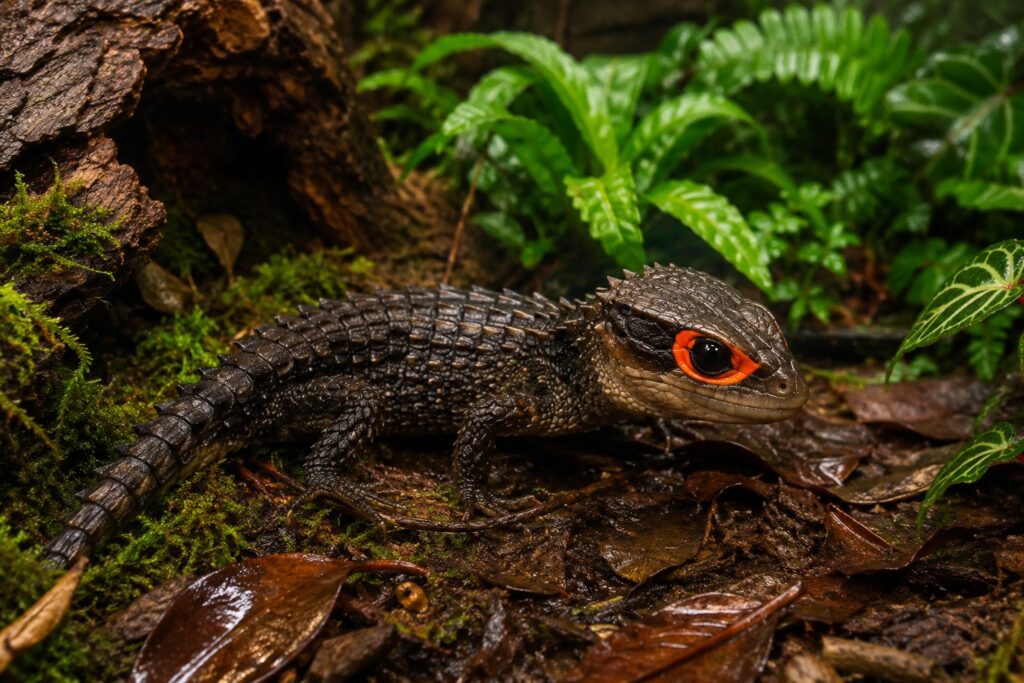
Chinese water dragons get sold as “green bearded dragons,” and that’s where the trouble starts. They look manageable as babies, then turn into three foot lizards that need a huge, humid enclosure with a pool. Chinese water dragon care isn’t complicated once you plan for the adult animal, but there’s one problem that shows up in so many water dragons it gets its own section here: nose rubbing.
Chinese Water Dragon Care Quick Specs
A Chinese water dragon needs a tall enclosure with a large water area, a basking spot of 95 to 100°F, a warm side of 80 to 85°F, humidity of 60 to 80%, strong UVB, and an insect based diet.
| Parameter | Target |
|---|---|
| Adult length | Males up to about 36 inches, females about 24 inches (mostly tail) |
| Lifespan | 10 to 15+ years |
| Adult enclosure | 72 x 36 x 72 inches for a male, about 48 x 24 x 48 minimum for a female |
| Basking surface | 95 to 100°F |
| Warm side | 80 to 85°F |
| Cool side | 75 to 80°F |
| Night | 70 to 75°F |
| Humidity | 60 to 80% |
| UVB | T5 HO 10 to 12%, replaced yearly |
| Diet | Insects, plus some fish and greens |
Most of that length is tail, but don’t let that fool you. A male water dragon needs a lot of space to climb, jump, and swim.
Enclosure Size: Plan for the Adult
This is the part of Chinese water dragon care most people underestimate. A hatchling water dragon is fine in a small enclosure for a few months, but an adult male needs something close to 6 feet tall, 6 feet long, and 3 feet deep. Females can manage in about 4 x 2 x 4 feet. Anything smaller and you’ll see stress, injuries, and nose rubbing.
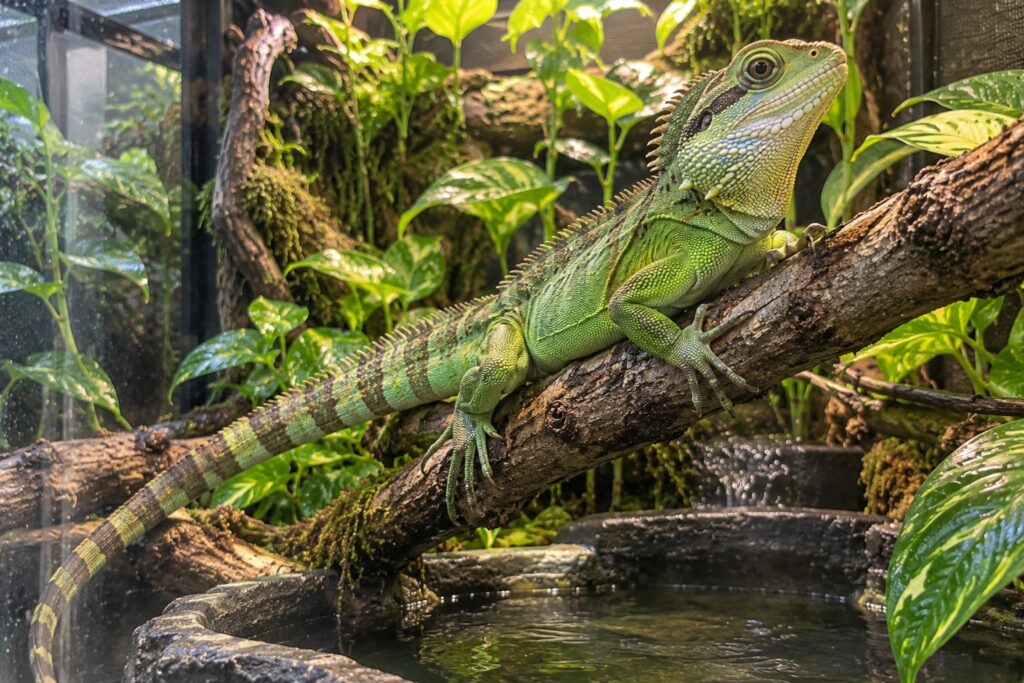
Water dragons are semi-arboreal and semi-aquatic. In the wild they live along rivers and jump into the water when startled. So the enclosure needs two things above all: height to climb and a big water area to swim. A large, shallow tub or a built-in pool that takes up a good chunk of the floor is ideal, with water deep enough for the dragon to fully submerge.
Fill the space with thick branches running diagonally and horizontally, especially near the top. Add plenty of live plants for cover, like pothos and ficus. A tall custom PVC enclosure or a large front opening glass build both work. Many keepers go with a bioactive enclosure, since it holds humidity well and handles waste from such a big lizard.
For substrate, a coco fiber, topsoil, and sphagnum mix holds humidity and lets the dragon dig a little. Avoid sand and anything that dries out completely.
Heat, Light, and Humidity for Chinese Water Dragon Care
The basking spot should read 95 to 100°F on the surface of the top branch, measured with an infrared temp gun. The warm side air should sit at 80 to 85°F, the cool side at 75 to 80°F, and night temperatures can drop to 70 to 75°F. Use a halogen flood bulb or two over the basking branch, on a dimming thermostat.
UVB is essential. Use a T5 HO 10 to 12% linear tube running most of the enclosure length, near the basking branch, and replace it every 12 months. It’s the same linear UVB setup we use for bearded dragons, just in a much taller and more humid enclosure. Run lights on a 12 hour timer.
Keep humidity between 60 and 80%. The big water area helps, and misting once or twice a day tops it up. A fogger or humidifier on a timer is useful in dry homes. Use a digital hygrometer at dragon height, since readings near the floor and near the top can differ a lot. If you’re not sure your numbers are right, here’s how to measure humidity accurately.
Change the water often. Water dragons drink from it, soak in it, and use it as a toilet, so dirty water quickly causes skin and eye infections. A filter helps, but plan on changing small tubs every day or two.
Feeding a Chinese Water Dragon
Feeding is the easy part of Chinese water dragon care. Water dragons are mostly insectivores. Good staples are dubia roaches, crickets, black soldier fly larvae, silkworms, and hornworms. Superworms and waxworms are occasional extras. Adults can also have small whole fish like silversides now and then, and a little chopped greens, though most water dragons ignore plants.
Juveniles eat daily. Adults eat every two to three days, as many appropriately sized insects as they’ll take in about 10 minutes. Size insects no larger than the space between the eyes.
Dust insects with calcium at most feedings and a multivitamin about once a week. With a good UVB tube, plain calcium without D3 is enough for most meals.
5 Fixes for Nose Rubbing
Nose rubbing is the most common problem in Chinese water dragon care. The dragon pushes or runs its snout against the glass over and over, and over time the tip of the snout gets scraped raw, swollen, or even permanently damaged. Infections can follow. Here’s how to work through it.
1. Make the glass visible. Water dragons don’t understand glass. They see open space and try to go through it, especially when startled. Cover the bottom third or half of the glass walls with an opaque background, window film, or paper. This alone often stops most of the rubbing.
2. Give it more space. Rubbing is very often a sign the enclosure is too small. A dragon that can’t climb, jump, or swim far enough keeps testing the edges. If your adult is in anything much smaller than the sizes above, upgrading is the real fix.
3. Add cover and reduce stress. Lots of plants, hides near the top, and a quiet room make a big difference. Water dragons are skittish, and one that feels exposed will panic and bolt into the glass when people walk past. Moving the enclosure away from a busy hallway helps.
4. Check the setup. Low humidity, temperatures that are too hot or too cold, or no water deep enough to swim can all make a dragon restless. Measure everything before assuming it’s behavioral.
5. Watch the snout and track it. Look at the tip of the snout once a week in good light. A slightly pink or scuffed snout means the problem is ongoing. Swelling, a dark crust, or a soft spot means infection. It’s easy to lose track of small changes, so log a weekly snout check in the Exotic Reptile Care app with a quick note or photo, and you’ll see whether your fixes are working. If the snout is swollen, crusty, or bleeding, take your dragon to a reptile vet. Snout infections can spread into the mouth and jaw.
Handling and Temperament
Captive bred water dragons usually calm down with regular, gentle handling, and many become fairly tame. Wild caught ones often stay jumpy. Approach slowly from the side, scoop under the belly, and support the whole body, including the base of the tail. Short sessions work best at first.
Like most lizards, water dragons can drop their tails if grabbed, and the tail grows back looking different. They can also whip with their tail and bite if frightened.
Housing Water Dragons Together
Never house two males together. They’ll fight. A single male with one or two females can work in a very large enclosure, but expect eggs and watch for bullying at feeding time. For most keepers, one dragon per enclosure is simplest.
Frequently Asked Questions
Are Chinese water dragons good for beginners?
Chinese water dragon care is manageable if you’re ready for a very large, humid enclosure with a pool. Most beginner problems come from underestimating their adult size.
How big do Chinese water dragons get?
Males can reach about 36 inches and females about 24 inches, most of it tail.
Why does my water dragon rub its nose on the glass?
Usually because it doesn’t understand the glass, the enclosure is too small, or it feels stressed. Covering the lower glass, upgrading the enclosure, and adding cover usually fixes it.
Do Chinese water dragons need water to swim in?
Yes. They need a water area big enough to fully submerge, both for hydration and for stress relief. Change the water often, since they use it as a toilet.
How long do Chinese water dragons live?
With good care, 10 to 15 years is common, and some live longer.
Good Chinese water dragon care comes down to space, water, and cover. Build for the adult, give it a pool, make the glass visible, and keep an eye on that snout. Do that and you’ll have one of the most impressive lizards in the hobby.