Calcium is the single most important supplement for leopard geckos, and getting the schedule wrong is one of the fastest ways to end up with a sick gecko. Too little calcium leads to metabolic bone disease, which weakens bones, causes deformities, and can kill your gecko. Too much vitamin D3, which works alongside calcium, can cause toxicity. Nailing your leopard gecko calcium schedule doesn’t have to be complicated, but it does require understanding what to use, when to use it, and why the details actually matter.
Why Leopard Geckos Need Calcium Supplements
Leopard geckos are insectivores. They eat nothing but bugs. And bugs, as nutritious as they are for protein, are naturally low in calcium and high in phosphorus. That ratio is the opposite of what your gecko needs. A healthy calcium to phosphorus ratio for leopard geckos is roughly 2:1 in favor of calcium.
Without enough calcium, your gecko’s body starts pulling it from the bones to keep vital functions running. Over time, this leads to metabolic bone disease, commonly called MBD. You’ll see it as a soft or rubbery jaw, kinked spine, trembling legs, difficulty walking, and eventually the gecko stops eating entirely. MBD is preventable with proper supplementation, but once it’s advanced, the damage to the bones is permanent. This is not something you want to learn the hard way.
The Three Calcium Supplements Every Leopard Gecko Needs
There’s a lot of confusion out there about which supplements to buy because there are so many options. But for most keepers, you only need three things. Some keepers simplify this to one product, which we’ll cover in a moment.
The first is plain calcium powder without vitamin D3. This is your everyday supplement. It’s also what goes in a small dish inside the enclosure for your gecko to lick whenever it wants. Pure calcium without D3 is safe for free access because your gecko can self-regulate how much it takes in.
The second is calcium powder with vitamin D3. Vitamin D3 is essential because it allows your gecko’s body to actually absorb and use the calcium. Without D3, calcium just passes through. However, D3 can be toxic in excess, which is why you don’t use it at every feeding and you don’t leave it in a dish for free access.
The third is a reptile multivitamin. This covers other essential nutrients like vitamin A, which supports eye health and immune function. You use this less frequently than calcium.
If you’d rather simplify, all-in-one products like Repashy Calcium Plus or Zoo Med Reptivite with D3 combine calcium, D3, and vitamins into a single powder. If you go this route, you dust at every feeding and skip the separate supplements. Both products have worked well for breeders and hobbyists for years.
Your Leopard Gecko Calcium Schedule by Age
The schedule differs depending on your gecko’s age because juveniles are growing rapidly and need more frequent supplementation than adults.
For baby and juvenile leopard geckos up to 12 months old, feed daily or every other day. At each feeding, dust the insects. If you’re using the three-supplement approach, dust with plain calcium at most feedings, use calcium with D3 twice a week, and use the multivitamin once a week. If you’re using an all-in-one like Repashy Calcium Plus, just dust at every feeding and you’re covered.
For adult leopard geckos over 12 months old, feeding drops to every 2 to 4 days depending on your gecko’s appetite and body condition. The dusting schedule stays the same relative to feedings. Plain calcium at most meals, calcium with D3 twice a week, multivitamin once a week. Or dust with the all-in-one every time you feed.
Regardless of age, keep a small dish of plain calcium without D3 in the enclosure at all times. Replace it daily or every other day so it stays fresh and uncontaminated. You’ll sometimes catch your gecko licking from it, especially females who are developing eggs. This free-access calcium acts as a safety net between feedings.
How to Dust Feeder Insects
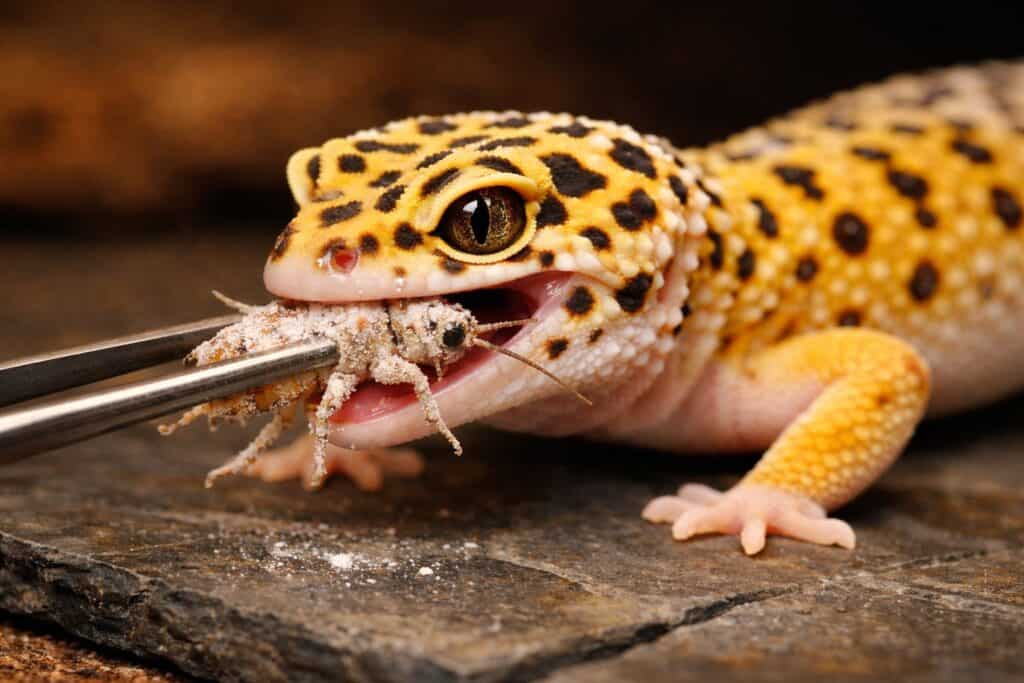
Dusting is simple once you get the hang of it. Put a small amount of powder in a plastic bag or a cup, drop in the feeder insects, and give it a gentle shake until the insects are lightly coated. You don’t need a thick layer. A light, even dusting is all it takes. Too much powder and the insects become unappetizing to your gecko, plus excess powder falls off immediately anyway.
Feed the dusted insects right away. The longer you wait, the more powder falls off as the insects move around. Tong feeding works great for this because you can offer each insect individually and make sure your gecko actually eats the dusted ones instead of picking through undusted stragglers.
Don’t Forget to Gut Load
Dusting is only half the equation. Gut loading means feeding your feeder insects a nutritious diet 24 to 48 hours before you give them to your gecko. Whatever the insects eat ends up in your gecko’s system. If the crickets have been sitting in a pet store cup eating nothing, they’re basically empty calories.
Good gut load options include fresh vegetables like carrots, sweet potato, squash, and dark leafy greens. Commercial gut load products also work well. The goal is to pack the insects with moisture and nutrients so your gecko gets the most out of every meal.
What About UVB Lighting
This is where the calcium conversation gets a little more nuanced. Leopard geckos are crepuscular, meaning they’re most active at dawn and dusk. In the wild, they do get some low-level UVB exposure. Many keepers have raised healthy leos without UVB lights for decades, relying entirely on dietary D3 supplementation.
However, providing a low-output UVB bulb like a 2 percent or shadedweller type lets your gecko synthesize its own vitamin D3 naturally. If you use UVB, you can reduce the amount of dietary D3 by mostly dusting with plain calcium and only using calcium with D3 about once a week instead of twice. The UVB fills the gap. This approach is becoming more popular among experienced keepers because it’s closer to how geckos process D3 in nature.
Either approach works. The important thing is to not double up. If you’re providing strong UVB and also loading up on D3 powder at every meal, you risk oversupplementing.
Keeping Your Leopard Gecko Calcium Schedule on Track
The trickiest part of supplementation isn’t knowing what to do. It’s remembering to actually do it consistently. When you’re feeding three times a week with different supplements on different days, it’s easy to lose track of which dusting you did last.
This is where logging your feedings helps a lot. The Exotic Reptile Care app lets you track every feeding, including what supplement you used, so you always know where you are in the rotation. You can set custom reminders for feeding days and supplement schedules so nothing gets missed. Over time, you build a complete record of your gecko’s nutrition that’s useful for spotting patterns or sharing with a vet if health issues come up.
Get the Basics Right and Stay Consistent
A solid leopard gecko calcium schedule comes down to three things: dust consistently, provide free-access calcium in the enclosure, and gut load your feeders. Whether you use the three-supplement rotation or an all-in-one product, what matters most is that you actually stick with it week after week. Calcium supplementation isn’t something you can be casual about with leopard geckos. But once you build the habit, it becomes second nature.
For more detailed information on leopard gecko nutrition and health, ReptiFiles has a comprehensive care guide that covers supplementation in depth.