A bad leopard gecko enclosure is behind most of the common problems new keepers deal with. Stuck sheds, appetite loss, lethargy, stress, even digestive issues. These are not random bad luck. They’re usually the enclosure telling you something is wrong. The good news is that leopard geckos are not complicated to house. You just need to get a few things right from the start, and most of those things are cheaper and simpler than the pet store makes them seem.
This guide covers leopard gecko enclosure sizing, the best enclosure types, heating, substrate, hides, humidity, and everything else you need for a setup that actually works.
What Size Leopard Gecko Enclosure Do You Need?
The outdated advice says a 20 gallon tank is fine for an adult leopard gecko. You’ll still see this in older care sheets and pet store handouts. It technically keeps a gecko alive, but it doesn’t give them enough room for a proper temperature gradient, multiple hides, and natural movement.
The current best practice for an adult leopard gecko enclosure is a 40 gallon breeder tank or equivalent, which gives you a 36 by 18 inch footprint. That’s enough space for a clear warm side and cool side with room in between for the gecko to actually move and explore. Leopard geckos are more active than most people expect, especially at night, and they’ll use every inch of a properly furnished enclosure.
For juveniles, a 20 gallon long works as a temporary setup for the first few months. Don’t keep them in anything smaller than that. And plan to upgrade to the full 36 by 18 inch size by the time they’re around 6 months old or reaching 6 inches in length.
Bigger is fine as long as you fill the space. A leopard gecko in a large, empty enclosure will be stressed. A leopard gecko in a large, well-cluttered enclosure with plenty of hides will be confident and active. The enclosure size itself isn’t the stressor. The lack of cover is.
Glass, PVC, or Wood?
Glass terrariums are the most common choice and they work well for leopard geckos. They hold heat reasonably, they’re easy to clean, and front-opening models make access straightforward without startling your gecko from above. The main downside is weight. A 40 gallon glass tank is heavy and a pain to move once it’s set up.
PVC enclosures are the premium option. They hold heat better than glass, they’re lighter, and they look clean. They also tend to be more expensive and harder to find locally, though online options have expanded a lot. For keepers who want the best temperature stability with the least effort, PVC is hard to beat.
Wooden vivariums are popular in the UK and Europe. They insulate well and come in front-opening designs. The downside is that wood can absorb moisture over time if not properly sealed, and they’re harder to sanitize during deep cleans.
For most leopard gecko keepers, a front-opening glass terrarium in the 36 by 18 by 18 inch range is the sweet spot between price, availability, and functionality.
One thing that doesn’t work well: mesh or screen enclosures. Those are designed for arboreal species that need airflow. For a ground-dwelling, heat-dependent gecko like a leopard gecko, a screen enclosure bleeds heat and humidity too fast.
Can You Use an Aquarium or Fish Tank for a Leopard Gecko?
Yes, a standard glass aquarium works, and plenty of well-kept geckos live in one. You need a secure mesh screen top, and you’ll be reaching in from above, which some geckos find stressful since it mimics a predator overhead. A front-opening leopard gecko terrarium solves that and holds heat more predictably, but it costs more and isn’t required. What doesn’t work is a tall aquarium with a small footprint. If you’re repurposing a fish tank, look for a long configuration rather than a show tank.
Heating a Leopard Gecko Enclosure
Leopard geckos are ectotherms. They depend entirely on their environment to regulate body temperature, and they need a clear thermal gradient to do it properly. Your leopard gecko enclosure should have a warm side and a cool side with a smooth transition between them.
Warm side floor temperature: 88 to 92 degrees Fahrenheit directly on the basking surface. Cool side: 75 to 80 degrees. Nighttime temps can drop to 68 to 72 degrees across the enclosure.
The heating debate in leopard gecko keeping has shifted significantly in recent years. Heat mats (under tank heaters) were the standard recommendation for decades because leopard geckos absorb heat through their bellies for digestion. Heat mats still work, especially in glass tanks, and most keepers have used them successfully. If you go this route, the mat should cover roughly one third of the floor on the warm side, and it must be connected to a thermostat. An unregulated heat mat can easily exceed 110 degrees and cause severe burns through the glass.
The more modern approach is overhead heating with a halogen flood bulb or deep heat projector. Overhead heat creates a more natural gradient by warming surfaces and air from above, similar to how the sun heats rocks in the wild. A halogen bulb also produces infrared-A and infrared-B wavelengths that penetrate deeper into tissue, providing more effective thermoregulation. If you’re setting up a new leopard gecko enclosure from scratch, overhead heating is worth considering.
Either method works. What matters is that the temperatures are correct and controlled by a thermostat. Digital thermometers with probes on both sides are essential for monitoring. Don’t trust stick-on analog gauges.
Do not use heat rocks. They cause burns. Do not use red or blue bulbs. They don’t provide meaningful heat advantages and may disrupt your gecko’s natural day/night cycle.
Lighting and UVB
Leopard geckos are crepuscular, most active at dawn and dusk. They don’t need intense lighting, but they do benefit from a consistent day/night cycle of about 12 hours on and 12 hours off.
The UVB question has evolved. For years the standard advice was that leopard geckos don’t need UVB because they’re nocturnal (they’re actually crepuscular) and can get vitamin D3 through supplementation. That’s technically true, but growing research and keeper experience show that low-output UVB improves health outcomes. Geckos with access to UVB tend to have better bone density, stronger immune function, and more natural behavior.
A low-output UVB tube like a 5 to 7 percent T5 fixture (Arcadia ShadeDweller or equivalent) provides the right level without being overwhelming. Mount it on the warm side so the gecko can self-regulate its UV exposure by moving between light and shade. If you have an albino leopard gecko, be extra cautious with lighting. Albino morphs are more sensitive to bright light and may need the UVB further away or behind more cover.
If you choose not to use UVB, make sure your calcium supplement includes D3, and dust feeder insects consistently. Our leopard gecko calcium schedule article walks through the exact supplementation routine.
Substrate Options
Substrate is one of the most debated topics in leopard gecko keeping. The short version: loose substrate is fine for healthy adult geckos as long as husbandry is correct. The risk of impaction comes from poor husbandry (too cold, dehydrated, wrong particle size), not from the substrate itself.
A 70/30 mix of organic topsoil and play sand is the most popular naturalistic option right now. It holds a slight amount of moisture, allows digging behavior, and looks natural. It’s also dirt cheap compared to commercial substrates.
Slate or ceramic tile over a thin layer of substrate gives you a hard, cleanable surface on the warm side while still allowing some loose substrate on the cool side for digging. This hybrid approach is a solid compromise.
Paper towels work for quarantine setups, juveniles, and sick geckos where you need to monitor droppings closely. They’re not a long-term solution for an enriched enclosure, but they’re practical when you need simplicity.
Avoid calcium sand (marketed as digestible, but it clumps when wet and causes problems), pure play sand by itself (too loose, no structure), and reptile carpet (harbors bacteria, catches toenails, impossible to truly clean).
Hides: The Most Important Furniture
Hides are not optional decorations. They’re the most critical piece of furniture in your leopard gecko enclosure. Without proper hides, your gecko will be chronically stressed, won’t eat well, and won’t thermoregulate properly.
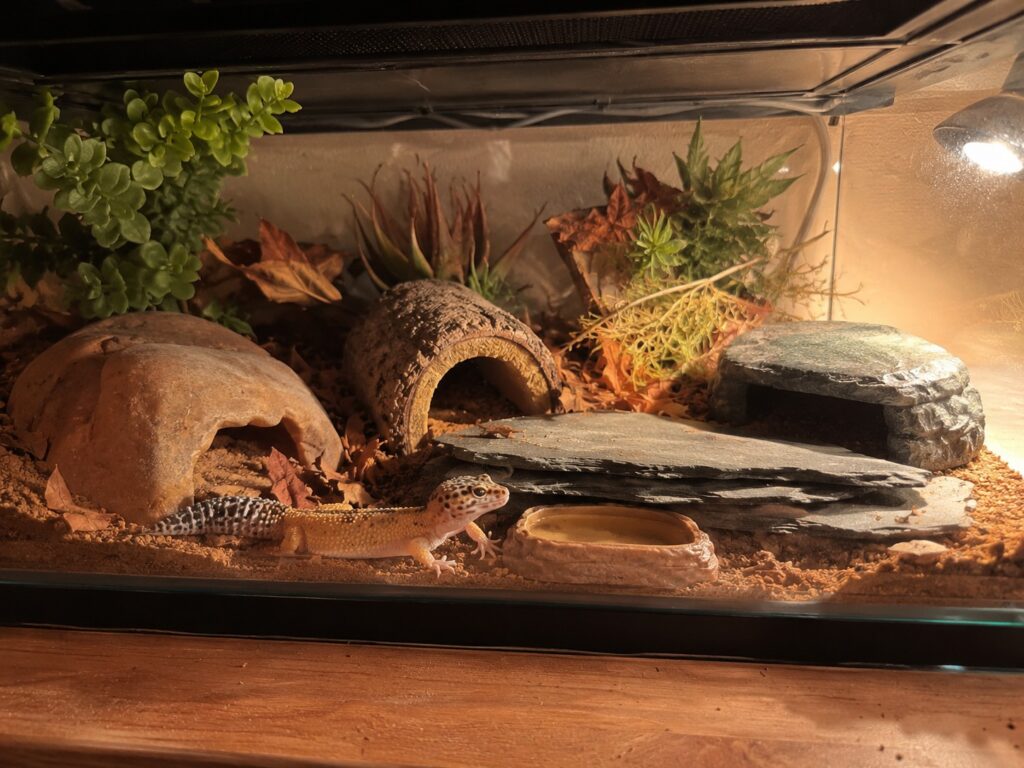
You need a minimum of three hides. A warm hide placed directly over the heat source. A cool hide on the opposite end. And a moist hide (humid hide) somewhere in the middle or warm side, stuffed with damp sphagnum moss or paper towels.
Each hide should be snug. The gecko should be able to fit inside and touch the walls when coiled up. If there’s a lot of empty space around the gecko, the hide is too big and won’t feel secure. Cork bark halves, commercial reptile hides, and coconut shells all work. Match the hide size to your gecko’s current size and upgrade as it grows.
The moist hide is critical for clean sheds. Leopard geckos shed their entire skin in one piece, and they need access to humid air during the process. Without a moist hide, you’ll deal with stuck shed, especially around the toes and tail tip, which can cut off circulation and cause tissue loss. Keep the moss in the moist hide damp (not dripping) and replace it weekly.
Beyond the three essential hides, add clutter. Rocks to climb on, fake or real plants to break up sight lines, and cork bark pieces. Leopard geckos are more active and confident in a furnished leopard gecko enclosure than a sparse one.
Water and Humidity
Leopard geckos come from arid and semi-arid regions, so they don’t need high ambient humidity. Keep the overall enclosure between 30 to 40 percent humidity. The moist hide provides the localized humidity spike they need for shedding.
Provide a shallow water dish with clean fresh water at all times. Place it on the cool side. Change the water daily. Some geckos drink from the dish regularly, others seem to ignore it. They’re getting some moisture from their food too, but the dish should always be available.
If your enclosure humidity is running too high (above 50 percent consistently), increase ventilation. Too much humidity across the whole enclosure can lead to respiratory infections and bacterial growth in the substrate.
Putting Your Leopard Gecko Enclosure Together
Here’s the setup in order. Start with the enclosure, 36 by 18 inch footprint minimum for an adult. Add 2 to 3 inches of substrate. Place the warm hide on one end over your heat source. Place the cool hide on the opposite end. Put the moist hide in the middle or warm side. Add the water dish on the cool side. Fill the open space with rocks, cork bark, and fake plants for cover and enrichment. Mount your heat source and connect it to a thermostat. Place thermometer probes on the warm and cool sides.
Run everything for 24 to 48 hours before adding your gecko. Check that the warm side basking surface reads 88 to 92 degrees, the cool side sits around 75 to 80, and humidity is in the 30 to 40 percent range. Once stable, introduce the gecko and leave it alone for a full week before attempting to feed or handle.
If your gecko settles in but starts refusing food while still being active, the enclosure is usually the first thing to double-check. Temperature, hide placement, and light exposure solve most early appetite issues.
Keeping It Consistent Long Term
The hardest part of maintaining a leopard gecko enclosure isn’t the initial setup. It’s keeping conditions consistent week after week, month after month. Heat bulbs lose output over time. Substrate dries out or gets soiled. The moist hide dries up between checks.
The Exotic Reptile Care app helps you stay on top of the routine. Set reminders for substrate changes, moist hide maintenance, and feeding days. Log your gecko’s weight regularly so you’ll catch any gradual decline before it becomes a real problem. For an animal that can live 15 to 20 years, consistent care tracking is what separates a gecko that thrives from one that just gets by.
A good leopard gecko enclosure isn’t about spending the most money. It’s about getting the temperatures right, providing the right hides, choosing a safe substrate, and being consistent. Nail those basics and your gecko will reward you with years of easy, low-drama keeping.
For more on keeping your gecko healthy in that enclosure, see our guides on preventing stuck sheds and avoiding impaction.
Leopard gecko enclosure: frequently asked questions
What size enclosure does a leopard gecko need?
An adult needs a 40 gallon breeder tank or equivalent, which gives a 36 by 18 inch footprint. The old 20 gallon advice keeps a gecko alive but doesn’t allow a proper temperature gradient, multiple hides, and natural movement. A 20 gallon long works as a temporary juvenile setup, but plan to upgrade to the full size by around six months or six inches of length.
Do leopard geckos need UVB?
They can survive on D3 supplementation alone, but low-output UVB is increasingly recommended because it improves bone density, immune function, and natural behavior. A 5 to 7 percent T5 tube like an Arcadia ShadeDweller mounted on the warm side lets the gecko self-regulate exposure. If you keep an albino morph, be extra cautious, since they’re more light-sensitive and need more cover.
What is the best substrate for a leopard gecko enclosure?
A 70/30 mix of organic topsoil and play sand is the most popular naturalistic option, allowing digging while holding a little moisture. Slate or tile over a thin substrate layer is a great cleanable compromise for the warm side. Avoid calcium sand, loose play sand on its own, and reptile carpet. Loose substrate is safe for a healthy adult as long as temperatures and hydration are correct.
How many hides does a leopard gecko need?
At least three: a warm hide over the heat source, a cool hide on the opposite end, and a moist hide with damp sphagnum moss in the middle or warm side. Each should be snug enough that the gecko touches the walls when coiled. The moist hide is non-negotiable for clean sheds, since without it you’ll get stuck shed on the toes and tail tip.
Do leopard geckos need heat at night?
Not usually. Nighttime temperatures can safely drop to 68 to 72°F across the enclosure, which most rooms hold on their own. If your home gets colder than that, use a thermostat-controlled overhead source rather than a bright bulb, and never use red or blue night lights, since they can disrupt the gecko’s day and night cycle.
What humidity does a leopard gecko enclosure need?
Keep ambient humidity low, around 30 to 40 percent, since leopard geckos come from arid regions. The moist hide provides the localized humidity spike they need for shedding, so you don’t want the whole enclosure damp. If ambient humidity sits above 50 percent consistently, increase ventilation to avoid respiratory infections and bacterial growth in the substrate.
How do I keep enclosure conditions stable long term?
The setup is the easy part, holding conditions steady week after week is the challenge, since bulbs lose output, substrate dries out, and the moist hide dries up between checks. Digital probe thermometers on both sides give you the readings, and logging them plus your gecko’s weight reveals problems early. The Exotic Reptile Care app sets reminders for moist hide maintenance, substrate changes, and feeding, and tracks weight so a gradual decline shows up in the data. It pairs naturally with a consistent care routine.
What size tank does a leopard gecko need?
A 40 gallon breeder or 36 by 18 inch footprint for an adult. A 20 gallon long works temporarily for juveniles up to around six months or six inches.
Is a terrarium or an aquarium better for a leopard gecko?
A front-opening terrarium is easier to work in, holds heat better, and avoids startling the gecko from above. A glass aquarium with a secure screen top works fine and costs less.