If you’ve just brought home a sulcata tortoise, the single most important thing you can get right is the sulcata tortoise diet. These animals grow massive, often reaching 100 pounds or more, and what you feed them in the first few years determines whether they grow at a healthy rate with a smooth shell or pyramid and develop long-term problems. The good news is their diet is simple once you understand one key principle: sulcatas are grazing herbivores, not salad eaters.
What a Sulcata Tortoise Diet Should Look Like
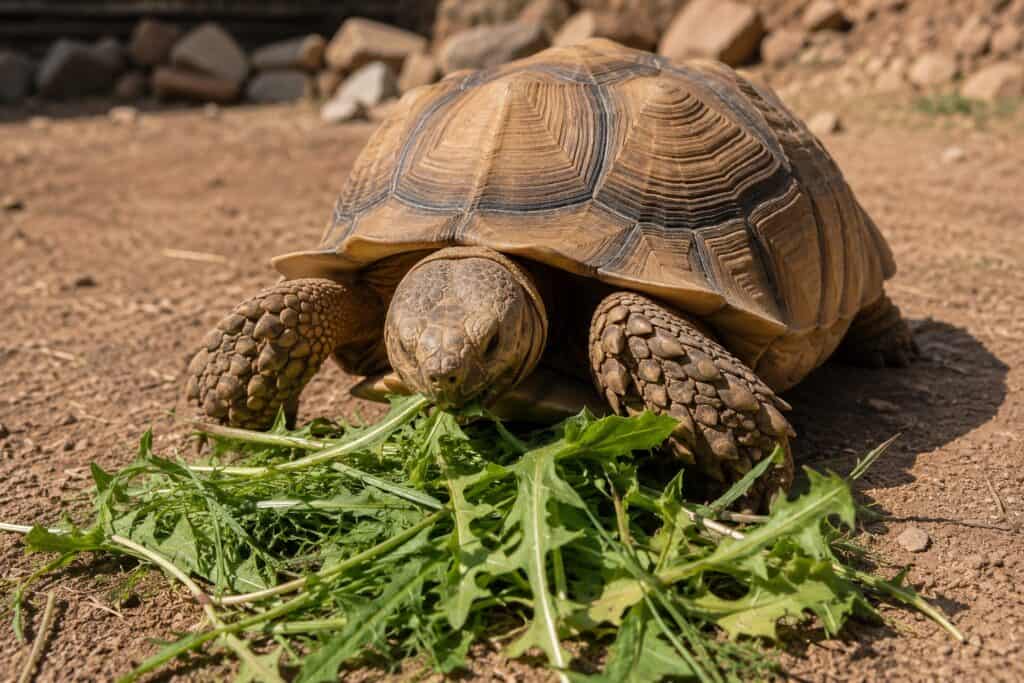
The foundation of a sulcata tortoise diet is grass and hay. Not lettuce, not fruit, not grocery store salad mix. Grass. In the wild, sulcatas spend their days grazing on dry grasses and weeds across the sub-Saharan savanna. Their digestive system evolved for high-fiber, low-protein, low-sugar plant matter. Your goal in captivity is to replicate that as closely as possible.
Roughly 80 to 90% of the diet should be grass, hay, and broadleaf weeds. The remaining 10 to 20% can be leafy greens and the occasional vegetable. Fruit should be rare, maybe once or twice a month as a treat, if at all.
The Best Foods for Sulcata Tortoises
Grass is the staple. If your sulcata has outdoor space, let them graze on pesticide-free lawn grass. Bermuda grass, orchard grass, and timothy grass are all excellent. If your tortoise is indoors or you need to supplement, timothy hay and orchard grass hay should always be available. Think of hay as the “always there” food, the equivalent of a ball python’s water bowl. It should never run out. The same high fiber, low protein principle applies to other grazing tortoises at a smaller scale, so if you keep or are considering one, our Russian tortoise care guide uses the same foundation with a different portion size. The weed list and weekly plan are in what to feed a Russian tortoise.
Broadleaf weeds are the next best thing. Dandelion greens (leaves and flowers), plantain weed, clover, hibiscus leaves and flowers, and mulberry leaves are all safe and nutritious. These same weeds feed most herbivorous reptiles. Our uromastyx diet guide uses nearly the same list for a desert lizard, with dry lentils and seeds on the side. If you have a yard, you probably already have half of these growing as “weeds.” Just make sure the area hasn’t been treated with pesticides, herbicides, or fertilizers.
For the leafy green portion, stick to high-fiber, calcium-rich options. Turnip greens, mustard greens, collard greens, and endive work well. These should be offered a few times a week as variety, not as the main course. Some keepers offer greens daily and skip the hay, and that’s where problems start. Greens are wetter and lower in fiber than grass and hay, and feeding too many of them leads to runny stools and shell growth issues.
Cactus pads (opuntia) are another great option if you can find them. They’re high in fiber and calcium and sulcatas love them. Remove the spines first. For a more detailed species profile beyond diet, see our sulcata tortoise care guide.
What to Avoid Feeding Your Sulcata
Some foods that seem harmless are actually problematic for sulcatas, either because of the nutritional profile or because they cause digestive issues over time.
Avoid fruit as a regular part of the diet. Bananas, strawberries, apples, and other fruits are high in sugar and can cause parasite blooms in the gut, diarrhea, and unhealthy growth rates. A small piece once or twice a month won’t hurt, but fruit should never be routine.
Avoid protein-heavy foods entirely. Sulcatas should never eat dog food, cat food, beans, or any animal protein. This is a strict herbivore. High protein diets cause rapid growth, kidney damage, and severe pyramiding of the shell that’s irreversible once it happens. Worth saying clearly, because keepers with mixed collections get this backwards: none of that transfers to box turtles. They’re omnivores that want earthworms and snails as roughly half the diet, and what box turtles eat instead is close to the opposite of the rule above.
Avoid iceberg lettuce and cucumber. They’re mostly water with almost no nutritional value. Your tortoise fills up on them and gets nothing useful in return.
Avoid spinach and beet greens in large amounts. They contain oxalates that bind calcium and prevent absorption. A small amount occasionally is fine, but they shouldn’t be a regular rotation item.
Avoid anything from the grocery store that’s been treated with pesticides unless you wash it thoroughly. Organic is safer for daily greens.
Sulcata Tortoise Diet by Age
| Age | Primary Diet | Feeding Frequency |
|---|---|---|
| Hatchling (under 1 year) | Finely chopped grass, hay, dandelion | Daily, small portions |
| Juvenile (1 to 3 years) | Grass, hay, broadleaf weeds, greens | Daily grazing + greens 3-4x/week |
| Sub-adult (3 to 7 years) | Grazing grass, hay, weeds | Daily grazing, greens 2-3x/week |
| Adult (7+ years) | Primarily grazing and hay | Continuous grazing, greens 2x/week |
Hatchlings and juveniles should get food daily. Offer a pile of chopped grasses, hay, and weeds roughly the size of their shell each day. As they grow, the proportion of hay and grazing should increase. Adults with outdoor access will do most of their eating by grazing throughout the day.
A proper grazing area is part of the enclosure build, not an afterthought. Our sulcata tortoise enclosure guide covers pen size, buried barriers, and the heated night box.
Calcium and Supplements
Calcium is critical for sulcata tortoises, especially growing ones. Dust food with calcium powder (no D3 if your tortoise gets regular outdoor sunlight, with D3 if they’re kept indoors under UVB). For hatchlings and juveniles, dust every other feeding. For adults, two to three times per week is enough.
A cuttlebone left in the enclosure gives your tortoise a way to self-supplement. Most sulcatas will nibble on it when they need calcium, and it also helps keep the beak trimmed.
A reptile multivitamin can be dusted once a week for growing tortoises, once every two weeks for adults. Don’t overdo vitamins. More is not better with fat-soluble vitamins like A and D3.
Tracking What Works for Your Sulcata
Sulcatas grow slowly, and diet problems don’t show up overnight. A tortoise on a bad diet might look fine for months before you notice pyramiding, soft shell, or a sudden weight plateau. That’s why tracking feeding schedules matters so much with these animals. When you can look back at three months of feeding logs and weight data, patterns become obvious that you’d miss day to day.
The Exotic Reptile Care app lets you log every feeding, track weight over time with growth charts, and set reminders for supplement schedules. For an animal that lives 50 to 100 years, keeping records from the start gives you a real picture of how your tortoise is developing.
Sulcata Tortoise Diet FAQ
Can sulcata tortoises eat bananas?
Occasionally, yes. A small piece once or twice a month as a treat is fine. Don’t make it a regular food. The sugar content is too high for a grazing herbivore and can cause digestive issues over time.
Do sulcata tortoises need water?
Yes. Always provide a shallow water dish large enough for your tortoise to soak in. Sulcatas drink and absorb water through soaking. Change the water daily since they tend to defecate in it.
Can sulcata tortoises eat romaine lettuce?
It’s not harmful in small amounts, but it’s low in fiber and nutrition compared to grass and hay. It’s filler, not food. Offer turnip or mustard greens instead if you want a leafy green option.
How much should I feed my baby sulcata?
Offer a pile of chopped greens, grass, and hay roughly the size of the tortoise’s shell once per day. If food is left over consistently, reduce the amount slightly. If it’s gone quickly, offer a bit more.
Keep It Simple, Keep It Consistent
The sulcata tortoise diet isn’t complicated. Grass, hay, weeds, and some greens. That’s the formula. The mistakes happen when keepers treat sulcatas like bearded dragons and offer colorful salad bowls full of fruit and variety. Sulcatas don’t need variety. They need fiber. Stick with the basics, supplement calcium, and track growth over time. Your tortoise will reward you with decades of slow, steady, healthy growth. If you keep other unusual species, see our care guides for the ackie monitor and red-eyed crocodile skink.