Building a sulcata tortoise enclosure is not like setting up for any other reptile, and the reason is simple. That two-inch hatchling in the pet store box is going to become a 70 to 150 pound animal that can push through a fence, dig under a shed, and rearrange your yard on a whim. Most people build for the tortoise in front of them. Then they build again eighteen months later, and again after that. Building for the adult from the start saves a genuinely painful amount of money. This guide covers the build itself. For the wider picture on diet, health, lifespan, and whether the species suits you at all, start with our sulcata tortoise care guide.
| Sulcata Enclosure Requirement | What You Actually Need |
|---|---|
| Adult size to plan for | 24 to 36 inch shell, 70 to 150+ pounds |
| Outdoor pen (adult) | 100 square feet absolute minimum, 400+ is realistic |
| Wall height | At least 24 inches above ground, solid, not see-through |
| Buried barrier | 12 to 24 inches below ground |
| Indoor space (juvenile) | 4×2 feet minimum, upgrade every few months |
| Basking temp | 95 to 100F |
| Night minimum | 65 to 70F, heated shelter required |
| Humidity (hatchling) | 70 to 80% with a humid hide |
| Humidity (adult) | 40 to 55% |
How Big Does a Sulcata Tortoise Enclosure Need to Be?
Bigger than you think, and bigger than almost anything sold as a tortoise setup. A hatchling can start in a 4×2 foot tortoise table, but that lasts maybe six to nine months at their growth rate. Sulcatas are the fastest-growing tortoise species and juveniles put on size alarmingly fast when fed properly.
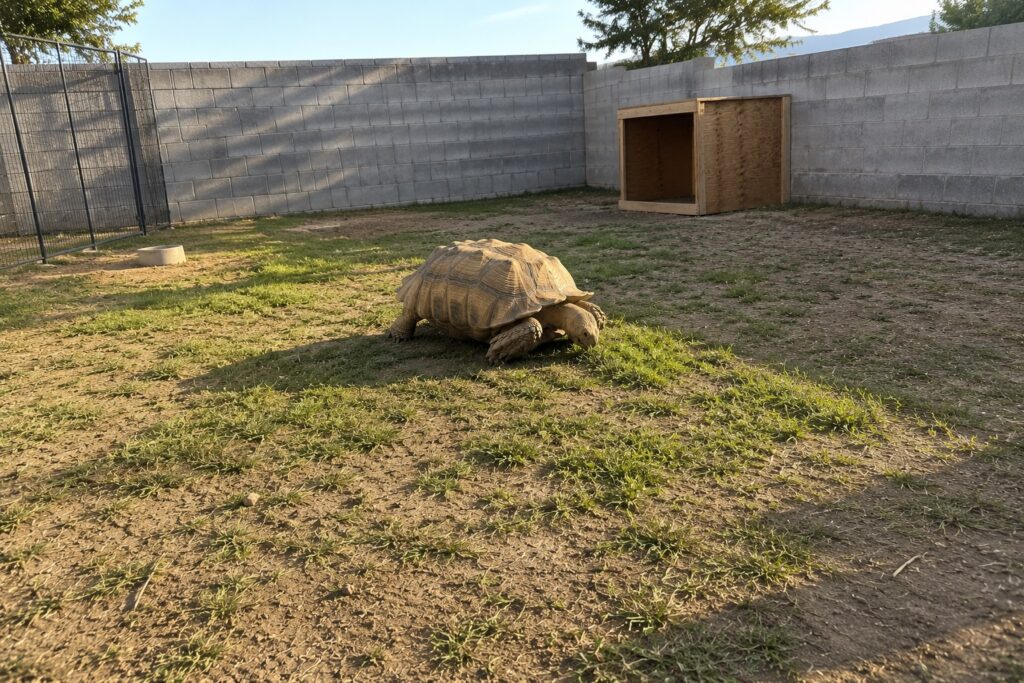
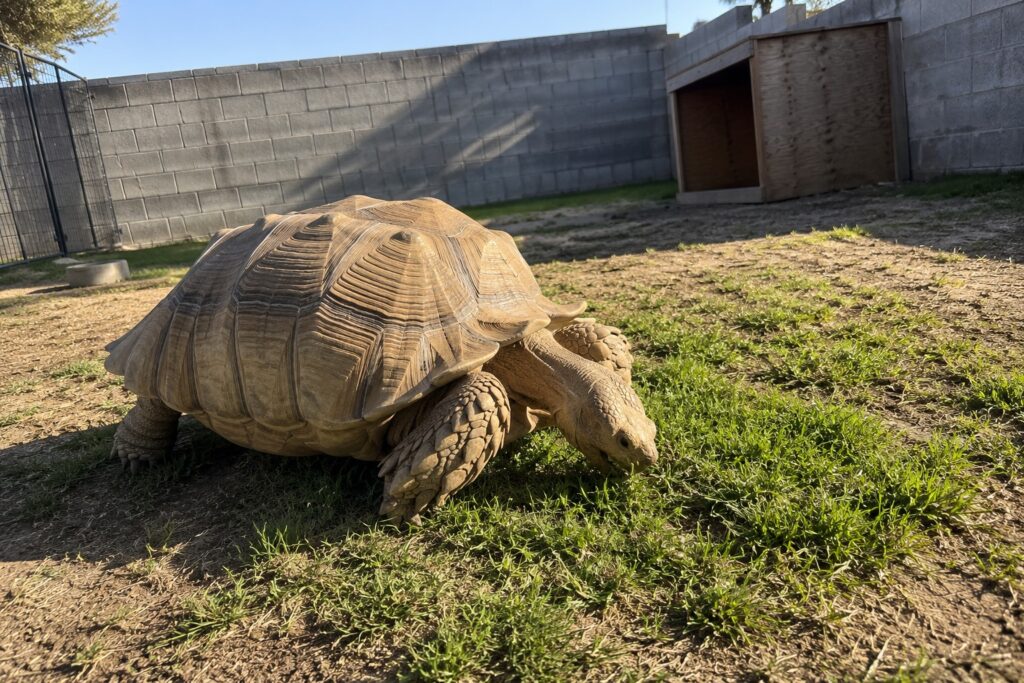
For an adult, the honest answer is that no indoor sulcata tortoise enclosure is adequate as a permanent home. You’re looking at 100 square feet as a bare minimum outdoor pen and 400 square feet or more if you want a tortoise that actually thrives. Many long-term keepers give over a good chunk of their back yard. If you live somewhere that gets real winters, you need a heated shed or outbuilding for the cold months, which is a construction project, not a shopping trip.
This is the reason sulcata rescues are overflowing across the US. Nobody plans for the space. If you can’t commit to a yard-scale sulcata tortoise enclosure within a few years, this species isn’t the right one, and there’s no shame in choosing a Russian tortoise instead.
Outdoor Sulcata Tortoise Enclosure: Walls and Buried Barriers
Two rules cover most escapes. Walls must be solid, and they must go underground.
Solid matters because sulcatas will walk directly into anything they can see through. Chain link, wire mesh, and lattice all read as open ground to them, and they’ll pace the perimeter for hours trying to push through, wearing down their beak and the front of their shell in the process. Use concrete block, brick, thick timber, or solid fence panel. Twenty-four inches above ground is the working minimum for an adult.
Underground matters because they dig. Sulcatas are one of the genuine tunneling tortoise species and in the wild they excavate burrows tens of feet long. A wall that stops at the surface is a suggestion. Sink your barrier 12 to 24 inches down, and check the perimeter every few months for fresh digging along the base.
Also watch what they dig near. A sulcata will happily tunnel under a shed foundation, a deck, or a fence post and destabilize it. Keep the pen away from anything structural, or run a buried barrier along those edges specifically.
The same digging and escape logic applies to smaller chelonians, just at a scale you can actually build in a weekend. Box turtles dig too, and they climb better than sulcatas do, so the barrier goes down and the wall needs an overhang. Our box turtle enclosure guide covers the scaled-down version.
Indoor Setup for Juveniles
Until your tortoise is big enough and the weather is right, you’ll need indoor housing. A tortoise table beats a glass tank every time. Glass sides cause the same walk-into-it behavior as wire fencing, and the enclosed sides trap stale air. An open-topped wooden table with solid sides is the standard, and the same floor-space-over-height logic that applies to other ground-dwelling species, like in our blue tongue skink enclosure guide, applies here in an extreme form.
Substrate should hold a bit of moisture without staying soggy. Cypress mulch, coconut coir, or a topsoil and play sand mix all work. Give it 4 to 6 inches so a juvenile can dig in. Skip reptile carpet, calcium sand, and rabbit pellets. Rabbit pellets in particular get recommended constantly and they mold fast and get eaten as low-quality food.
If you’re curious whether a planted, self-cleaning approach works here, it mostly doesn’t. Our bioactive enclosure guide explains where bioactive shines, and a sulcata is the counterexample, they eat the plants, crush the cleanup crew’s habitat, and out-produce any bioactive system in waste within months.
Heating and Lighting Your Sulcata Tortoise Enclosure
Basking should sit at 95 to 100F measured at shell height, with ambient warmth around 80 to 85F on the warm end and cooler space to retreat to. Overhead heat only, use a halogen flood or ceramic emitter mounted safely above. Never use heat rocks, they cause plastron burns and sulcatas sit still long enough to get badly hurt.
At night, don’t drop below 65 to 70F. This is where the outdoor build gets serious. Your sulcata tortoise enclosure needs a heated night box or shed the tortoise can walk into on its own, insulated, with a heat source on a thermostat. A dog-house-style box with a radiant heat panel and a rubber flap door is a common solution. Many keepers dig the box partly into a slope so the ground helps hold temperature.
Indoors, UVB is non-negotiable. Use a linear T5 HO fixture running a good portion of the enclosure length, replaced roughly every 12 months even if it still lights up. Outdoors in real sunlight you don’t need a bulb, unfiltered sun is better than anything you can buy. Glass and most plastics block UVB, so a tortoise in a sunroom is not getting what it looks like it’s getting.
Humidity, Water, and Shell Pyramiding
Pyramiding is the bumpy, raised-scute shell growth you see on so many captive sulcatas, and it’s largely a husbandry problem rather than a diet-only problem. Hatchlings and juveniles raised too dry pyramid. Keep young tortoises at 70 to 80% humidity with a humid hide, a covered area with damp sphagnum or coir they can sit in. Adults are fine in the 40 to 55% range.
Provide a shallow water dish big enough to climb into but no deeper than the bridge of the shell, the seam where the top and bottom shell meet. Tortoises can and do drown. Change it daily, because they will also use it as a toilet. Juveniles benefit from a 15 to 30 minute soak in shallow lukewarm water once or twice a week.
Space and humidity handle half the shell equation. The other half is what goes in the bowl, and our sulcata tortoise diet guide covers the high-fiber, low-protein feeding that keeps growth smooth instead of fast and lumpy.
Grazing Space Is Part of the Enclosure
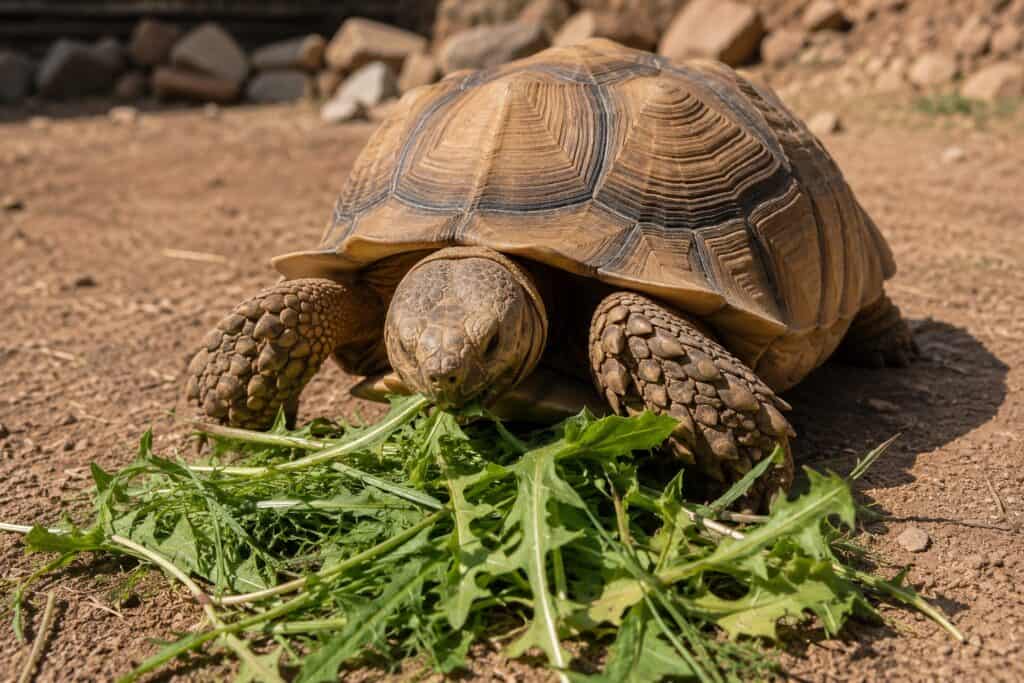
This is the piece people miss when planning a sulcata tortoise enclosure. These are grazing animals. In a proper setup, most of their food is growing under their feet, not arriving in a dish.
Plant the pen with a mix of Bermuda, orchard grass, timothy, fescue, and let clover, dandelion, and plantain weeds come up. Make sure nothing in or near the pen has been treated with pesticide, herbicide, or fertilizer, and check for toxic ornamentals like azalea, oleander, and buttercup before your tortoise finds them first.
A planted pen also solves boredom. A sulcata with grass to work through spends its day grazing instead of pacing the wall trying to escape.
Tracking Growth in a Fast-Growing Species
Sulcatas grow quickly enough that trouble shows up in the numbers before it shows up on the shell. Growth that’s too fast is as much a warning as growth that’s stalled, since rapid gain paired with dry conditions is exactly what drives pyramiding.
Weighing monthly and logging it gives you a curve you can actually read. The Exotic Reptile Care app handles weight logging with growth charts, and you can set reminders for things that are easy to let slide on a big outdoor setup, like the annual UVB bulb swap or the quarterly perimeter check for fresh digging.
Common Sulcata Enclosure Mistakes
Buying a tank instead of building a table. Using see-through fencing. Forgetting the buried barrier until the tortoise is already under the neighbor’s fence. Skipping the heated night box and hoping a mild winter holds. Housing two males together, which reliably ends in ramming and flipped tortoises. And letting a sulcata get onto a slope or near a step where it can flip, since a tortoise stuck on its back in the sun can die within hours.
If your tortoise shows soft or unusually pale shell areas, wheezing, bubbling from the nose, or swollen eyes, get it seen. Use the ARAV vet directory to find someone who actually treats chelonians, because a general practice vet is often guessing with a species this size.
FAQ: Sulcata Tortoise Enclosure Questions
Can a sulcata tortoise live indoors permanently?
Not realistically. A juvenile can be housed indoors for the first couple of years, but an adult needs yard-scale space. If your climate rules out year-round outdoor living, you need a heated shed or converted outbuilding, not a room.
How deep should a sulcata tortoise enclosure barrier be buried?
Twelve inches is the minimum and 24 inches is safer for a full-grown adult. Sulcatas are dedicated diggers and a surface-level wall will not hold them once they decide to go under it.
What temperature should a sulcata enclosure be at night?
Keep the shelter above 65 to 70F. Sustained cold nights lead to respiratory infections, which are common and serious in this species. A thermostat-controlled heat source in an insulated night box is the standard fix.
Do sulcata tortoises need a substrate outdoors?
Grass and natural soil are ideal. Just confirm the ground hasn’t been chemically treated and that no toxic plants are growing in or hanging over the pen.
Can two sulcata tortoises share one enclosure?
Two males will fight, ram each other, and flip one another, which can be fatal. Mixed or female pairs sometimes work if the space is genuinely large with multiple shelters and sight breaks, but plan on separating them.
Build the sulcata tortoise enclosure for the animal you’ll have in five years, not the one in your hands today. The keepers who end up surrendering their tortoises almost never do it because they stopped caring. They do it because the setup never caught up with the tortoise.