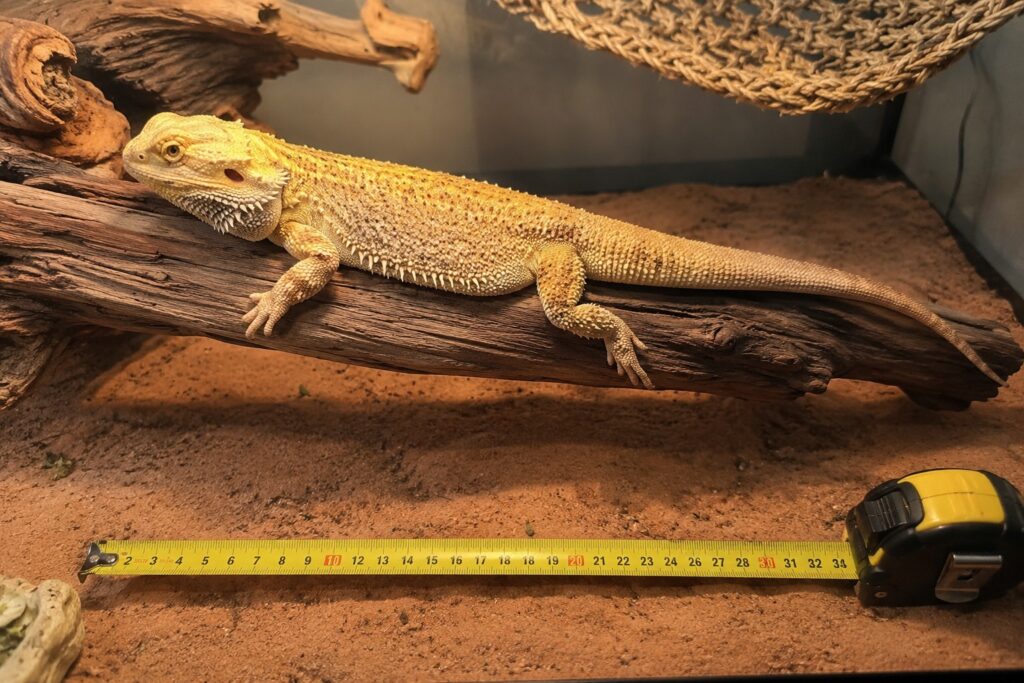
How big do bearded dragons get? Most adults land between 18 and 24 inches nose to tail tip, weighing 380 to 510 grams. That number surprises people who bought a four-inch hatchling at a pet store, and it’s the reason so many beardies end up in 20 gallon tanks that were never going to be big enough.
The tail is doing a lot of the work in that measurement. Roughly half a bearded dragon’s total length is tail, so a 22 inch dragon has a body around 10 to 11 inches. Useful to know when you’re picturing what fits in an enclosure.
| Age | Total Length | Weight |
|---|---|---|
| 1 month | 3 to 4 inches | 4 to 6 g |
| 2 months | 5 to 9 inches | 8 to 40 g |
| 3 months | 8 to 11 inches | 22 to 110 g |
| 4 months | 9 to 12 inches | 41 to 115 g |
| 6 months | 11 to 18 inches | 180 to 190 g |
| 8 months | 13 to 20 inches | 230 to 280 g |
| 12 months | 16 to 22 inches | 350 to 465 g |
| 18 to 24 months | 18 to 24 inches | 380 to 510 g |
Those ranges are wide on purpose. Two healthy dragons the same age can differ by several inches, and that’s normal.
How Big Do Bearded Dragons Get by Species
Almost every bearded dragon in the pet trade is a central bearded dragon, Pogona vitticeps, and that’s the animal those numbers describe. But the name covers several species and the size difference is significant.
Rankin’s dragons, Pogona henrylawsoni, top out around 10 to 12 inches. They’re a genuinely good option if space is your limiting factor, and they’re often mislabeled in shops as “dwarf beardies.”
German giants are the other end. They’re a selectively bred line of central bearded dragons, not a separate species, and they can reach 26 to 30 inches and 700 grams or more. Genuine German giant genetics are rarer than sellers claim, so treat the label with suspicion unless the breeder can show you the lineage.
Males generally end up slightly larger than females, with broader heads and thicker tail bases. The difference isn’t dramatic, usually an inch or two.
The Growth Timeline
Growth is front-loaded and fast. A hatchling roughly doubles in length in its first two months, and most of the total size is reached by 12 months. After that it slows to a crawl, with dragons filling out in weight and bulk through 18 to 24 months rather than adding much length.
The first six months are where husbandry mistakes cost you the most. A dragon that’s underfed, kept too cool, or raised without functional UVB during that window doesn’t fully catch up later, even if you correct everything afterward.
By 12 months your dragon is essentially adult sized. If yours is 16 inches at a year old, that’s within range and probably fine. If it’s 11 inches at a year old, something has been wrong for a while.
What Actually Determines How Big Bearded Dragons Get
Four things, roughly in order of impact.
Diet. Juveniles need heavy insect feeding, as much as they’ll eat in 10 to 15 minutes, two or three times a day, alongside daily greens. Protein drives growth at this stage. The ratio flips as they mature, and adults should be eating mostly plants with insects a few times a week. Getting an adult onto greens is its own battle, covered in our guide to a bearded dragon not eating greens.
Temperature. Bearded dragons can’t digest properly without heat. A basking surface too cool means food sits undigested and growth stalls regardless of how much you’re offering. Adults want a basking surface of 100 to 110F, juveniles a bit hotter. Too hot is also a problem, since an overheating dragon avoids the basking spot entirely and eats less, which we covered in bearded dragon basking temperature too high.
UVB. Without it, dragons can’t synthesize D3, can’t absorb calcium, and develop metabolic bone disease. Veterinary references describe this as the most common bone disorder in pet reptiles, driven by poor calcium to phosphorus ratios, missing UVB, and inadequate temperatures. It causes deformities and permanently limits growth. Use a linear T5 HO tube, not a coil, and replace it yearly.
Genetics. Some dragons are just smaller. If husbandry is right and growth tracks the chart reasonably, don’t chase a number.
Does Tank Size Stunt Growth?
This is the most persistent myth in the hobby, and it’s wrong in the specific form people repeat it. A small enclosure does not directly limit how big a bearded dragon gets the way it does for some fish. Your dragon doesn’t sense the walls and stop growing.
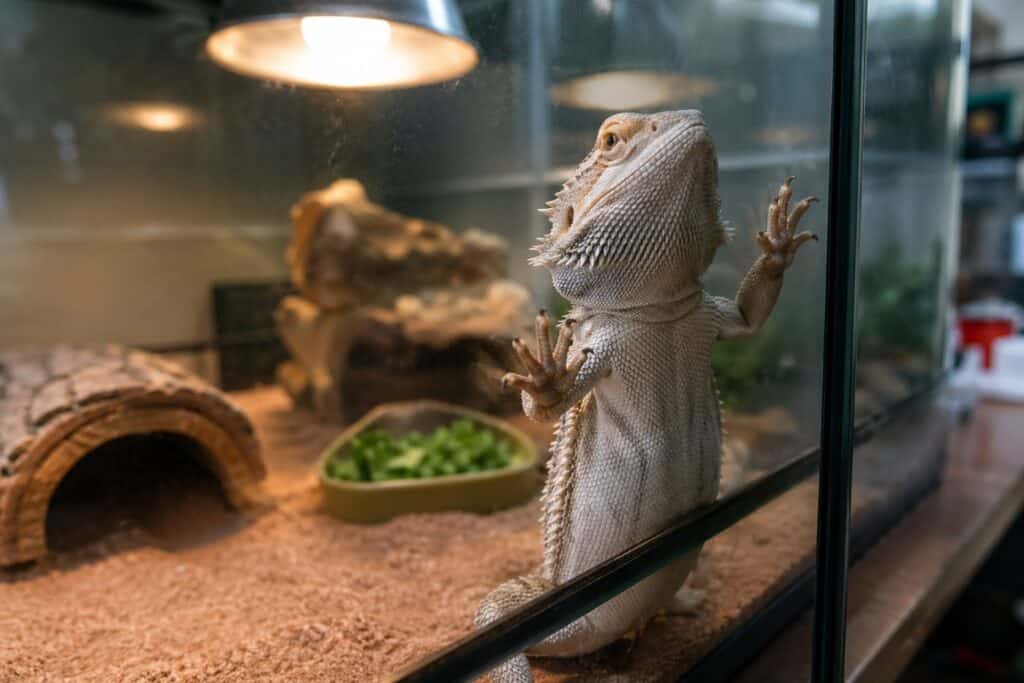
What actually happens is indirect and still bad. A 20 gallon tank can’t hold a proper thermal gradient, so the dragon can’t thermoregulate, so it can’t digest efficiently. Small enclosures also raise stress, and stressed dragons eat less. The growth problem is real, the mechanism is just husbandry rather than magic.
Practical minimum for an adult is a 40 gallon breeder, and 120 gallons or a 4x2x2 foot enclosure is much better. Given how big bearded dragons get, buying the adult enclosure up front is cheaper than buying three.
When Slow Growth Is Actually a Problem
Weigh monthly and compare against the chart. Some flat months are normal, particularly in an adult. What matters is the trend.
Worth investigating: no weight gain across six to eight weeks in a dragon under a year, visible spine and hip bones, a head that looks oversized for the body, weakness in the limbs or trouble climbing, or a jaw that looks soft or swollen. That last group points at metabolic bone disease and needs a vet.
Two things that look like stunting but aren’t. Brumation pauses growth entirely and can last weeks or months, which is normal in dragons over about ten months old and covered in our bearded dragon brumation signs guide. And a dragon that’s stressed from a recent move or a bad enclosure setup will slow down temporarily, often alongside a darkened beard, which we explain in bearded dragon black beard.
Tracking Growth Instead of Guessing
Nobody notices gradual stalling in real time. You see your dragon every day, which is exactly why you can’t tell whether it’s grown in the last six weeks. A number on a scale can.
Weigh weekly for the first year, then monthly. The Exotic Reptile Care app plots weight over time as a growth chart, so a plateau shows up as a flat line rather than a vague feeling that something’s off. Logging feeds alongside it also answers the obvious follow-up question, which is whether a stall came from eating less or from something else.
If you do end up at a vet, six months of weight data is worth more than any description you can give from memory.
FAQ: How Big Do Bearded Dragons Get?
How big do bearded dragons get in inches?
Central bearded dragons typically reach 18 to 24 inches total length, with roughly half of that being tail. German giants can exceed 26 inches, and Rankin’s dragons stay around 10 to 12.
At what age do bearded dragons stop growing?
Length is mostly finished by 12 months. They continue filling out in weight and bulk until 18 to 24 months.
How much should an adult bearded dragon weigh?
Most healthy adults sit between 380 and 510 grams. Large males and giant lines run heavier. Body condition matters more than the number, so check that the hips and spine aren’t prominent and the belly isn’t distended.
Can a small tank stunt a bearded dragon’s growth?
Not directly, but it causes the problems that do. A tank too small to hold a proper temperature gradient prevents normal digestion and raises stress, both of which slow growth.
Why is my bearded dragon not growing?
Most often inadequate basking temperature, dead or missing UVB, or not enough insect protein during the first year. Brumation and recent stress also pause growth temporarily.
If you take one number away, make it 40 gallons as an absolute floor and 120 as the real target. How big bearded dragons get is mostly decided in the first year, and the enclosure you choose at the start is what determines whether the heat, light, and space are there when it counts.