Box turtle care gets recommended to beginners constantly, and it shouldn’t be. They’re not difficult exactly, but they’re demanding in ways that don’t show up until year three, and they routinely outlive the interest of the person who bought them. Fifty years is normal. A hundred happens.
They’re also not tortoises, despite living entirely on land and being sold alongside them. Box turtles are woodland animals that want damp soil, deep leaf litter, and humidity that would rot a Russian tortoise. Almost every mistake in box turtle care traces back to someone treating one like a desert species.
| Requirement | Target |
|---|---|
| Enclosure (indoor minimum) | 4 x 2 feet, more is better |
| Substrate depth | 4 to 6 inches, damp |
| Humidity | 60 to 80% |
| Basking spot | 85 to 88F |
| Ambient | 70 to 80F |
| Night | 65 to 75F |
| UVB | Linear T5, 5 to 6% |
| Lifespan | 40 to 100 years |
Know Which Species You Have
Most pet box turtles in the US are eastern box turtles, and the care below is written around them. Three-toed, ornate, and Gulf Coast box turtles are all common enough to encounter.
Ornate box turtles come from prairie and grassland rather than woodland, so they want somewhat drier conditions and lean further toward insects in their diet. Three-toed and Gulf Coast are close enough to eastern that the same setup works.
Asian box turtles are a different genus entirely with much more aquatic requirements, so don’t apply any of this to one.
Get the Legality Right Before Anything Else
This matters more for box turtles than almost any other reptile in the hobby.
Wild box turtle populations are in serious decline, and collection from the wild is a large part of why. They’re slow to mature, they lay few eggs, and a removed adult is a real loss to a local population. Many US states protect them outright, and taking one from the wild or keeping one you found is illegal in a good number of them.
Buy captive bred, from a breeder who can tell you the hatch date. If you find a box turtle crossing a road, move it to the side it was already heading toward and leave it there. Relocating one is close to a death sentence, since they navigate a home range they’ve known for decades.
Captive bred animals are also healthier. Wild-caught box turtles arrive loaded with parasites, dehydrated, and stressed, and they often never settle into captivity.
Housing: Outdoors Wins
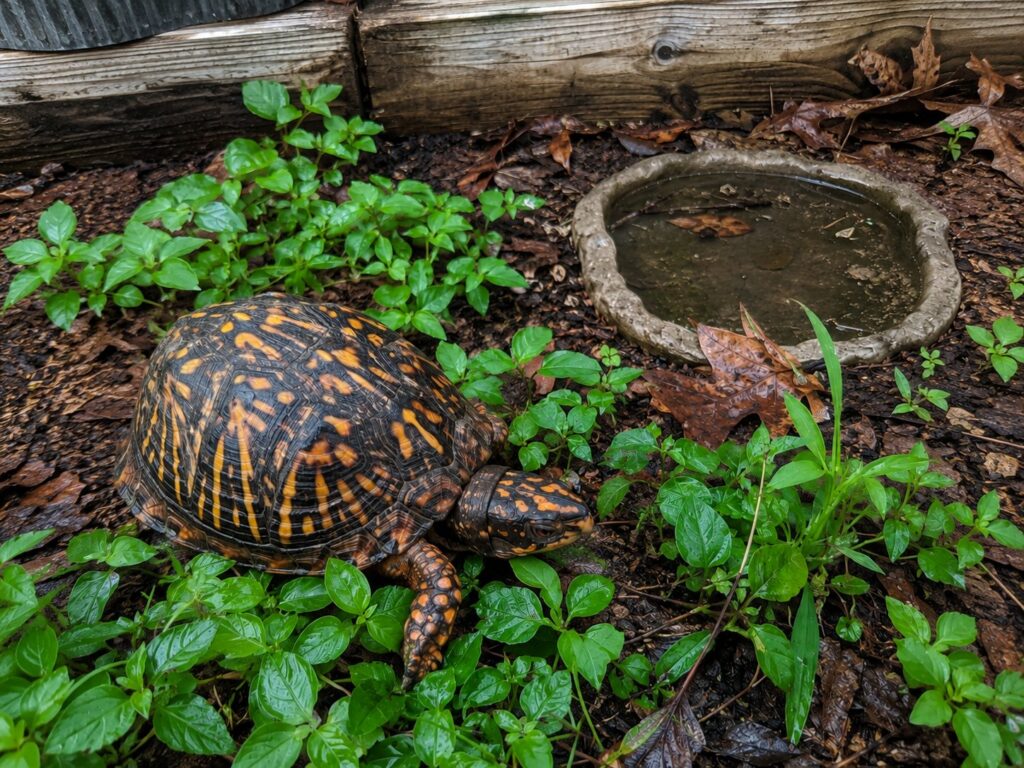
If your climate allows it, an outdoor pen is the best box turtle care setup there is and it isn’t close. Natural sunlight, real weather, room to roam, and the chance to dig and forage.
Build it with walls at least 18 inches high and sunk 8 to 12 inches into the ground, because box turtles dig and climb better than they look like they should. Cover the top with wire mesh against raccoons, dogs, and birds, which take a serious number of pet turtles every year. Plant it heavily, add logs and leaf litter, and sink a shallow water dish flush with the soil.
Indoors, the common tank recommendations are too small. A 4 by 2 foot footprint is a realistic minimum for one adult, and a large tortoise table, a stock tank, or a purpose-built wooden enclosure works better than a glass aquarium. Glass sides stress them and glass holds humidity poorly at the top while trapping stale air below.
Our box turtle enclosure guide covers the build in detail, including the substrate mix and layout.
Humidity Is the Thing People Get Wrong
Sixty to eighty percent, and it needs to be real humidity in the substrate rather than a number on a gauge.
The way you achieve it is depth and dampness underneath, not misting the air above. Four to six inches of a coco coir and topsoil mix, kept damp enough to hold a shape when squeezed but not wet enough to drip, topped with leaf litter and sphagnum moss in one corner. The turtle burrows into it and sits in its own humid microclimate.
Low humidity is the slow killer in box turtle care. It causes pyramided shell growth, poor sheds, sunken eyes, and eventually kidney damage from chronic dehydration. None of it is dramatic on any given day, which is precisely why it goes unnoticed for years.
Mist daily, especially in the morning, since that’s when they’re most active. Keep a water dish large enough for the turtle to climb fully into and change it every day. They drink from it, soak in it, and defecate in it, usually in that order.
Our reptile temperature and humidity guide puts these figures next to other species if you keep more than one.
Temperature and Lighting
Box turtles want less heat than most reptiles people keep. A basking spot at 85 to 88F is plenty, with ambient temperatures in the 70s and a cooler end they can retreat to. Nights can fall to 65 to 75F.
Overheating is a genuine risk, particularly outdoors in summer. They need deep shade and damp ground available at all times, and a turtle that can’t escape midday sun will die of it.
For UVB, use a linear T5 tube at 5 to 6 percent, spanning a good portion of the enclosure. They need less than a bearded dragon does but they absolutely do need it, and without it calcium absorption fails regardless of how well you feed them. Replace the tube every 12 months, since output collapses long before the light stops working.
Outdoors, natural sunlight handles this and does it better than any bulb.
Feeding
Box turtles are omnivores, which separates them from every tortoise you’ve read about. Roughly half protein and half plants for an adult, with hatchlings leaning more carnivorous and adults shifting toward plants as they age.
Earthworms, slugs, snails, and insects on the protein side. Dark leafy greens, squash, and vegetables on the plant side. Fruit is a normal part of the diet rather than a rare treat, which is another point where tortoise advice leads people astray. Our box turtle diet guide covers ratios, the full safe list, and the feeding schedule by age.
Feed in the morning on a flat slab rather than directly on substrate, dust with calcium two or three times weekly, and keep a cuttlebone available permanently.
Handling and Temperament
Box turtles tolerate handling. They don’t enjoy it. There’s no version of this animal that becomes affectionate, and a turtle that withdraws into its shell every time you approach is telling you something clear.
Keep handling to what husbandry requires. They’re an observation animal, and the reward is watching a turtle behave naturally in a well built enclosure rather than holding one.
Wash your hands afterward. Turtles carry salmonella as a matter of course, and the CDC guidance on reptile-associated salmonella is worth reading if there are young children in the house.
Brumation
Wild box turtles brumate through winter, and captive ones usually try to. Appetite falls off in autumn, activity drops, and they start burrowing deeper.
Brumation done properly is healthy and appears to support long-term condition and breeding. Done badly it kills turtles. It requires a vet check first, a fasting period so the gut is empty, a controlled temperature around 40 to 50F, and monitoring throughout.
If you’re not prepared for that, keeping the turtle warm and active through winter is an acceptable alternative. What you shouldn’t do is let a turtle half-brumate in a cool room by accident, which is where problems come from.
Health Problems to Know
Ear abscesses are close to a box turtle signature. A visible swelling on one or both sides of the head, usually caused by vitamin A deficiency, poor water quality, or both. It needs a vet to drain and it’s very preventable with a varied diet.
Vitamin A deficiency more broadly shows as swollen eyes, discharge, and appetite loss. It comes from a narrow diet with no orange or dark green vegetables.
Metabolic bone disease brings a soft shell, deformity, and weakness, from inadequate UVB or calcium.
Shell rot appears as soft, discoloured, or pitted patches, usually from substrate that’s soaking wet rather than merely damp, or an injury that got infected.
Respiratory infection shows as bubbling from the nose, open-mouth breathing, wheezing, and lethargy, and usually follows a cold or overly wet setup.
Any of these needs a vet who works with chelonians. The ARAV vet directory is the place to find one, and finding one before you need one is the right order to do it in.
Tracking a Fifty Year Animal
Box turtles change slowly, which makes memory a bad tool for keeping them. Seasonal appetite swings are normal, so “he’s not eating much” means one thing in October and something else entirely in June.
Weight and shell length recorded over years is what separates the two. Growth that seems fine month to month can be well below where it should be across two years, and the only way to see it is a chart.
The Exotic Reptile Care app keeps feeding logs and weight charts on the same profile, and you can track shell length and weight over the years rather than trusting a memory that spans decades. It also handles reminders for the things easy to lose track of, like the annual UVB tube change. Our post on tracking reptile feeding schedules explains why this matters most for species with variable appetites.
FAQ: Box Turtle Care Questions
How long do box turtles live?
Commonly 40 to 60 years in captivity, with well kept individuals reaching 80 to 100. Plan for the animal outliving your interest in it and possibly you.
Are box turtles good pets for beginners?
They’re manageable but not easy. They need real space, high humidity, and a decades-long commitment, and they don’t enjoy handling. They’re a poor fit for a child’s first pet despite being sold that way.
Can I keep a box turtle I found outside?
Usually no, and often illegally. Wild box turtles are protected in many states and collection is a major cause of population decline. Move a road-crossing turtle to the side it was heading and leave it.
Can box turtles live indoors permanently?
Yes, with a large enough enclosure, correct humidity, and proper UVB. An outdoor pen is better if your climate allows it, even seasonally.
Do box turtles need to brumate?
Not necessarily. Brumation is natural and healthy when done properly, but keeping a turtle warm and active through winter is a valid choice. An accidental half-brumation in a cool room is the outcome to avoid.
Can two box turtles live together?
Often poorly. Males harass females persistently and can injure them. If you house more than one, use a large outdoor pen with heavy planting and visual barriers, and keep it to one male.
Deep damp substrate, a big footprint, and a vet lined up before you need one. That’s most of box turtle care, and the rest is patience with an animal that measures its life in decades rather than seasons.