Carpet python care is straightforward once the snake is an adult. The first year is the part that tests people. Baby carpet pythons are famous for biting anything that moves near them, and plenty of new keepers assume they bought an aggressive snake. They didn’t. Almost every carpet grows out of it, and how you handle the first few months decides how fast.
This guide covers the subspecies, the setup numbers, feeding, and five ways to get through the nippy stage.
Carpet Python Care Quick Specs
A carpet python needs a tall enclosure with sturdy perches, a basking spot of 88 to 92°F, a cool end of 75 to 80°F, humidity of 40 to 60%, and one appropriately sized rodent every one to three weeks depending on age.
| Parameter | Target |
|---|---|
| Adult length | 5 to 9 feet, depending on subspecies |
| Lifespan | 20 to 30 years |
| Adult enclosure | 4 x 2 x 2 feet minimum, 6 x 2 x 3 feet for large coastals |
| Basking spot | 88 to 92°F |
| Warm side | 82 to 85°F |
| Cool end | 75 to 80°F |
| Night | 70 to 75°F |
| Humidity | 40 to 60%, higher during shed |
| Adult feeding | One rat every 2 to 3 weeks |
Which Carpet Python Is Which
“Carpet python” covers several subspecies, and adult size varies a lot between them. Know which one you’re buying before you build the enclosure.
| Subspecies | Adult length | Notes |
|---|---|---|
| Irian Jaya | 4 to 6 feet | Smallest, usually calm |
| Jungle | 5 to 7 feet | Black and yellow, often nippy young |
| Darwin | 5 to 7 feet | Common, hardy |
| Coastal | 6 to 9 feet | Largest, needs the biggest enclosure |
| Diamond | 6 to 8 feet | Needs cooler temperatures |
Diamond pythons are the exception on heat. They come from cooler parts of Australia and do badly if kept as warm as the others year round. If you have a diamond or a diamond cross, get subspecies advice from the breeder.
For a first carpet, an Irian Jaya or a Darwin is the easiest choice.
Setting Up a Carpet Python Enclosure
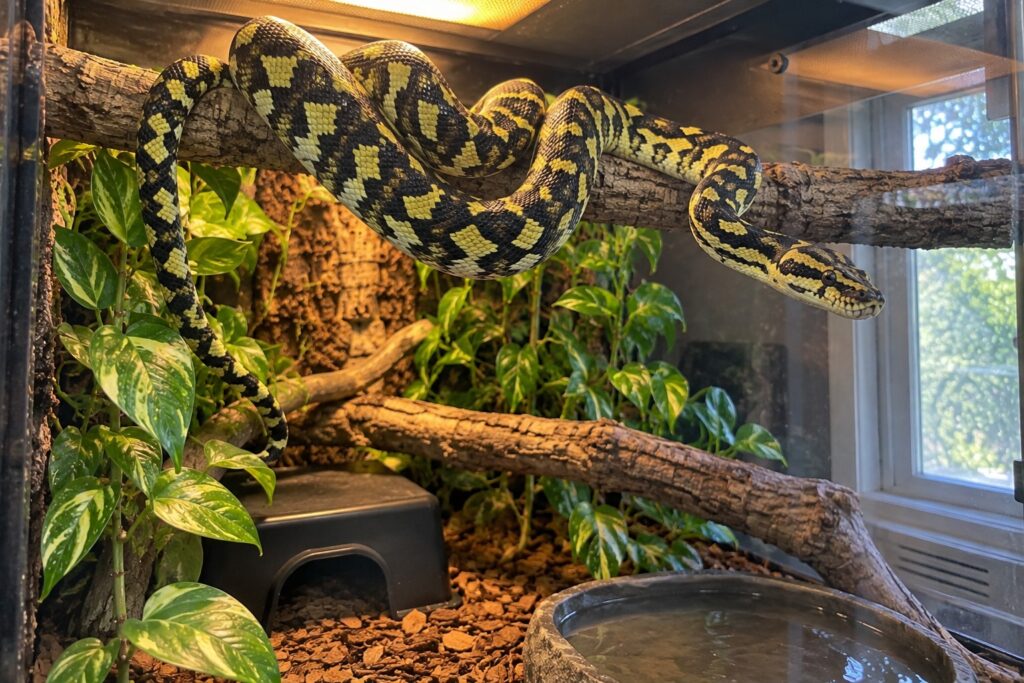
Carpet pythons are semi-arboreal. They spend a lot of time off the ground, so good carpet python care means an enclosure with real height and perches, not just floor space. This is the main difference from a ball python enclosure, where floor space and tight hides matter most.
Adults of the smaller subspecies need at least 4 x 2 x 2 feet. Large coastals need something closer to 6 x 2 x 3 feet. PVC or sealed wood enclosures hold heat and humidity better than glass tanks.
Give them at least two strong horizontal perches, one near the basking spot and one in the cooler half. Perches should be about as thick as the snake’s body and fixed firmly, since a seven foot python is heavy. Add a hide on the floor at each end, a large water bowl, and some cover from fake plants or cork.
Hatchlings do better in something small. A baby in a huge enclosure feels exposed and stays defensive. A tub or small enclosure with a perch and two tight hides is ideal for the first six months.
Cypress mulch, coconut husk, or a soil mix all work as substrate. Avoid cedar and pine.
Temperature and Humidity for Carpet Python Care
Aim for a basking spot of 88 to 92°F, a warm side of 82 to 85°F, and a cool end of 75 to 80°F. Night temperatures can drop to 70 to 75°F.
Overhead heat suits carpets best, since they bask up high. A halogen bulb, deep heat projector, or radiant heat panel all work. Every heat source goes on a thermostat, and any bulb inside the enclosure needs a guard. A climbing snake will wrap around a bare bulb and burn itself. If you’re unsure of your numbers, here’s how to check your temperature readings properly.
Humidity of 40 to 60% is right for most carpets. Raise it toward 70% when the snake goes into shed by misting lightly or adding a humid hide. UVB isn’t required, but a low output tube is a good addition and many keepers see more daytime basking with one.
Feeding a Carpet Python
Carpets are eager feeders, which is one of the easy parts of carpet python care. Feed frozen thawed prey, about as wide as the widest part of the snake’s body.
- Hatchlings: one fuzzy or hopper mouse every 7 days
- Juveniles: one adult mouse or rat pup every 7 to 10 days
- Subadults: one small or medium rat every 10 to 14 days
- Adults: one medium or large rat every 2 to 3 weeks
Warm the prey in a sealed bag in hot water and offer it with long tongs. Carpets strike fast and from a distance, so keep your hand well back. Don’t handle for 48 hours after a meal.
Watch the body shape. A healthy carpet is slim and muscular with a slightly triangular cross section. A round, soft body means you’re overfeeding.
5 Ways to Get Through the Nippy Stage
The nippy stage is the hardest part of carpet python care. Baby carpet pythons bite for two reasons, and it helps to know which one you’re dealing with. A defensive bite is a quick strike and release from a snake in an S shaped coil, usually with hissing. A feeding bite is a grab and hold, often with a coil thrown around your hand. The fixes are different.
1. Use a hook every time. Before you pick the snake up, touch it gently on the body with a snake hook. This tells it that food isn’t coming. Carpets learn this fast, and it stops most feeding bites.
2. Lift from below, with confidence. Hesitating over the snake with your hand looks like a predator. Slide the hook or your hand under the middle of the body and lift in one smooth move. Once a baby carpet is up and supported, most stop striking.
3. Keep sessions short and regular. Five minutes, three or four times a week, works better than one long session. End the session while the snake is calm, not right after a strike, or it learns that biting makes you go away.
4. Don’t handle at the wrong time. Skip handling for 48 hours after a meal, on feeding day, and when the snake is in shed with cloudy eyes. Most “random” bites happen at one of these times. It’s easier to log feed days in the app than to remember them, and Exotic Reptile Care tracks sheds too, so you can check before you open the enclosure.
5. Fix the enclosure. A defensive baby is usually a scared baby. Add cover, tighten the hides, and move it to a smaller enclosure if it’s in a big one. Keep the enclosure off the floor, since snakes housed at ground level see everything coming from above.
Most carpets calm down between 12 and 18 months, once they’re big enough to stop seeing everything as a threat. If an adult stays defensive, check temperatures and hiding spots before blaming the snake.
Common Health Problems
Respiratory infections are the main issue, usually from an enclosure that’s too cool or too damp. Signs are wheezing, bubbles at the nostrils, and open mouth breathing. Take these to a reptile vet quickly.
Stuck shed happens when humidity runs low. Check for retained eye caps and skin on the tail tip after each shed. Mites show up as tiny black dots around the eyes and under the chin. Burns from unguarded heat sources are common in climbing snakes and easy to prevent with a guard.
Frequently Asked Questions
Are carpet pythons good for beginners?
Yes, if you’re patient with a nippy baby. Carpet python care itself is simple, but they’re bigger and more active than a ball python. If you want something smaller and gentler, a western hognose is an easier first snake.
How big do carpet pythons get?
Most reach 5 to 7 feet. Irian Jayas stay around 4 to 6 feet, and coastals can reach 9 feet.
Do carpet pythons bite?
Babies often do. Most grow out of it by 12 to 18 months with regular, calm handling. Adult bites are usually feeding mistakes, which hook training prevents.
How often should I feed a carpet python?
Hatchlings every 7 days, juveniles every 7 to 10 days, and adults every 2 to 3 weeks.
Do carpet pythons need to climb?
Yes. They’re semi-arboreal and use perches daily, so the enclosure needs height and strong branches.
Carpet python care comes down to height, heat from above, and patience in the first year. Use a hook, keep handling short and regular, and your nippy baby will turn into a calm, impressive adult.