Figuring out the right bearded dragon food isn’t complicated, but it does change as your beardie grows. What counts as good bearded dragon food for a baby looks completely different from what an adult should be eating. A baby dragon that isn’t eating enough insects will fall behind on growth. An adult dragon eating too many insects and not enough greens is going to get fat. The ratio between protein and plants shifts with age, and getting it wrong is one of the most common mistakes new keepers make.
This guide breaks down exactly what to feed your bearded dragon at every life stage, which foods are safe staples versus occasional treats, what to avoid completely, and how to handle supplements so your dragon actually gets the nutrition it needs.
Here’s how bearded dragon food splits between insects and plants at each life stage, since that ratio is what most keepers get wrong.
| Age | Insects vs. Plants | Insect Feedings |
|---|---|---|
| Baby (under 6 months) | 70 to 80% insects | 2 to 3 times daily |
| Juvenile (6 to 12 months) | Roughly 50/50 | Once daily |
| Adult (over 12 months) | 70 to 80% plants | Every other day or 3x weekly |
How Bearded Dragon Food Changes With Age
Bearded dragons are omnivores. They eat both insects and plant matter. But the balance between those two shifts dramatically as they grow.
Babies and juveniles under six months need a diet that’s roughly 70 to 80 percent insects and 20 to 30 percent greens and vegetables. They’re growing fast and need the protein. At this stage, you’re offering insects two to three times per day, as many as they’ll eat in a 10 to 15 minute window. That can mean 30 to 60 small insects per day, which sounds like a lot, but baby beardies are hungry.
Juveniles between six and twelve months start transitioning. The ratio shifts closer to 50/50. You’re still offering insects daily, but only once per day, and greens should be available all the time.
Adults over twelve months should be eating mostly plants. Think 70 to 80 percent greens and vegetables, 20 to 30 percent insects. Insects go down to every other day or a few times per week. This is where a lot of keepers go wrong. They keep feeding adults like juveniles because the dragon still goes crazy for bugs. But an adult beardie on a heavy insect diet is heading straight for obesity, fatty liver, and a shorter life.
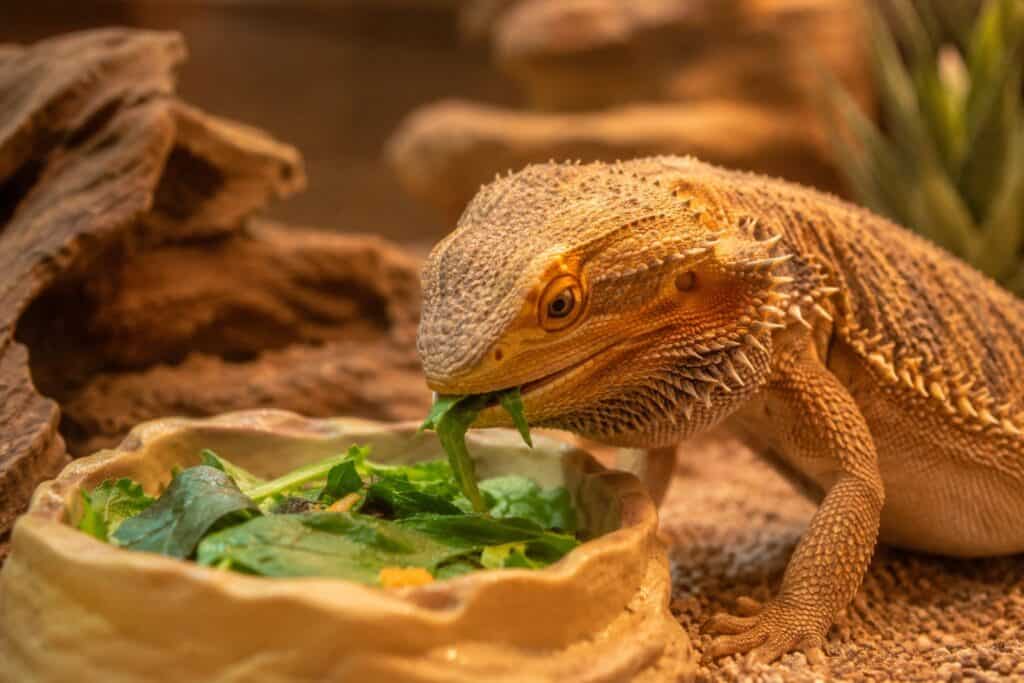
Fresh greens and vegetables are a core part of bearded dragon food at every age and should be available in the enclosure daily. Even if your baby dragon ignores the salad bowl for weeks, keep putting it in there. They’ll come around eventually.
Best Greens and Vegetables for Bearded Dragons
The plant portion of your bearded dragon food should be mostly dark leafy greens. Not iceberg lettuce, which is basically crunchy water with zero nutritional value. You want nutrient-dense greens that your dragon can eat every single day without issues.
The best daily staple greens include collard greens, mustard greens, turnip greens, dandelion greens, and endive. If you also keep a fully herbivorous lizard, the same greens form the base of a uromastyx diet, just without the insects. These have a solid calcium to phosphorus ratio, which matters a lot for reptiles. You can rotate between them throughout the week to keep things interesting. The same staples carry over to other omnivorous lizards, which is handy if you keep more than one species. Our blue tongue skink diet guide uses the same greens list with a very different protein share.
For vegetables, butternut squash, bell peppers, green beans, snap peas, and acorn squash are all good options. Shred or chop everything into small pieces, especially for younger dragons. Nothing should be bigger than the space between your beardie’s eyes.
Carrots and sweet potato can be offered occasionally but not daily since they’re high in vitamin A. Same with kale and spinach. Kale contains goitrogens that can affect thyroid function in large amounts, and spinach binds calcium, which makes it harder for your dragon to absorb. How much kale is actually safe, and why cabbage belongs further down the list, is covered in can bearded dragons eat kale. A little here and there is fine. Just don’t make them staples. Tomatoes are another occasional-only food, safe in small amounts but acidic, and you should know whether bearded dragons can eat tomatoes safely before offering them. Broccoli lands in the same category. We break down the portion and frequency in can bearded dragons eat broccoli.
If your bearded dragon flat out refuses greens, you’re not alone. That’s one of the most common challenges keepers face. We wrote a whole article on getting your bearded dragon to eat greens with specific strategies that actually work.
Cucumber is mostly water and fine occasionally, but it is close to empty calories. Celery is the same story – around 95 percent water, harmless, and nutritionally close to nothing, which is covered in whether bearded dragons can eat celery. Grapes are a sugary treat, not a staple.
Insects and Protein Sources
Insects are the protein backbone of any bearded dragon food plan, especially during the first year of life. Choosing the right feeder insects is just as important as choosing the right greens. The key is variety. Don’t just feed crickets forever because they’re cheap and available. Mix it up.
The best staple feeder insects are dubia roaches, black soldier fly larvae (also called calciworms or nutrigrubs), and crickets. Dubia roaches are probably the single best feeder insect for bearded dragons. They’re high in protein, low in fat, easy to gut load, and they don’t smell, chirp, or escape the way crickets do. If you can get dubias, use them as your primary feeder.
Black soldier fly larvae are another excellent option. They’re naturally high in calcium, which is unusual for a feeder insect. You can offer them without dusting, though dusting never hurts.
Crickets are the classic choice. They’re fine nutritionally but they’re noisy, they escape, they die fast, and they smell terrible if you let the colony go. Still, most pet stores carry them, so they’re the easiest to find.
Hornworms and silkworms make great supplemental feeders. They’re soft, hydrating, and most beardies love them. Offer them a few times a week alongside your staples.
Mealworms are okay for adult dragons but avoid them for babies. The chitin shell is harder to digest and can cause impaction in smaller dragons. Superworms are the same deal, fine for adults in moderation, too risky for babies and small juveniles.
Waxworms are pure fat. Think of them as candy. They’re great for underweight dragons that need to put on some mass, or as a rare treat. Don’t let them become a regular part of the rotation or your dragon will get addicted and refuse everything else.
One rule that applies to all feeders: the insect should never be longer than the space between your dragon’s eyes. This reduces the risk of choking and impaction.
Always gut load your insects 24 to 48 hours before feeding. That means feeding the insects nutritious food like fresh vegetables, so those nutrients pass along to your dragon. An unfed cricket is basically an empty shell of chitin.
And never feed wild-caught insects. Ever. They can carry parasites, pesticides, and diseases that will make your dragon seriously sick.
Fruits Your Bearded Dragon Can Eat
Fruits should make up no more than 5 to 10 percent of your bearded dragon’s overall diet. They’re high in sugar and water, which can cause digestive issues if you overdo it. Think of fruit as a weekly treat, not a daily food group.
Safe fruits include blueberries, strawberries, mango, papaya, melon, peaches, and figs. Cut everything into small pieces. Remove any seeds or pits.
Avoid citrus fruits like oranges, lemons, and limes. They’re too acidic for your dragon’s digestive system. Also skip avocado, which is toxic to most reptiles.
A few small pieces of fruit mixed into the salad bowl once or twice a week is plenty. Some keepers use fruit to entice picky eaters to eat their greens. Toss a couple blueberries on top of the collard greens and suddenly the whole salad becomes more interesting.
Bearded Dragon Food to Avoid
Some foods are genuinely dangerous for bearded dragons. Here’s what should never go in the food bowl:
Iceberg lettuce, which has almost no nutrition and can cause diarrhea. Spinach in large amounts, because it binds calcium. Avocado, which is toxic. Citrus fruits, which are too acidic. Rhubarb, which is toxic. Fireflies or lightning bugs, which are lethal even in small amounts. Any wild-caught insects. Onion, garlic, and chives. Any insect you found in your house or yard.
The firefly one is worth repeating because it catches people off guard. A single firefly can kill a bearded dragon. If you live somewhere with fireflies, make absolutely sure none can get into the enclosure.
Supplements and Calcium
Even with a varied diet, bearded dragons need supplementation to stay healthy. Calcium is the big one. Without enough calcium and vitamin D3, your dragon is at risk for metabolic bone disease, which is painful, debilitating, and sometimes fatal.
For babies and juveniles, dust insects with calcium powder containing D3 at every feeding. Add a multivitamin dust once or twice per week.
For adults, dust with calcium and D3 two to three times per week. Multivitamin once per week or every other week.
If your dragon has proper UVB lighting, which it should, it’s synthesizing some D3 on its own. That’s the part diet alone can’t solve. Without functional UVB a dragon can eat a perfectly calcium-rich diet and still develop metabolic bone disease, because the calcium never gets absorbed. How UVB drives calcium absorption, and what tube to use, is the other half of this. But supplemental D3 in the calcium powder provides a safety net. Most experienced keepers use both UVB and D3 supplementation together.
Don’t overdo the multivitamin. Vitamin A in particular can reach toxic levels with excessive supplementation. Follow the schedule and you’ll be fine.
For more on getting the calcium balance right with a similar species, our article on leopard gecko calcium schedules covers the general principles well.
How to Set Up a Feeding Routine That Works
Consistency is what makes a bearded dragon food routine actually work. Without a schedule, even the best bearded dragon food choices won’t add up to proper nutrition. Here’s a simple structure.
For babies under six months: offer insects two to three times daily in 10 to 15 minute sessions. Put fresh greens in the enclosure every morning. Dust every insect feeding with calcium. Add multivitamin twice a week.
For juveniles six to twelve months: offer insects once daily. Fresh greens every morning. Calcium at every insect feeding. Multivitamin once or twice a week.
For adults over twelve months: offer insects every other day or three times per week. Fresh greens every morning. Calcium two to three times per week on insect days. Multivitamin once a week.
Remove uneaten insects after each feeding session. Leftover crickets can bite your dragon at night, and loose feeders stress some beardies out. Remove uneaten greens by the end of the day so they don’t spoil.
If you’re finding it hard to keep track of feeding days, supplement schedules, and what your dragon actually ate, the Exotic Reptile Care app can help. You can log every feeding, set custom reminders for supplement days, and track your dragon’s weight over time so you’ll know if the diet is working or needs adjusting.
Getting Your Bearded Dragon to Eat Better
Some beardies are great eaters from day one. Others are stubborn, picky, and convinced that waxworms are the only food that exists. A few practical tips that experienced keepers swear by:
Offer greens first thing in the morning before insects. A hungry dragon is more likely to eat its salad if bugs aren’t an option yet. Mix colors and textures in the salad bowl. Bearded dragons are visually attracted to bright colors, especially reds, oranges, and yellows. A few shredded bell pepper pieces or a bit of grated butternut squash can make the whole bowl more appealing.
Try bee pollen sprinkled on greens. A lot of keepers report that bee pollen drives beardies crazy. You can find it at health food stores. Just a light dusting on the salad can turn a greens-hater into a greens-eater.
If your bearded dragon suddenly stops eating altogether, that’s a different issue. It could be brumation, stress, illness, or environmental problems. Check out our article on why your bearded dragon might not be eating for troubleshooting steps.
Keep It Simple and Stay Consistent
Getting bearded dragon food right doesn’t require a biology degree. Dark leafy greens every day, appropriate insects based on age, a little fruit here and there, and consistent supplementation. That’s the formula. Where most keepers run into trouble is with consistency, not complexity. Stick to the schedule, rotate your greens and feeders, and pay attention to what your dragon actually eats versus what you put in the bowl. That awareness is what separates good keepers from great ones.
For more detailed guidance on building a healthy setup around good nutrition, see our bearded dragon tank setup guide.
Bearded dragon food: frequently asked questions
What is the best staple food for a bearded dragon?
There isn’t one single food, since beardies are omnivores that need both. The best staple greens are collard, mustard, turnip, and dandelion greens plus endive, and the best staple insects are dubia roaches and black soldier fly larvae. A good bearded dragon food plan rotates through several of each rather than relying on any one item.
What can bearded dragons not eat?
Never feed iceberg lettuce, avocado, rhubarb, citrus fruits, onion, garlic, or chives. Skip fireflies entirely, since a single one can kill a dragon, and never offer any wild-caught insect because of parasites and pesticides. Spinach and kale aren’t banned but shouldn’t be staples, as spinach binds calcium and kale contains goitrogens in large amounts.
How often should I feed my bearded dragon?
It depends on age. Babies under six months eat insects two to three times a day, juveniles once a day, and adults over a year drop to insects every other day or a few times a week. Fresh greens go in the enclosure every morning at every age, even if a baby ignores them for weeks.
Can bearded dragons eat fruit?
Yes, but only as a treat making up no more than 5 to 10 percent of the diet, since fruit is high in sugar and water. Safe options include blueberries, strawberries, mango, papaya, and melon, cut small with seeds removed. A few pieces once or twice a week is plenty, and it doubles as a trick for tempting picky eaters onto their greens.
What supplements does a bearded dragon need?
Calcium with D3 and a multivitamin. Dust every insect feeding with calcium for babies and juveniles plus multivitamin once or twice weekly, and for adults dust calcium two to three times a week with multivitamin roughly weekly. Even with proper UVB, the D3 in calcium powder acts as a safety net against metabolic bone disease. Don’t overdo the multivitamin, since vitamin A can build to toxic levels.
Why won’t my bearded dragon eat its greens?
Usually it’s because insects are more exciting, not because anything’s wrong. Offer greens first thing in the morning before any bugs, mix in bright colors like bell pepper, and try a light dusting of bee pollen, which many keepers swear by. If a dragon that normally eats suddenly refuses all food, that’s a different issue tied to temperature, brumation, or illness rather than pickiness.
How do I keep track of feeding and supplement days?
The tricky part isn’t choosing bearded dragon food, it’s remembering which days you dusted calcium versus multivitamin, especially as the schedule changes with age. Logging each meal and setting supplement reminders removes the guesswork. The Exotic Reptile Care app lets you log every feeding, set custom reminders for calcium and vitamin days, and track weight over time so you can see whether the diet is actually working.