The box turtle diet question trips people up because most turtle and tortoise care advice is written for herbivores, and box turtles aren’t. They’re omnivores with a genuine appetite for meat, and feeding one like a Russian tortoise will leave it underfed and slowly deficient.
They also change through their lives. A hatchling is close to carnivorous. An adult eats more plants than protein. Getting the ratio roughly right for the age in front of you matters more than any individual food on the list.
| Age | Rough Split | Frequency |
|---|---|---|
| Hatchling to 1 year | 60 to 70% protein | Daily |
| Juvenile, 1 to 5 years | About 50/50 | Daily to every other day |
| Adult, 5 years plus | 40% protein, 60% plants | Every other day |
| Fruit | 10 to 20% of plant portion | Most feedings |
| Calcium dust | Two to three times weekly | Plus cuttlebone always |
The Protein Half
This is the part keepers coming from tortoises tend to skip, and it’s the part box turtles want most.
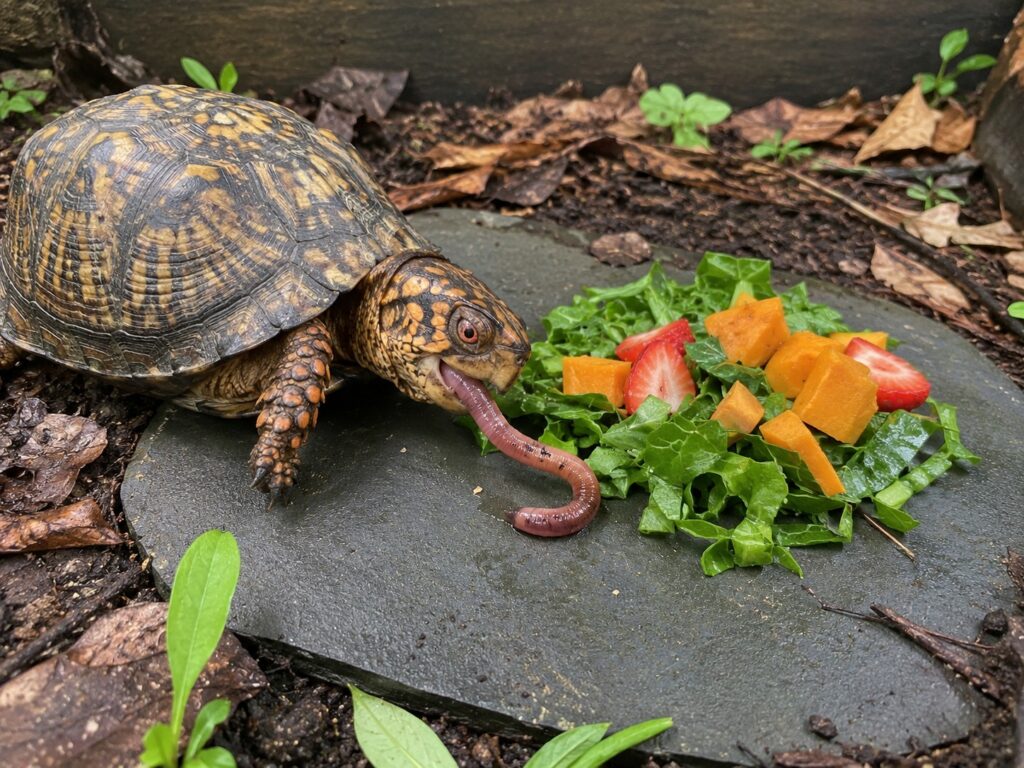
Earthworms are the single best staple. Nightcrawlers from a bait shop or a worm farm are cheap, well balanced, and box turtles go after them with real enthusiasm. Slugs and snails are excellent too, and a captive-bred snail or one from a garden you know hasn’t been treated with pellets is safe. Never collect from anywhere that might have seen molluscicide.
Beyond that: crickets, dubia roaches, black soldier fly larvae, and superworms. Mealworms in moderation, since the hard shell is tough on younger turtles. Waxworms are a treat and nothing more.
Cooked lean meat, boiled egg, and small amounts of low-fat wet cat food come up constantly in box turtle diet discussions. They work occasionally as variety. They should not be regular items, because the protein and fat levels are formulated for a mammal and long-term use is linked to shell deformity and kidney strain.
Whatever the protein source, dust it with calcium two or three times a week and leave a cuttlebone in the enclosure permanently so the turtle can self-regulate.
The Plant Half
Dark leafy greens carry the load. Collard greens, mustard greens, dandelion greens and flowers, turnip greens, endive, and escarole. These have the calcium content you want and none of the problems.
Add colour and variety with squash, grated carrot, bell pepper, green beans, and sweet potato. Chop everything small enough to be manageable, since box turtles tear rather than chew.
Mushrooms deserve a mention because they’re one of the few genuinely interesting facts about the box turtle diet. Box turtles eat mushrooms readily in the wild, including species toxic to humans, and they tolerate them fine. Standard supermarket mushrooms are a good and well-liked addition.
Skip iceberg lettuce entirely, which is water with no nutrition. Go easy on spinach and beet greens, which bind calcium. Avoid avocado and rhubarb, which are genuinely toxic.
If you also keep a tortoise, don’t feed them the same bowl. A grazing species like a sulcata needs a completely different plan, laid out in our sulcata tortoise diet guide, and our Russian tortoise care post covers another herbivore with its own requirements.
Fruit Actually Belongs Here
This is the other place box turtles differ from tortoises. Fruit isn’t a rare treat for them, it’s a normal part of what they eat in the wild, and it should make up perhaps 10 to 20 percent of the plant portion.
Berries of all kinds, melon, tomato, figs, mango, papaya, and apple with the seeds removed. Strawberries and blackberries are usually the favourites.
There’s a practical use for this beyond nutrition. A turtle that’s being fussy about greens will often take them if berries are mixed through, and fruit is the reliable way to get a newly acquired or stressed turtle eating at all.
Don’t overdo it. Too much sugary fruit causes loose stools and, over time, can encourage a turtle to hold out for the good stuff.
When and Where to Feed
Feed in the morning. Box turtles are most active in the hours after dawn, especially once the enclosure has been misted and the humidity is up. A turtle offered food in the afternoon often ignores it entirely.
Use a flat slab, a slate tile, or a shallow saucer rather than putting food straight onto substrate. Box turtles take mouthfuls of whatever is underneath the food, and soil, coir, or bark going down repeatedly is an impaction risk over time. Our box turtle enclosure guide covers where that slab should sit and how the rest of the setup supports feeding.
Hatchlings and juveniles eat daily. Adults do well every other day, though many keepers offer a smaller amount daily instead and either approach works.
Remove uneaten wet food within a few hours. It spoils fast in a warm humid enclosure and attracts flies.
Keep a shallow water dish large enough for the turtle to climb into and change it daily. Box turtles drink, soak, and frequently defecate in it, and they need it for both hydration and shell condition.
What a Bad Diet Looks Like Later
The consequences of getting the box turtle diet wrong show up slowly, which is exactly why so many turtles end up affected.
Pyramiding, where the shell scutes grow upward into bumps, comes from a combination of excess protein, low humidity, and calcium problems. It doesn’t reverse.
Metabolic bone disease shows as a soft shell, weakness, trembling, and jaw deformity, and traces back to insufficient calcium or inadequate UVB to process it. Diet and lighting are joined at the hip here, and neither compensates for the other.
Vitamin A deficiency is common in turtles fed a narrow diet with no orange or dark green vegetables. It appears as swollen eyes, discharge, and a turtle that stops eating. It’s very treatable and entirely preventable with variety.
Obesity happens too, usually from too much fruit and too much fatty protein, and it shows as a turtle that can’t fully retract into its shell.
Any of those means a vet who works with chelonians, which you can find through the ARAV vet directory rather than a general practice.
Seasonal Appetite Is Normal
Box turtles are seasonal animals. Appetite climbs in spring and summer, falls off in autumn, and stops during brumation if you allow it.
A turtle eating less in October is behaving correctly. A turtle eating less in June is telling you something. The difference matters, and it’s the reason a vague sense of how much your turtle has been eating isn’t good enough.
Weight is the number that settles it. Slow decline through autumn is expected. Decline in the growing season is not, and a shell length and weight record over a couple of years shows growth that’s actually happening rather than growth you assume is happening.
The Exotic Reptile Care app logs feeding alongside weight with growth charts, so the seasonal pattern becomes visible and a genuine problem stands out against it. Our post on tracking reptile feeding schedules covers why this matters more for species with variable appetites than for anything on a fixed weekly routine.
FAQ: Box Turtle Diet Questions
What do box turtles eat?
Both animal and plant food. Earthworms, slugs, snails, and insects for protein, dark leafy greens and vegetables for the plant portion, and a regular share of fruit. Roughly half and half for an adult.
How often should I feed a box turtle?
Hatchlings and juveniles daily. Adults every other day, or a smaller portion daily. Expect appetite to fall away naturally in autumn.
Can box turtles eat fruit?
Yes, and unlike most tortoises they should. Fruit is a normal part of a wild box turtle diet and can make up 10 to 20 percent of the plant portion.
Can box turtles eat mushrooms?
Yes. Box turtles eat mushrooms in the wild, including some toxic to people, and ordinary supermarket mushrooms are a well-liked addition.
Can box turtles eat cat food or dog food?
Occasionally, as a small part of the protein rotation. Not regularly. The protein and fat levels are wrong for a turtle and long-term use is associated with shell and kidney problems.
Do box turtles need calcium supplements?
Yes. Dust food two to three times weekly and leave a cuttlebone in the enclosure permanently so the turtle can take what it needs.
If you remember one thing, make it earthworms and dark leafy greens with berries mixed through, served in the morning on a flat slab. That covers most of a good box turtle diet, and variety across the week handles the rest.