Most of the problems people have with a Russian tortoise enclosure come from buying one instead of building one. The glass tanks and plastic kits sold for tortoises are too small, too tall-sided, and too closed in, and a tortoise that spends its life pacing the corners of one is not a happy animal.
These are steppe tortoises from Central Asia. They walk long distances, they dig seriously deep burrows, and they live somewhere dry with hard winters. The enclosure that suits them looks more like a large open sandbox than a vivarium.
| Element | Target |
|---|---|
| Footprint (one adult, minimum) | 4 x 2 feet |
| Better | 8 x 4 feet or outdoors |
| Wall height | 12 to 16 inches, opaque |
| Substrate depth | 4 to 6 inches minimum |
| Basking surface | 95 to 100F |
| Cool end | 70 to 75F |
| Humidity | 40 to 60% |
| UVB | Linear T5, 10 to 12% |
Build a Table, Not a Tank
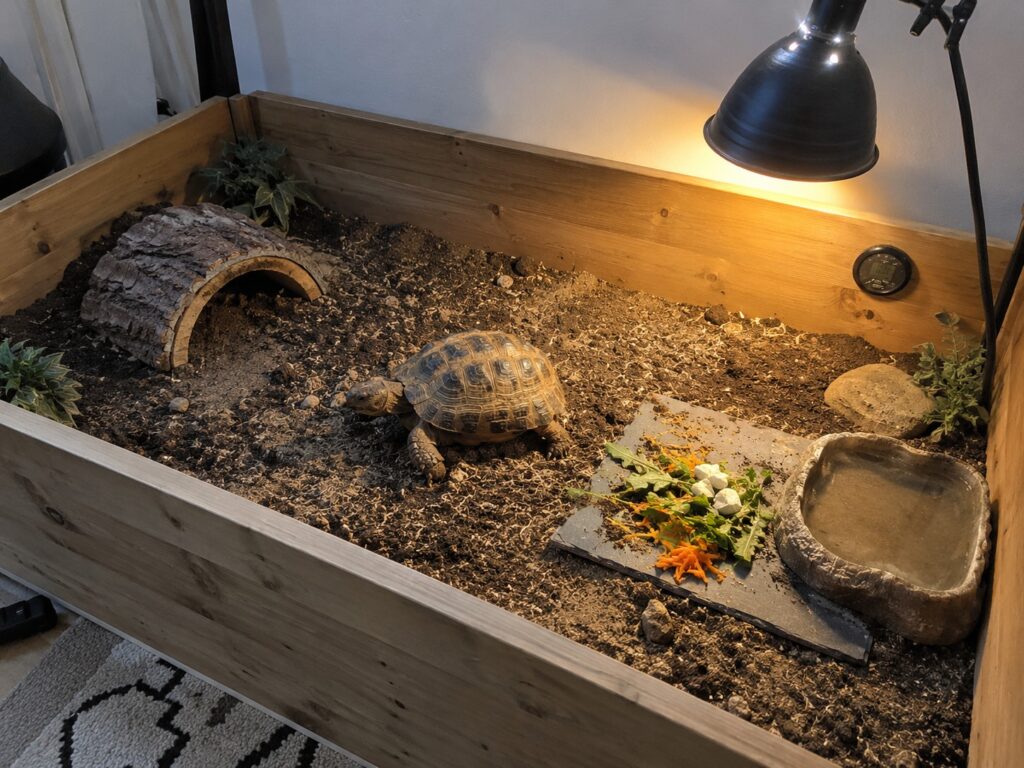
An open-top tortoise table beats a glass vivarium for this species and it isn’t a close call.
Glass traps humidity at the bottom, restricts airflow, and gives you a stale, damp layer right where the tortoise lives. Russian tortoises are arid animals and that combination causes respiratory infections. Glass also confuses them. They walk into it repeatedly, trying to reach what they can see through it, and that pacing is one of the most common signs of an unsuitable enclosure.
A table is just a shallow wooden box with an open top and solid sides. Seal the interior with a pond liner, exterior grade paint, or a plastic sheet so damp substrate doesn’t rot the timber. Plenty of keepers build one from a sheet of plywood in an afternoon, and it costs less than a glass tank of a quarter the floor space.
Solid sides matter more than people expect. A tortoise that can’t see out stops trying to get out.
The exception is a very dry house in winter, where an open table can drop humidity too low. In that case raise the local humidity with a damp hide rather than closing the whole enclosure in.
Size: Floor Space Is the Only Number That Counts
Four feet by two feet is the realistic minimum for a single adult, and it’s a minimum rather than a target. Eight by four is where these tortoises start behaving normally.
Ignore gallon ratings entirely. A 40 gallon tank is a tall box with a small footprint, and height does nothing for an animal that can’t climb. What you want is walking distance and a genuine temperature gradient, and you can’t produce either in a short enclosure.
Wall height should be 12 to 16 inches. Russian tortoises climb better than their shape suggests, particularly in corners, and a determined one will scale a low wall and drop onto a hard floor. That fall cracks shells.
Hatchlings can start smaller but grow into the adult footprint faster than most people plan for. If you’re building anyway, build the adult size now.
Substrate They Can Actually Dig Into
This is the part most setups get wrong, and it’s the part Russian tortoises care about most.
They are serious burrowers. In the wild they dig burrows several feet deep and spend a large share of their lives underground, escaping heat, cold, and predators. A tortoise standing on bare surface with nowhere to dig is under constant low-level stress.
Use a mix of organic topsoil and play sand, roughly 70/30, or a coco coir and topsoil blend. Four to six inches is the minimum depth and eight is better. It should hold a burrow shape without collapsing, which is what the sand content is for.
Keep most of it on the dry side with one damp corner. Russian tortoises want 40 to 60 percent humidity overall, which is drier than a box turtle needs but not the bone-dry setup they were kept in for years. Very low humidity contributes to pyramided shell growth and chronic dehydration, and the burrows these tortoises dig in the wild are far damper than the air above them. If you keep both, don’t copy one setup to the other, and our box turtle enclosure guide shows how differently that build goes.
Substrates to avoid outright: reptile carpet, which gives no digging and snags claws. Walnut shell and crushed corn cob, which cause impaction. Cedar and pine shavings, which release oils that irritate reptile airways. Alfalfa pellets, which mould quickly and get eaten.
Heat, Light and the Gradient
One end hot, the other end genuinely cool. Without that, none of it works.
The basking surface should read 95 to 100F, measured with an infrared temp gun pointed at the actual spot, not at the air. A flat slate or stone tile under the lamp works well, since stone holds and spreads heat the way ground does in the wild.
Ambient should sit in the high 70s to low 80s, with a cool end at 70 to 75F. Nights can drop to 65F safely and the drop is healthy.
Use a white halogen flood bulb for basking, and don’t buy by wattage. Buy something in range, measure, and adjust the lamp height. An open-top table loses more heat than a closed vivarium, so you may need more than you expect.
For UVB, a linear T5 tube at 10 to 12 percent, spanning a good portion of the length and mounted over the warm end. Russian tortoises are high UV animals and they need it to process calcium at all. Replace the tube every 12 months regardless of whether it still lights up, because output falls long before that. Our reptile temperature and humidity guide has these numbers alongside the other species you might keep.
Skip coloured night bulbs. They need darkness.
Furnishing It
Two hides minimum, one at each end, so the tortoise can choose temperature and shelter separately. Half logs, cork bark, or a simple wooden box all work.
A shallow water dish that the tortoise can climb into and out of unaided, sunk flush with the substrate. They drink and soak, and a dish with a lip they can tip themselves in is a drowning risk. Change it daily.
Feed on a flat slab rather than directly on substrate, so the tortoise isn’t swallowing soil and sand at every meal. That’s a genuine long-term impaction risk and the fix costs nothing.
Add rocks, logs, and slopes for texture and mild climbing, but keep anything they could fall from low. A tortoise flipped onto its back under a hot lamp can overheat and die, so avoid steep-sided objects they can tip against.
Live planting is possible but awkward, since Russian tortoises eat and trample most of what you put in. If you want a planted setup, our guide on setting up a bioactive reptile enclosure explains why arid species with heavy grazing habits are among the harder candidates for it.
Outdoors Is Better If You Can
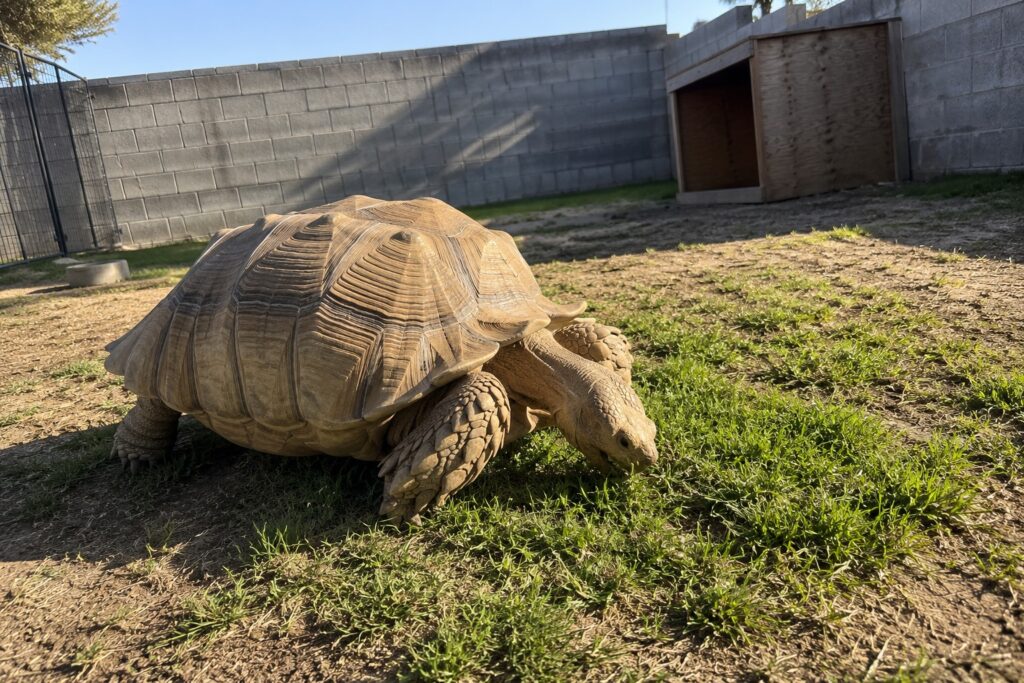
Natural sunlight, real weather, room to roam, and grazing they choose themselves. A Russian tortoise in a decent outdoor pen behaves like a different animal.
Build walls at least 12 inches above ground and sink them 12 inches below, because these tortoises dig under barriers with real commitment. Paving slabs or a wire skirt buried along the perimeter stops it.
Cover or secure the top against dogs, raccoons, and birds. Provide permanent shade and a dig area, since overheating outdoors is the main risk. Plant it with weeds they can graze on, and make sure nothing in the pen is toxic.
Seasonal use works well in a cool climate. Outdoors in summer, indoors in winter. Just don’t leave one outside unattended in weather that could turn.
Escape-Proofing Deserves Its Own Section
Russian tortoises escape. It’s the running joke among keepers and it’s completely earned.
They dig under, they climb corners, they push at anything loose, and they do it patiently over weeks. A tortoise that appears settled will still be testing the perimeter when you’re not watching.
Corners are the weak point, because a tortoise can brace against two walls and climb where it couldn’t climb a flat side. Rounding the interior corners with a curved piece of plastic or wood removes that purchase.
Check the perimeter regularly, indoors and out. Substrate gets pushed into piles against walls, and a pile is a ramp. That’s the most common way an indoor tortoise gets out of an enclosure that was secure when you built it.
Setting a reminder to check it monthly alongside your other husbandry tasks is the easiest way to stay ahead of it. The Exotic Reptile Care app handles that kind of recurring check, and logging weight in the same place gives you the other early warning, since a tortoise that stops gaining is usually telling you something about temperature or diet before it shows in behaviour.
Signs the Enclosure Is Wrong
Constant pacing along one side, or repeated pushing into a corner, usually means too little space or transparent walls.
Digging at the substrate surface without ever settling often means the layer is too shallow to burrow into properly.
Sitting permanently at the cool end and refusing to bask points at a basking spot that’s too hot. Sitting permanently under the lamp points at an enclosure that’s too cold overall.
Bubbling from the nose, open-mouth breathing, or wheezing means humidity or ventilation is wrong, and that needs a reptile vet through the ARAV vet directory rather than a wait-and-see approach.
Pyramided shell growth is a longer-term signal that usually involves diet and hydration together, and our Russian tortoise care guide covers the feeding side of that.
FAQ: Russian Tortoise Enclosure Questions
How big should a Russian tortoise enclosure be?
Four feet by two feet is the minimum floor space for one adult. Eight by four is considerably better, and an outdoor pen is better still. Judge by footprint, not gallons.
Can a Russian tortoise live in a glass tank?
Poorly. Glass restricts airflow, traps humidity at substrate level, and causes constant pacing because the tortoise can see through it. An open-top table with solid sides is the better build.
How deep should the substrate be?
Four to six inches minimum, eight if you can. Russian tortoises burrow heavily and shallow substrate leaves them digging at the surface without ever settling.
What substrate is best for a Russian tortoise?
A topsoil and play sand mix around 70/30, or coco coir blended with topsoil. Avoid reptile carpet, walnut shell, corn cob, cedar, and pine.
Do Russian tortoises need a humid hide?
Yes, and it matters most for hatchlings and in a dry house. Ambient should sit between 40 and 60 percent, with one damp hide or corner giving a higher local pocket the tortoise can use when it wants it.
Can Russian tortoises live outside?
Yes, and they do well outdoors where the climate allows. Walls need to be sunk about 12 inches into the ground, since they dig under barriers readily, and they need permanent shade and predator protection.
Build the table wider than you think you need, make the substrate deep enough to disappear into, and round off the corners. That handles most of what goes wrong with a Russian tortoise enclosure, and the rest is checking the perimeter more often than feels necessary.