You bought a Kenyan sand boa because everyone said they were easy, and mostly they are. Then it vanished into the sand for nine days and refused a perfectly good mouse. You probably didn’t miss anything. Sand boas just run on their own logic, and once you understand the two things that trip people up, burrowing and the huge size difference between males and females, they really are one of the easiest snakes you can keep.
This guide covers the numbers, the setup, and the part most care sheets skip: what to actually do when your boa stops eating.
Kenyan Sand Boa Quick Specs
A Kenyan sand boa needs a warm sand surface around 90 to 95°F, a cool end of 75 to 82°F, dry air, and several inches of diggable substrate. Everything else is secondary to those four things.
| Parameter | Male | Female |
|---|---|---|
| Adult length | 15 to 20 inches | 24 to 32 inches |
| Adult weight | 80 to 150 g | 300 to 800 g |
| Minimum enclosure | 24 x 12 inch floor | 36 x 18 inch floor |
| Warm surface | 90 to 95°F | 90 to 95°F |
| Cool end | 75 to 82°F | 75 to 82°F |
| Night | Down to 70°F | Down to 70°F |
| Humidity | 30 to 50% | 30 to 50% |
| Adult prey | Fuzzy or hopper mouse | Adult mouse |
| Adult feeding | Every 14 to 21 days | Every 14 to 21 days |
| Lifespan | 15 to 20+ years | 15 to 20+ years |
The male and female columns are basically two different snakes, and treating them the same is where most feeding problems start.
Males and Females Are Not the Same Animal
Adult female Kenyan sand boas are often five times heavier than adult males. A mature male might top out at 120 grams and fit in your palm, while a big female can pass 600 grams and look like a sausage with a head.
That changes three things. A male is fine in a 24 x 12 inch footprint for life, a female needs at least 36 x 18. A male on adult mice gets fat fast. And males are the ones that go on long winter hunger strikes, while females tend to eat through almost anything.
Unsure of the sex? Assume female and build the bigger enclosure. Overbuilding for a male costs nothing, underbuilding for a female means buying twice.
Setting Up a Kenyan Sand Boa Enclosure
The enclosure is mostly floor. Height barely matters because a Kenyan sand boa almost never climbs, so 12 inches of height is plenty. What you want is floor space and substrate depth.
A front opening PVC enclosure holds heat better, but a glass tank with a screen top works fine since this species likes dry air anyway. Just make sure the lid locks. Sand boas are strong for their size and will push a loose top open.
Keep it simple. A flat stone or piece of slate on the warm end, a cork bark flat or two on the surface (your boa will mostly bury itself anyway), and a shallow, heavy water dish near the cool end. Skip branches, they just eat floor space.
Add one humid hide on the cool end. A small plastic hide or cork round packed with lightly damp sphagnum moss is enough. Your boa will mostly ignore it, then move in for a few days before a shed. That pocket of moisture lets you keep the rest of the enclosure properly dry. Check the moss weekly and swap it out if it smells sour or starts to mold.
Substrate: Depth Matters More Than Type
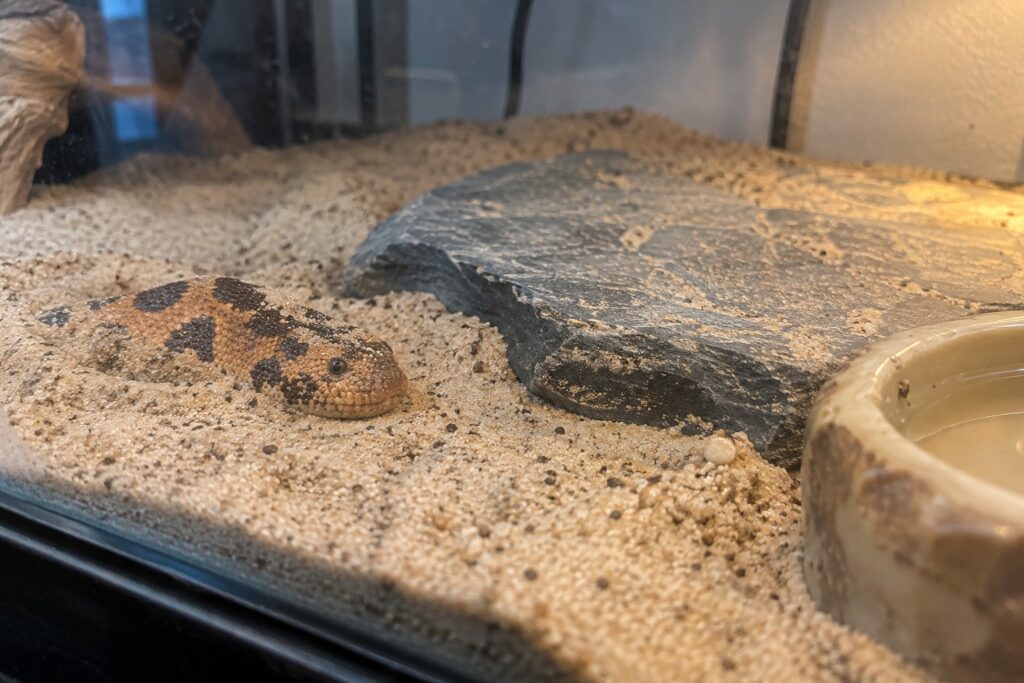
Give your Kenyan sand boa at least 3 to 4 inches of substrate, and 5 to 6 inches if you can. This is a burrowing species. It hunts by waiting just under the surface with its eyes poking out, and it feels exposed and stressed without enough depth to hide.
My pick is roughly 60% play sand and 40% organic topsoil with no fertilizer or perlite. The soil holds burrow shape and cuts dust. Plain washed play sand also works fine. Aspen is okay for hatchlings and quarantine but doesn’t hold burrows.
Avoid calcium sand and crushed walnut shell. The calcium stuff clumps when it gets damp, and walnut shell is sharp and dusty. Also avoid anything that stays wet. Damp substrate on a sand boa is how you get scale rot on the belly.
Spot cleaning is a little different with burrowers, since waste gets buried along with the snake. A cat litter scoop over the top layer every few days handles most of it. For the full schedule, including deep cleans, here’s how often to clean a snake enclosure.
Heating Your Kenyan Sand Boa
Heat the substrate surface, not the air. A Kenyan sand boa warms itself by lying against or just under warm sand, so the number that matters is what the sand surface reads under your heat source. That should be 90 to 95°F, with the cool end sitting at 75 to 82°F.
A heat mat under the warm third works, but deep substrate insulates it, so the surface might read 85 while the glass underneath is scorching. Keep the sand over the mat shallower and probe the surface, not the glass. For deep sand setups I prefer overhead heat, a halogen bulb or deep heat projector aimed at the flat stone. It warms the top layer the way sunlight would, and your boa digs down to whatever temperature it wants.
Either way, the heat source goes on a thermostat. A mat without one can climb past 110°F and burn a buried snake. Use a digital probe on the surface and an infrared temp gun for the cool end. If you’re not sure your readings are right, here’s how to measure temperature and humidity properly inside any enclosure.
Nights can drop to around 70°F without any problem, so the heat can go off with the lights. Humidity should stay dry, 30 to 50%, which most homes hit without trying.
Lighting and UVB for Sand Boas
A low output UVB tube over the warm half is worth adding. Sand boas survive without it, but they’re more active and hold better color with it, and it gives them a clear day and night rhythm. Use a low strength tube made for shade dwelling species, about half the enclosure length, over the warm end so heat and light sit together. Run lights on a 12 hour timer year round.
Follow the manufacturer’s mounting distance for your tube and replace it on their schedule, since UVB output fades long before the light looks dim.
Feeding a Kenyan Sand Boa
Hatchlings eat pinky mice every 5 to 7 days. Around 6 months, move to fuzzies every 7 to 10 days. Adults eat every 14 to 21 days: fuzzies or hoppers for males, adult mice for females. The prey should be about as wide as the widest part of the snake’s body, no bigger.
Use frozen thawed, warmed in a sealed bag in hot water, and offer it with tongs at the surface right above your boa. Most strike from under the sand, which is honestly one of the best parts of keeping them. If yours won’t take it from tongs, leave it on the sand overnight near the warm end.
The biggest mistake is overfeeding. Ambush predators that barely move don’t burn much, and a female fed weekly on adult mice turns obese within a year. If you see a thick crease along the sides when your boa bends, or the tail looks stubby next to the body, push meals out toward the 21 day end and hold prey size steady. A lean adult should look rounded but still show a slight taper toward the tail.
Mice are the staple, but variety helps. Rat pups for big females or the occasional quail chick keep some boas from fixating on one prey type. Every few meals, lightly dust the prey with a calcium and multivitamin powder before offering. Whole prey covers most of what a sand boa needs, so this is a safety margin, not a daily job. Scrub the water bowl weekly too, since kicked-in sand turns it to sludge fast.
When Your Kenyan Sand Boa Stops Eating
This is the question every sand boa keeper asks eventually, and the answer depends on who is refusing and when. Work through it in this order before you panic.
Check the sex and the season first. An adult male refusing food between roughly November and March is normal. Many males skip three or four months every winter, even in a heated enclosure, because their internal clock tells them it’s time to rest. A female doing the same thing is less common and worth paying closer attention to.
Check the weight, not the calendar. Weigh your boa on a gram scale every two to three weeks during a fast. A healthy adult male can go months and lose less than 10% of his body weight. If he drops faster than that, or looks thin along the spine, the fast has stopped being normal. This is exactly where a written record earns its keep. The Exotic Reptile Care app has the weight log and a growth chart built in, so you can see whether a four month fast is a flat line or a slow slide, which is really hard to judge by eye on a snake that lives under sand.
Check the surface temperature. Probe the actual sand surface under your heat source. A thermostat that got bumped, a heat mat under too much substrate, or a bulb that’s losing output can drop the surface into the low 80s. That’s warm enough to look fine and cool enough to kill an appetite.
Check for shed. Cloudy blue eyes mean a shed is coming, and most sand boas won’t eat until it’s done. Offer again a few days after.
Check the prey. Hatchlings especially refuse prey that isn’t properly warm. Offer right at dusk, and try braining the mouse (a small cut to the skull to release scent) for stubborn ones.
If you’ve ruled all of that out and your boa is losing weight, has a swollen or wrinkled appearance, or shows bubbles around the mouth, stop troubleshooting at home and find a reptile vet near you. The logic here overlaps a lot with what we cover for a corn snake that stops eating for weeks, so it’s worth a read if you keep both.
Handling and Temperament
Most Kenyan sand boas are calm, with one quirk. Because they hunt from under the sand, a hand dropping in right above them looks like food, and you might get a feeding bite. It barely hurts, but it surprises people.
Touch the substrate first with a snake hook so your boa knows it’s not dinner, then scoop from underneath with some sand still around it. Keep sessions short and skip handling for 48 hours after a meal.
Common Health Problems
Obesity is the number one issue. After that, respiratory infections, usually from a cool enclosure plus damp substrate, show up as clicking, wheezing, or mucus at the mouth. Scale rot shows up as brown or reddish belly patches, almost always from wet bedding. Mites are rarer in sand setups, but check for tiny black dots around the eyes and chin. For retained shed on the tail tip, a short lukewarm soak usually fixes it.
Choosing a Kenyan Sand Boa
Morphs like albino, snow, stripe, and nuclear don’t change care at all. What matters is that the breeder can tell you the sex, recent feeding dates, and prey size. A captive bred Kenyan sand boa with four frozen thawed meals in a row is a much easier start than one that has only taken live.
Set the enclosure up for a female, weigh your boa once a month, and don’t take a winter fast personally. Get those three right and a sand boa will happily sit under your sand for the next 20 years.
Frequently Asked Questions
How big do Kenyan sand boas get?
Males reach 15 to 20 inches and 80 to 150 grams. Females hit 24 to 32 inches and 300 to 800 grams, with most of the gap showing after the first year.
Do Kenyan sand boas need a heat lamp?
Not necessarily. A thermostat controlled heat mat or an overhead halogen both work, as long as the warm end sand surface reads 90 to 95°F. Overhead heat suits deep substrate better.
How long can a Kenyan sand boa go without eating?
A healthy adult male can skip three to four months over winter if he loses less than about 10% of his weight. Hatchlings and females shouldn’t go that long.
Can Kenyan sand boas live together?
No. One per enclosure. Two buried ambush feeders sharing sand is a recipe for one grabbing the other at feeding time.