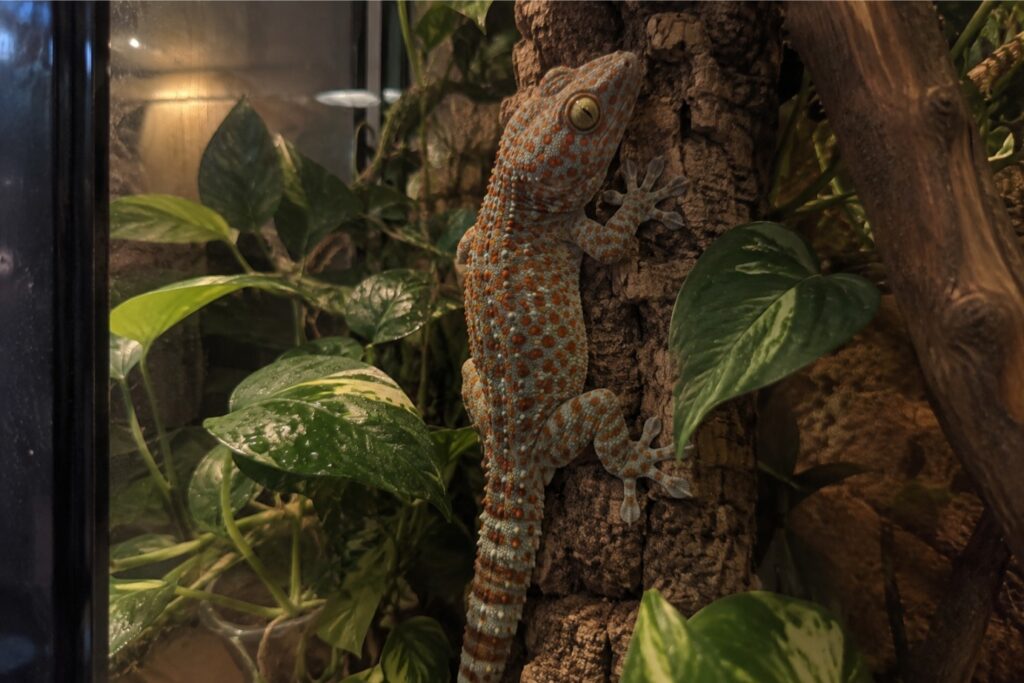
Everyone who keeps a tokay has a bite story. Usually it goes like this: you reach in to top up the water, a blue and orange gecko the size of a hot dog launches off the glass, clamps onto your finger, and simply refuses to let go. Tokay gecko care isn’t hard. The setup is simple and they’re tough animals. But you need to go in knowing you’re getting a gecko with opinions, and a grip that can last a full minute.
This guide covers the setup numbers, feeding, why tokays bite and what actually helps, and a 30 day plan for settling in a new one.
Tokay Gecko Care Quick Specs
A tokay gecko needs a tall enclosure of at least 18 x 18 x 24 inches, a basking area of 90 to 95°F, ambient temperatures around 78 to 85°F, humidity between 60 and 80%, and a varied insect diet.
| Parameter | Target |
|---|---|
| Adult size | 10 to 14 inches, males larger |
| Adult weight | 150 to 300 g |
| Lifespan | 15 to 20 years |
| Enclosure | 18 x 18 x 24 inch minimum, 24 x 18 x 36 better |
| Basking surface | 90 to 95°F |
| Ambient | 78 to 85°F |
| Night | 70 to 75°F |
| Humidity | 60 to 80%, with a dry-down |
| UVB | Low output tube recommended |
| Diet | Insects, dusted |
| Housing | Alone (pairs only for breeding) |
Tokays are one of the biggest geckos in the hobby, and they live a long time. That 15 to 20 year lifespan catches people out, so plan for it.
Why Tokays Bite, and What Actually Helps
Tokays bite because they’re territorial, fast, and scared of things that come at them from above, which is exactly how a hand enters most enclosures. It’s defense, not aggression for fun. A tokay that feels cornered will open its mouth, bark, and then bite hard and hold on.
What helps is changing how you approach, not trying to “train” the bite out of it. Open the enclosure slowly and pause for a few seconds before reaching in. Come in from the side at the gecko’s level, not from above. Do maintenance with long tongs and a spray bottle whenever you can. For moving a tokay out of the way during cleaning, a soft cloth or a small towel works better than a bare hand, and a light pair of gardening gloves takes the fear out of it for you, which makes you calmer, which makes the gecko calmer.
If you do get bitten, don’t pull away. That’s how you end up with torn skin or a hurt gecko. Put your hand and the gecko down on a flat surface or back on its perch. Most tokays let go within a minute once they feel secure footing. Some let go faster if you stay completely still. Wash the bite with soap and water afterward. It will bleed a little and bruise, but it’s rarely more than that.
In practice, the easiest tokay gecko care starts with a captive bred animal. Captive bred tokays, especially ones handled a little from young, are noticeably calmer than wild caught ones. Many settle to the point where they tolerate short, careful handling. Some never do. Accept that before you buy, and treat a tokay as a display gecko that sometimes allows handling, not the other way round.
Setting Up a Tokay Gecko Enclosure
Tokays are arboreal and spend their lives on tree trunks and walls, so height matters more than floor space. An 18 x 18 x 24 inch front opening glass terrarium is the minimum for an adult, and 24 x 18 x 36 is much better. Front opening doors are worth it, since they let you reach in at the gecko’s level instead of from above.
Fill the vertical space. Big pieces of cork bark, cork rounds mounted on the back wall, and diagonal branches give them places to perch, climb, and hide. They love a cork tube hide high up in the warm zone. Add plenty of live or artificial plants for cover. Pothos and snake plants are hard to kill and handle tokays climbing all over them.
For substrate, use something that holds moisture without getting soggy, like a coco fiber and topsoil mix a few inches deep. Tokays suit bioactive setups really well, since a planted enclosure holds humidity steadily and a cleanup crew handles waste. If you want to go that route, here’s how to build a bioactive enclosure that drains properly.
Lock the doors. Tokays are escape artists and can squeeze through gaps you’d never expect from a gecko that size.
Temperature, Humidity, and Lighting for Tokay Gecko Care
Tokays are nocturnal but still bask, usually in the evening and early morning. Give them a basking area of 90 to 95°F near the top of the enclosure, with the rest of the enclosure sitting around 78 to 85°F and cooler spots lower down. At night, 70 to 75°F is fine, and in most homes you won’t need night heat.
A low wattage halogen bulb over one side of the screen top works well for basking. Put it on a dimming thermostat and measure the actual perch surface with an infrared temp gun.
Humidity should run 60 to 80%. Mist the enclosure heavily once in the evening, when they become active, and lightly in the morning if it’s dry. Let it dry down between mistings, since constantly wet surfaces lead to skin and respiratory problems. Tokays often lick droplets off leaves and glass, but they’ll also use a shallow water dish, so provide both.
A low output UVB tube, like a 5 or 6% tube made for shade dwelling species, is worth adding over the basking side on a 12 hour timer. Tokays can survive without it with good supplements, but they get the same benefits as other reptiles, and it gives them a proper day and night cycle.
Feeding a Tokay Gecko
Feeding is the fun part of tokay gecko care. Tokays eat insects, and they eat them with real enthusiasm. Good staples are dubia or discoid roaches, crickets, black soldier fly larvae, and silkworms. Hornworms and the occasional superworm make good extras. Big adults can take large roaches with no trouble. Offer insects no longer than the width of the gecko’s head.
Juveniles eat daily or every other day. Adults do well with 5 to 8 insects every two to three days. Tokays get fat fast in captivity, so watch the base of the tail and the belly. A healthy adult has a solid tail and a body that isn’t sagging on the sides.
Dust insects with calcium at most feedings. If you’re using UVB, plain calcium without D3 works for most meals, with a multivitamin about once a week. Without UVB, use a calcium with D3 at every other feeding. Gut load feeders for a day or two beforehand. If you keep other geckos too, here’s a broader rundown of gecko feeders across species.
Feed in the evening, when they’re active. Tong feeding works well once they’re settled, and it keeps your fingers away from a hungry tokay.
Tokay Gecko Care for the First 30 Days
A lot of tokays in pet stores are still wild caught, and even captive bred ones can take a while to settle. How you handle the first month makes a big difference to whether you end up with a relaxed gecko or a stressed one that won’t eat.
Week one: leave it alone. Set the enclosure up fully before the gecko arrives, then put it in and walk away. No handling, no rearranging. Mist in the evening, offer a few insects at dusk, and check the next morning to see what was eaten. Weigh it once when it arrives, gently in a deli cup on a gram scale. The Exotic Reptile Care app keeps weight and feeding history together, so log it in the app and you’ll have a starting number to compare against as the month goes on.
Weeks two and three: watch, don’t push. A new tokay may skip meals, hide all day, and bark at you. That’s normal. What you want to see is at least some insects disappearing each week and droppings that look formed. Weigh it once a week. Some weight loss in the first two weeks is common, but it should level off.
Get a fecal exam if it’s wild caught. Wild caught tokays very often arrive with internal parasites. Take a fresh dropping to a reptile vet for a fecal exam within the first few weeks. Parasites are easy to treat once identified and a common cause of a tokay that eats but still loses weight.
Week four: start short, careful contact. If the gecko is eating reliably and holding weight, you can start doing maintenance with your hands in the enclosure for longer, moving slowly. Don’t try to pick it up yet. Let it get used to your presence first.
If weight keeps dropping past the first two weeks, if it refuses all food for more than three weeks, or if you see runny or bloody droppings, don’t wait. That’s when a vet visit matters.
Common Health Problems
The big three health issues in tokay gecko care are parasites, which are common in wild caught animals, metabolic bone disease from poor supplements or no UVB, and stuck shed. Stuck shed on the toes is the one to watch closely. It can cut off circulation and cost a tokay its toe tips. If humidity has been low and you see bits of old skin left on the toes after a shed, give the gecko a lukewarm humid box for 20 minutes and gently roll the skin off with a damp cotton swab.
Tokays can also drop their tails if grabbed or badly stressed. The tail grows back, but it looks different and it costs the gecko energy. Never grab a tokay by the tail.
Frequently Asked Questions
Do tokay geckos make good pets?
For the right keeper, yes. They’re hardy, striking, and interesting to watch at night. They’re not a good choice if you want a gecko to handle, since many never enjoy it and the bite is strong. If you want a calmer gecko with a similar setup, gargoyle geckos are a much easier alternative.
Does a tokay gecko bite hurt?
It pinches hard and can draw a little blood, and they tend to hold on. It isn’t dangerous. Put the gecko down on a stable surface, stay still, and it will usually let go on its own.
Why does my tokay gecko bark at night?
That loud “to-kay” call is how they communicate, mostly males advertising territory or looking for a mate. It’s normal and most common in the evening and at night.
How long do tokay geckos live?
With good care, 15 to 20 years is typical, and some live longer. They’re a long commitment.
Can tokay geckos live together?
Not as a rule. Males will fight, sometimes badly. A male and female can be paired for breeding, but for a pet, one per enclosure is the safe choice.
Good tokay gecko care is really about respect. Give them height, humidity, and plenty of food, approach them from their level instead of from above, and let them settle on their own schedule. Do that and you’ll end up with a gecko you mostly watch, occasionally handle, and never forget.