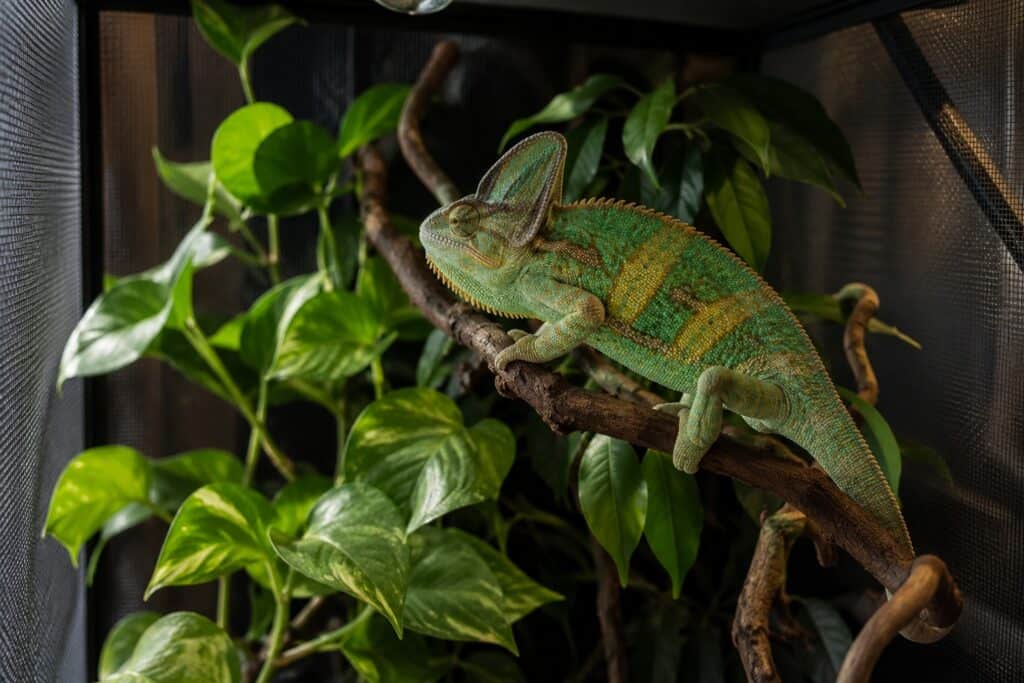
Chameleon care has a bad reputation, and some of it is earned. A lot of first chameleons die in their first year. But it’s rarely because chameleons are impossible. It’s usually one of five mistakes, and they’re the same five almost every time. Pick the right species, build the cage properly, and avoid those mistakes, and a chameleon is a very manageable animal.
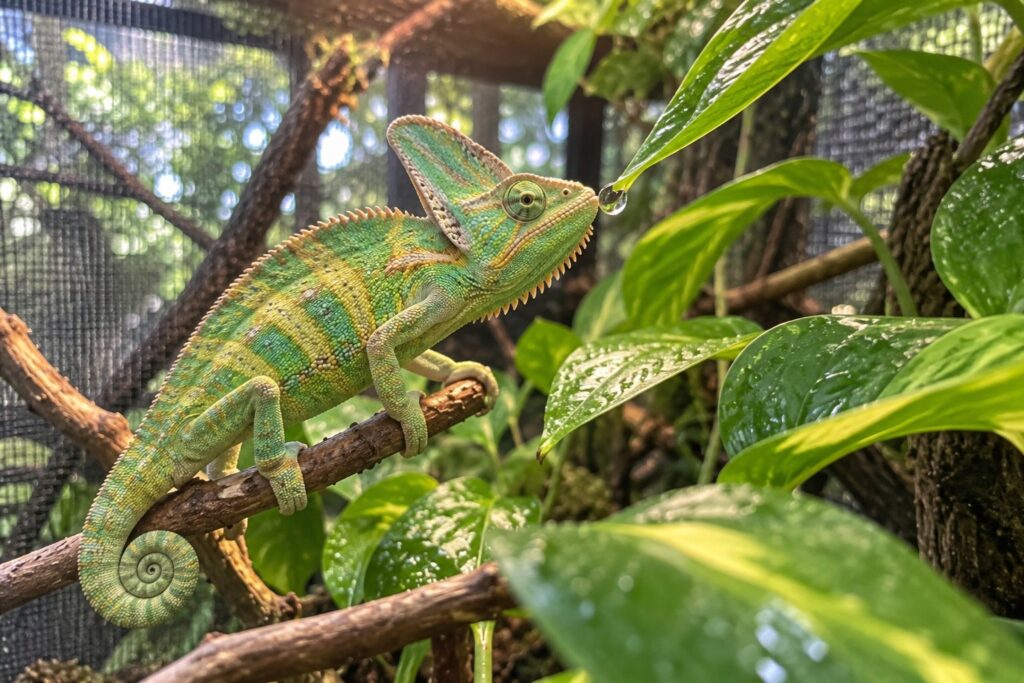
This guide covers choosing between the two chameleons most people keep, the key numbers for each, and those five mistakes ranked by how often they cause problems.
Veiled or Panther: Which Chameleon Should You Get?
For a first chameleon, it’s almost always a veiled or a panther. Both are captive bred in large numbers, both are hardy compared to other species, and both have well understood needs.
Veiled chameleons are the tougher of the two. They tolerate a wider range of temperatures and humidity, they’re usually cheaper, and they eat some plant matter as well as insects. The trade off is temperament. Many veileds stay defensive for life and don’t enjoy being handled.
Panther chameleons are the showpiece. Males come in a huge range of colors depending on their locale. They’re usually calmer than veileds, but they need more humidity, cost more, and have a little less room for mistakes in the setup.
If you mostly want a hardy, forgiving first chameleon, get a male veiled. If the colors are the whole reason you’re interested and you’re willing to fine tune humidity, get a male panther. Either way, start with a male, since females lay eggs whether or not they’ve met a male, which complicates care and shortens their lives.
Other species like Jackson’s chameleons need cooler, montane conditions and aren’t covered here. Get a species specific guide before buying anything less common.
Chameleon Care Numbers Side by Side
| Parameter | Veiled Chameleon | Panther Chameleon |
|---|---|---|
| Adult male size | 17 to 24 inches | 15 to 20 inches |
| Lifespan (male) | 6 to 8 years | 5 to 7 years |
| Adult cage | 24 x 24 x 48 inch screen | 24 x 24 x 48 inch screen |
| Adult basking | 85 to 95°F | 80 to 85°F |
| Ambient | 72 to 80°F | 72 to 78°F |
| Night | 60 to 70°F | 65 to 70°F |
| Humidity | 40 to 60% | 50 to 70% |
| UVB | T5 HO 5 to 6% | T5 HO 5 to 6% |
| Adult feeding | Every other day | Every other day |
The basics are the same. A tall screen cage packed with live plants, a basking branch near the top, a linear T5 HO UVB tube, all lights off at night, and water delivered as droplets rather than in a bowl. The full build is in our guide on how to build a chameleon enclosure. For species detail, see our veiled chameleon care guide and our panther chameleon care guide.
The 5 Mistakes That Kill Most First Chameleons
These are ranked roughly by how often they cause problems. If your chameleon is struggling, work down the list in this order.
1. Dehydration. This is the most common cause of trouble in chameleon care, by a wide margin. Chameleons don’t recognize standing water, so a water bowl does almost nothing. They drink moving droplets off leaves, and if those droplets aren’t there often enough, they slowly dry out.
The early signs are easy to miss. Look for orange or yellow urates instead of white, sunken eyes, and less interest in food. By the time a chameleon looks wrinkled, it’s been dehydrated for a while.
The fix is a misting system running two or three times a day, plus a dripper onto a leaf. Mist long enough that droplets run off the leaves, and watch to make sure your chameleon actually drinks.
2. Weak or Old UVB. Chameleons need strong UVB to use calcium. Without it, they develop metabolic bone disease, which shows up as weak grip, trembling, a soft jaw, and bent limbs. It’s the second biggest killer, and it’s almost entirely preventable.
The common mistakes are using a compact coil bulb instead of a linear tube, mounting the tube too far from the basking branch, or forgetting to replace it. A T5 HO tube loses most of its useful UV output within a year while still looking bright. Replace it every 12 months, no matter how it looks.
3. Getting Supplements Wrong. Insects are naturally very low in calcium. The Merck Veterinary Manual’s page on lizard nutrition points out that this is why insect-eating lizards need their feeders supplemented before every meal.
For chameleons, the standard routine is calcium without D3 at most feedings, calcium with D3 about twice a month, and a multivitamin about twice a month. Overdoing it causes problems too. Too much vitamin A or D3 can be as harmful as too little, so stick to the schedule rather than adding extra.
Gut load your insects for 24 to 48 hours before feeding with fresh greens and a quality gut load mix. A dusted but starved cricket is still a poor meal.
4. Overfeeding, Especially Females. This one surprises people, because a chameleon that eats a lot looks healthy. But adult chameleons that eat every day get fat, and fat chameleons have shorter lives. Females are the biggest concern. A heavily fed female grows larger clutches of eggs, and producing them wears her out.
Juveniles eat daily. Adults do well on feedings every other day, with 5 to 10 insects for a veiled male and fewer for females. It helps to track feedings in the app so you can see how much is going in over a week rather than guessing. Exotic Reptile Care also logs weight, which makes slow weight gain obvious before it becomes a problem.
If you keep a female, give her a laying bin from around six months old: a container at least 12 inches deep, filled with damp sand and soil. Egg binding is an emergency and needs a vet.
5. Stress From Handling and Visibility. Chameleons are solitary and easily stressed. Constant handling, a cage in a busy room, other pets watching them, or a view of another chameleon can all keep them stressed. Stress shows up first as a refusal to eat, then as dark colors and a weaker immune system.
Treat a chameleon as a display animal. Handle it only when needed, let it walk onto your hand instead of grabbing it, and keep the cage somewhere quiet. Dense plants give it somewhere to hide, which makes a big difference. If you can see your chameleon clearly from everywhere in the room, add more plants.
Daily and Weekly Chameleon Care Routine
Good chameleon care is mostly about small habits done every day.
Every day, check that the misting system ran and that the chameleon drank. Look at the urates and the eyes. Feed juveniles and offer insects to adults on their feeding days. Remove uneaten insects at the end of the day so they don’t stress or bite the chameleon.
Every week, weigh your chameleon on a gram scale, wipe down the cage, check that plants are healthy, and clear the drainage.
Every month, check temperatures with a temp gun and look over the UVB tube. Every year, replace the tube.
Frequently Asked Questions
Are chameleons good pets for beginners?
They can be, if you’re ready for a display animal that needs a proper setup and daily attention. A male veiled chameleon is the most forgiving choice for a first chameleon.
How long do chameleons live?
Veiled males usually live 6 to 8 years and panther males 5 to 7 years. Females of both species tend to live shorter lives because of egg production.
Do chameleons need a water bowl?
No. They rarely recognize standing water. Use a misting system, a dripper, or both, so they can drink droplets off leaves.
Can two chameleons live together?
No. Chameleons are solitary and should always be housed alone, ideally out of sight of each other.
What size cage does a chameleon need?
An adult veiled or panther chameleon needs a screen cage of at least 24 x 24 x 48 inches. Juveniles can start smaller but should move up within a few months.
Most chameleon care comes down to water, UVB, and restraint. Keep droplets on the leaves, keep the UVB tube fresh, don’t overfeed, and leave your chameleon alone to do its thing. Do that and the bad reputation won’t apply to you.