Blue tongue skink care sits in a sweet spot that not many reptiles occupy. They’re big enough to be interesting, calm enough to handle, smart enough to recognize you, and hardy enough to forgive the mistakes every new keeper makes. If you want a lizard with the personality of a bearded dragon but with more heft and less drama, this is the animal.
The catch is that they’re omnivores with genuinely specific dietary needs, and they get much bigger than the hatchling in the shop suggests. Most of the problems keepers run into come down to an enclosure that’s too small and a diet built on the wrong things.
| Blue Tongue Skink Basics | What to Expect |
|---|---|
| Adult size | 18 to 24 inches |
| Lifespan | 15 to 20 years, sometimes 30 |
| Enclosure (adult) | 4x2x2 feet minimum |
| Basking surface | 95 to 105F |
| Cool end | 75 to 80F |
| Humidity (Australian) | 40 to 60% |
| Humidity (Indonesian) | 60 to 80% |
| Diet split | Roughly 50% protein, 40% veg, 10% fruit |
| Housing | Always alone |
Which Species You Actually Have
This matters more than most care sheets admit, because humidity requirements differ significantly between the two groups.
Australian species include the northern blue tongue, the most common in the US pet trade and the largest at around 24 inches. Also eastern, blotched, and centralian. These come from drier habitats and want 40 to 60 percent humidity. Northerns are the usual recommendation for beginners because they’re bold, tolerant, and widely captive bred.
Indonesian species include Merauke, Halmahera, Kei Island, and the Irian Jaya. These come from tropical habitat and need 60 to 80 percent humidity. They also tend to be more defensive and are more often wild caught, which brings parasite and stress issues. Good animals, but not where I’d start.
If you don’t know which you have, ask the breeder. Getting humidity wrong in either direction causes respiratory infections or stuck shed, and it’s the most common blue tongue skink care mistake I see.
Enclosure Size and Setup
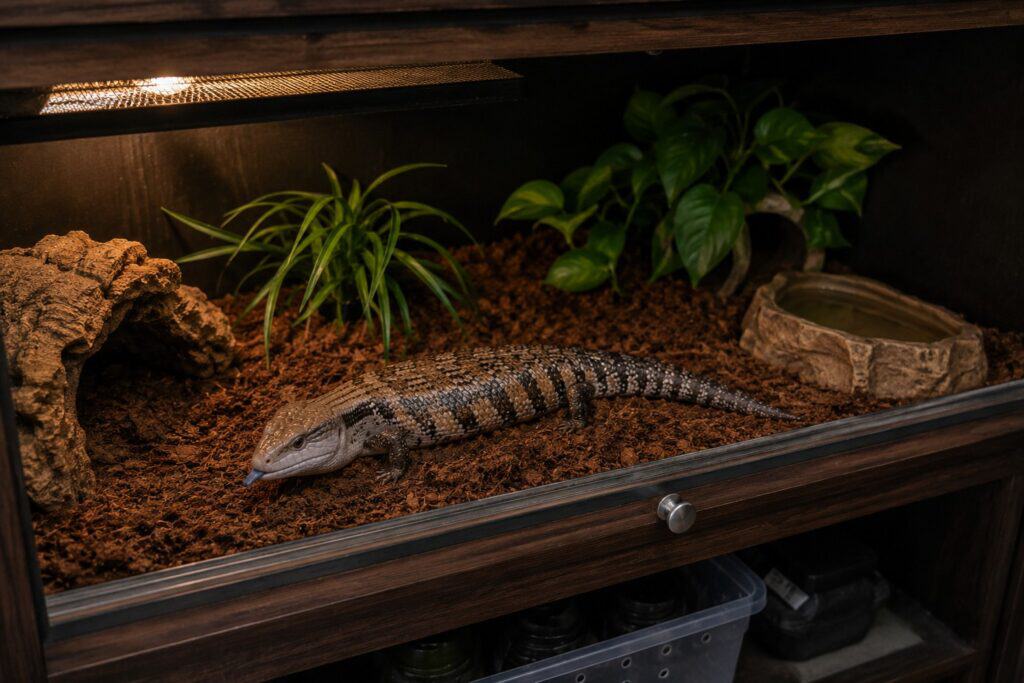
An adult needs a minimum of 4 by 2 by 2 feet. That’s eight square feet of floor, and it’s a floor rather than a goal. These are ground-dwelling animals that cover real distance, and a 40 gallon tank is not adequate for an adult no matter what the shop says.
Front-opening PVC is the best option. It holds heat and humidity better than glass, it’s lighter, and reaching in from the side rather than from above reduces stress. Glass works if it’s big enough, though you’ll fight humidity in a screen-topped tank.
Substrate should be deep, four to six inches minimum. Blue tongue skinks burrow, and a skink with nowhere to dig is a stressed skink. Cypress mulch, coconut husk, or a mix of organic topsoil and play sand all work well. Deep substrate also buffers humidity, which does half the work for you.
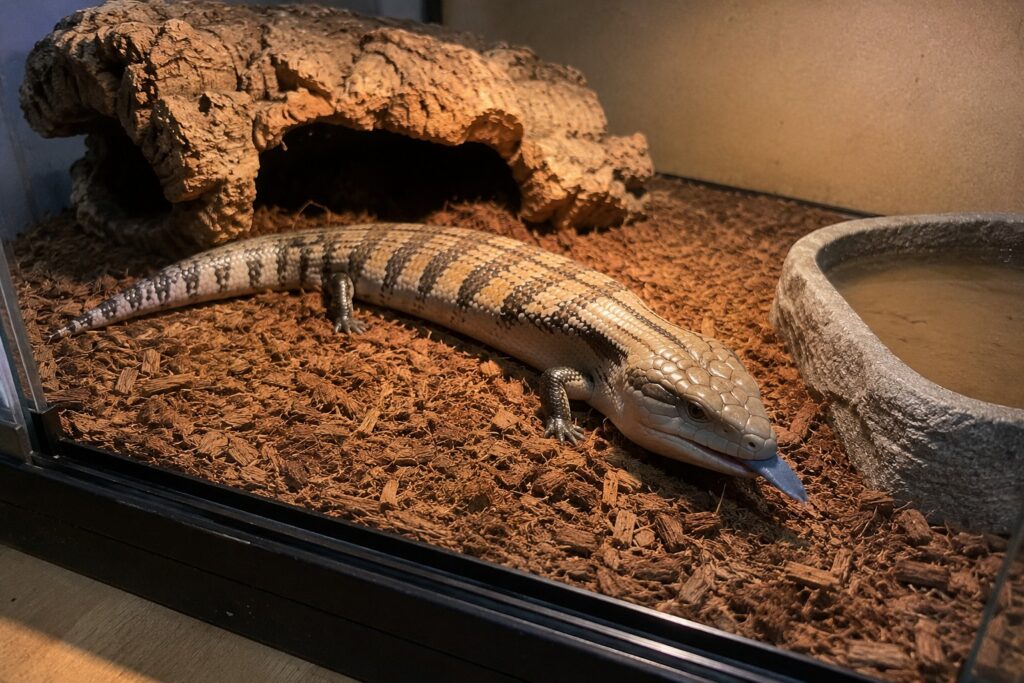
Add a hide on each end, some cork bark, and a shallow water dish big enough to soak in. Our blue tongue skink enclosure guide covers the build in more detail, including specific equipment choices.
One rule with no exceptions: house them alone. Blue tongue skinks are solitary and will fight, sometimes seriously. Cohabitation is not a thing with this species.
Temperature, Lighting, and Humidity
Basking surface should read 95 to 105F, measured with an infrared temp gun on the surface itself rather than the air above it. Ambient warm end sits around 80 to 85F, cool end 75 to 80F, and nights can drop to 65 to 75F. Use an overhead halogen flood on a dimming thermostat rather than a heat mat, since these animals bask from above like they would under the sun.
UVB is not optional. Use a linear T5 HO tube at 6 percent for Australian species, running across roughly half to two thirds of the enclosure length so the skink can move in and out of it. Replace it every 12 months even while it still lights up, since output falls long before the bulb dies.
Humidity depends on which species you have, as above. Deep substrate, a large water dish, and a partially covered top handle most of it. If you’re keeping multiple species and want the ranges side by side, our reptile temperature and humidity guide lays them out together.
Blue tongue skinks also do well in bioactive setups, since they appreciate deep substrate and the humidity stability that a planted system provides. Our bioactive enclosure guide covers the approach, with the caveat that a big skink will flatten plants regularly.
Blue Tongue Skink Care: Diet and Feeding
This is where blue tongue skink care differs most from other popular lizards. They’re true omnivores, not insectivores that tolerate greens, and they need a genuine mix.
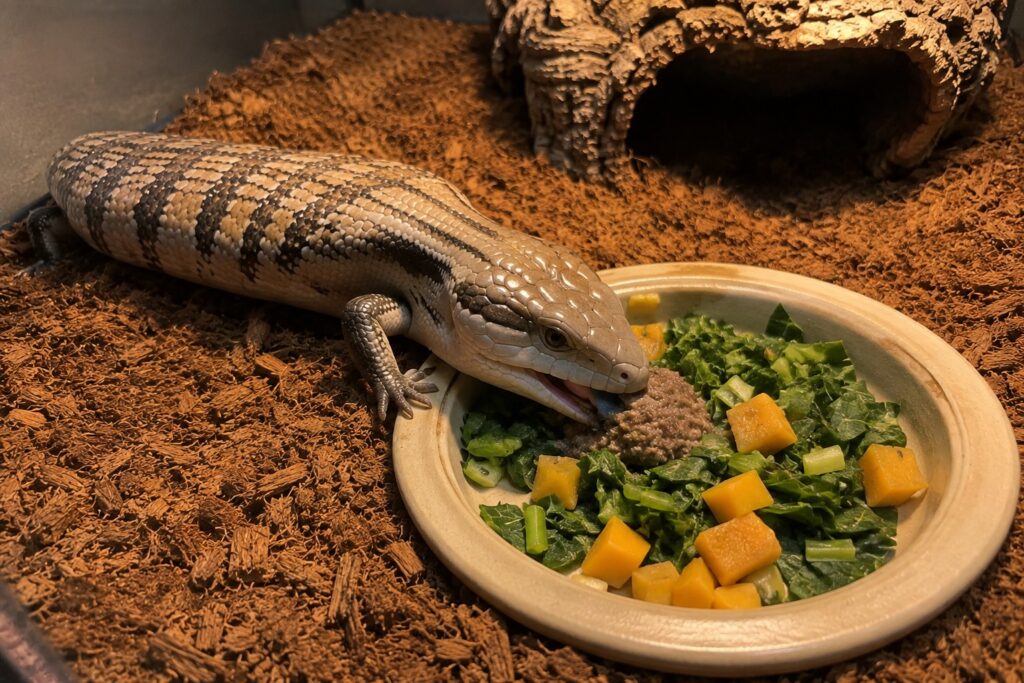
The working ratio is roughly half protein, forty percent vegetables, and ten percent fruit. Protein can come from high-quality grain-free wet dog or cat food, which sounds strange and is standard practice in this hobby. Check the label for no onion or garlic. Beyond that: dubia roaches, snails, hornworms, cooked egg, and lean ground turkey all work.
Vegetables should be the same calcium-friendly greens you’d feed a bearded dragon. Collard, mustard, dandelion, and turnip greens, plus squash, green beans, and bell pepper. Fruit is a small share, offered as berries, mango, or papaya. The full food list, the ratios by age, and what to avoid entirely are in our blue tongue skink diet guide.
Dust with calcium powder at most feedings and add a multivitamin weekly. Skipping this leads to metabolic bone disease, which veterinary references describe as the most common bone disorder in pet reptiles, driven by poor calcium ratios, missing UVB, and inadequate temperatures.
Feeding frequency: juveniles every day or every other day, adults two or three times a week. Obesity is a real problem in this species because they’ll eat enthusiastically well past what they need. A skink with fat rolls behind the front legs is overweight.
Handling and Temperament
Blue tongue skinks are among the most handleable lizards in the hobby. Captive bred northerns in particular tame down quickly and many genuinely seem to tolerate or enjoy interaction.
Support the whole body. These are heavy-bodied animals and a skink that feels unsupported will thrash. Scoop from underneath rather than grabbing from above, which reads as a predator.
New arrivals need time. Give a skink a week or two to settle before handling, then start with short sessions. Expect some hissing, tongue displays, and body flattening early on. That’s bluffing, not aggression, and it fades with consistent gentle handling.
Bites are uncommon but they have strong jaws, so respect a skink that’s clearly telling you to back off.
Common Health Problems
Metabolic bone disease from missing UVB or supplementation. Watch for trembling, weakness, a soft or swollen jaw, and difficulty walking.
Obesity from overfeeding, which is probably the most widespread issue in this species. Feed to a schedule, not to appetite.
Respiratory infections from humidity that’s too high for the species or temperatures too low. Signs are wheezing, clicking, bubbling at the nostrils, and open-mouth breathing when not basking.
Retained shed, particularly on toes and the tail tip, from humidity that’s too low. Left alone it constricts and causes tissue loss.
Mites, which show up as tiny black dots around the eyes and in skin folds, usually after bringing home a new animal without quarantine.
For any of these, use the ARAV vet directory to find someone who treats reptiles. A general small animal practice will often be working from guesswork with a species this size.
Building a Routine You’ll Actually Keep
Blue tongue skink care is mostly consistency across fifteen or twenty years, which is a long time to run on memory alone. The things that slip are predictable: the annual UVB replacement, weekly multivitamin dusting, and monthly weigh-ins.
Weight is the single most useful number here given how prone this species is to obesity. A skink that’s gained 80 grams over six months is on a trajectory you want to catch early, and that’s invisible day to day. The Exotic Reptile Care app logs weight with growth charts, tracks feeding and shed cycles, and handles custom reminders for the maintenance items. If you’re building a broader system, our guide to a reptile care routine that sticks covers the habit side of it.
FAQ: Blue Tongue Skink Care Questions
How big do blue tongue skinks get?
Most reach 18 to 24 inches, with northern blue tongues at the larger end. They’re heavy-bodied, so they feel considerably bigger than the length suggests.
How long do blue tongue skinks live?
Fifteen to twenty years is typical with good care, and some individuals reach 30. Plan for a long commitment.
What size enclosure does a blue tongue skink need?
A minimum of 4 by 2 by 2 feet for an adult. A 40 gallon tank is not adequate for a full-grown skink regardless of what starter kits suggest.
Can blue tongue skinks eat dog food?
Yes, high-quality grain-free wet dog or cat food is a standard protein source in this hobby. Check that it contains no onion or garlic, and treat it as part of the protein share rather than the whole diet.
Can two blue tongue skinks live together?
No. They’re solitary and will fight, sometimes causing serious injury. House them separately, always.
Do blue tongue skinks need UVB?
Yes. Use a linear T5 HO tube at around 6 percent for Australian species, replaced yearly. Without UVB, calcium absorption fails and metabolic bone disease follows.
If you’re deciding whether this species is for you, the honest summary is that blue tongue skinks are one of the easiest large lizards to live with and one of the easiest to overfeed. Buy the four foot enclosure up front, learn which species you have so you get humidity right, and weigh your skink monthly. Get those three things sorted and the rest of it is genuinely straightforward.