Leopard gecko humidity is the husbandry number people worry about least and get wrong most. Everyone checks their temperatures. Far fewer own a hygrometer, and the ones who do usually have it stuck to the glass in whatever spot the suction cup happened to grab.
The target is narrow but not difficult: 30 to 40 percent across most of the enclosure, with one humid hide sitting at 70 to 80 percent. That combination gives your gecko a dry environment to live in and a damp pocket to shed in, which is exactly what it gets in the wild.
| Area | Target | How to Get There |
|---|---|---|
| Ambient enclosure | 30 to 40% | Good ventilation, dry substrate |
| Humid hide | 70 to 80% | Damp sphagnum moss or paper towel |
| Too low | Under 30% | Stuck shed, dehydration |
| Too high | Over 50% sustained | Respiratory infection, scale rot |
| Water dish | Always available | Shallow, changed daily |
Why Leopard Gecko Humidity Matters More Than It Looks
Leopard geckos come from dry rocky grasslands in Afghanistan, Pakistan, and northwest India. That’s an arid climate, but it isn’t a desert in the sand-dune sense, and the animals spend their days in burrows and rock crevices where moisture collects. So the wild picture is a dry surface environment with damp retreats underneath.
Replicating that is the whole job. Get the ambient number too high and you’re looking at respiratory infections and scale rot, both of which are serious. Get it too low with no humid hide and you get retained shed, which sounds cosmetic and isn’t.
Stuck shed around the toes is the classic version. It dries, tightens, and constricts blood flow, and geckos lose toes to it every year. Around the eyes it’s worse, since a gecko that can’t see properly stops hunting and stops eating.
The Humid Hide Is the Whole Solution
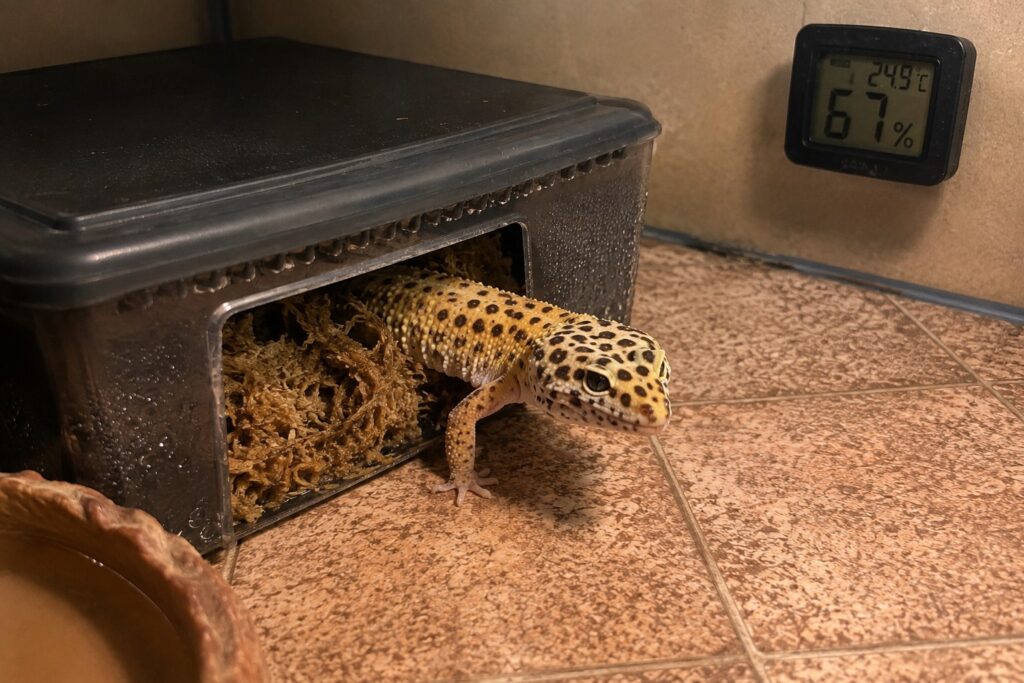
If you fix one thing, fix this. A humid hide is a small enclosed container with a damp substrate inside and a hole cut in the side, placed on the warm end or just off it. The warm end placement isn’t incidental. Damp moss over a cool floor doesn’t loosen shed much – it’s warmth and moisture together that does the work, which is why a humid hide on the cool side underperforms. If the hide is maintained properly and sheds are still coming off badly, check the warm-side temperatures next.
Build it from any opaque plastic container with a lid. Cut an entry hole and sand the edges smooth. Fill it with damp sphagnum moss, damp paper towel, or coconut fiber. Damp means squeezed out, not dripping. Standing water at the bottom leads to bacterial growth and defeats the point.
Check it every couple of days and re-moisten as needed. Rinse the moss weekly and replace it monthly, since it will get soiled and start to smell.
Leave it in permanently rather than only during a shed cycle. Your gecko decides when it needs the damp, and it’ll also use the hide for regular sleeping. Some keepers run two, one on the warm side and one on the cool side, which is more work but gives the gecko a genuine choice.
Measuring Leopard Gecko Humidity Properly
Buy a digital hygrometer with a probe. The analog dial gauges that come bundled with starter kits are close to useless and often read 15 or 20 points off.
Placement matters. Put the probe at floor level in the middle of the enclosure, not stuck to the upper glass where the reading tells you about the air near the lid rather than the air your gecko lives in. Check it at different times of day, since it will swing after misting, after a water change, and overnight.
Take a second reading inside the humid hide occasionally to confirm it’s actually holding 70 to 80 percent. Plenty of humid hides read barely above ambient because the lid doesn’t seal or the moss dried out a week ago.
When Leopard Gecko Humidity Is Too Low
Under 30 percent, and especially under 20, you’ll see it in the shed. Patches of retained skin on the toes, tail tip, and around the eyes. Shedding that takes several days instead of coming off in one or two pieces. A gecko that looks dull and papery for longer than usual.
Fixes, roughly in order of how much they help: add or repair the humid hide first, since that solves most cases on its own. Add a larger water dish to raise ambient slightly. Reduce excessive ventilation if you have a screen top with a fan pointed at it. Switch from very dry substrates to something that holds a little moisture in one area.
If shed is already stuck, soak the gecko in shallow lukewarm water for 15 to 20 minutes, then gently work the skin loose with a damp cotton swab. Never pull skin that isn’t ready to come off. Repeat over a couple of days if needed.
Stuck shed and the discomfort that comes with it is one of the reasons behind a leopard gecko that stops eating but stays active, so if both are happening at once, start here.
When Leopard Gecko Humidity Is Too High
Sustained readings above 50 percent are the more dangerous direction. Respiratory infection is the main risk, and it shows as wheezing, clicking sounds when breathing, bubbles or mucus around the nose and mouth, or a gecko holding its head raised and breathing with effort.
That needs a vet rather than a husbandry tweak. Use the ARAV vet directory to find someone who treats reptiles, since respiratory infections get worse fast and geckos hide illness until it’s advanced.
To bring humidity down: improve airflow with a full screen top, move the water dish to the cool end and downsize it, switch away from moisture-holding substrates like coconut fiber for the main floor, and check that the humid hide isn’t leaking moisture into the whole enclosure. If you live somewhere genuinely humid, a small dehumidifier in the room does more than anything inside the tank.
Seasonal swings catch people out. An enclosure that sits at 35 percent all winter can drift to 55 in a humid summer without anything changing on your end.
Keeping Track Across Shed Cycles
Humidity problems reveal themselves through shedding, and shed cycles are slow enough that most keepers can’t remember whether the last one was rough. That’s the information you actually need.
Logging sheds gives you a pattern. Two clean sheds followed by three problem ones tells you something changed in the enclosure, probably seasonally. The Exotic Reptile Care app tracks shed dates and lets you note whether it came off cleanly, so you’re comparing records rather than impressions. Chronic shed and humidity problems are also among the quieter things that shorten a leopard gecko’s lifespan, so it’s worth catching the pattern early.
While you’re setting reminders, the humid hide moss is a good one. It’s the maintenance task that slips first.
FAQ: Leopard Gecko Humidity Questions
What humidity should a leopard gecko be kept at?
Ambient humidity should sit at 30 to 40 percent, with a humid hide maintained at 70 to 80 percent for shedding.
Should I mist my leopard gecko’s enclosure?
Generally no. Light misting of the humid hide is fine, but regularly misting the whole enclosure pushes ambient humidity too high and risks respiratory infection. Maintain the humid hide instead.
Why does my leopard gecko have stuck shed?
Almost always low humidity or a missing or dried-out humid hide. Toes and eyelids are the usual spots. Soak in shallow lukewarm water and address the hide before the next cycle.
Can leopard gecko humidity be too high?
Yes, and it’s more dangerous than too low. Sustained readings above 50 percent lead to respiratory infections and scale rot. Improve ventilation and reduce moisture sources.
Do leopard geckos need a water dish?
Yes. Keep a shallow dish available at all times and change the water daily. It also contributes a small amount of ambient humidity.
Get the humid hide right and most leopard gecko humidity problems disappear on their own. It’s a plastic box with wet moss in it, and it prevents more health issues than almost anything else you can put in the enclosure.