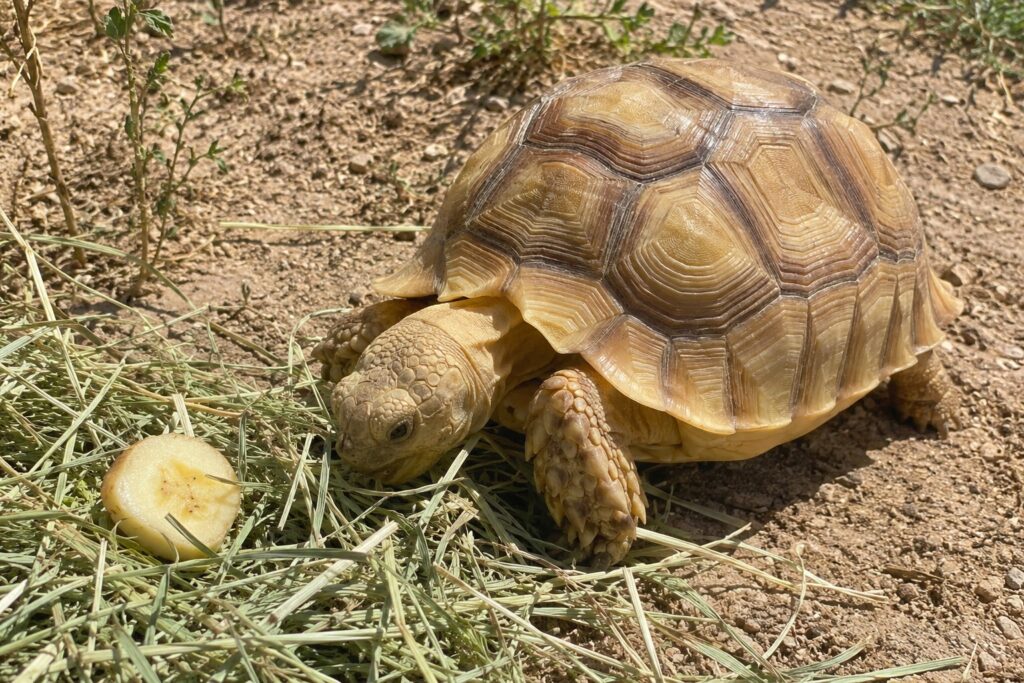
Can sulcata tortoises eat bananas? Technically yes, but only as a rare treat, and most keepers are better off skipping the fruit completely. A sulcata is a grassland grazer built to live on dry, fibrous grass, and the sugar in a banana works against its gut, its growth, and its appetite for the food it actually needs. The part of the banana plant that’s worth feeding is the leaf, not the fruit.
Why Bananas Are a Problem for Sulcatas
A ripe banana has about 12 grams of sugar per 100 grams and very little fiber compared with the grasses a sulcata evolved to eat. It also has the wrong mineral balance: roughly 5 mg of calcium for every 22 mg of phosphorus, while a growing tortoise needs far more calcium than phosphorus.
That sugar feeds the wrong bacteria and parasites in a sulcata’s gut. The result is often soft or runny droppings, a smelly enclosure, and a tortoise that suddenly wants sweet food instead of hay. The Merck Veterinary Manual’s guide to tortoise nutrition explains why grazing species do best on a high-fiber, plant-based diet, and fruit is the opposite of that.
There’s a longer-term cost too. Rich, sugary food encourages fast growth, and fast growth is one of the drivers behind pyramiding, the lumpy shell that never goes back to smooth. You can read more in the pyramiding section of our sulcata care guide.
Bananas, Banana Leaves, and Other Fruit at a Glance
| Food | Verdict | Why |
|---|---|---|
| Banana fruit | Rare treat at most | High sugar, low fiber, poor calcium balance |
| Banana leaves | Fine in rotation | Fibrous and low in sugar; pesticide-free only |
| Banana peel | Skip | Often waxed or sprayed, and still sugary |
| Apples | Rare treat at most | Sugary; remove seeds and core |
| Strawberries | Rare treat at most | Sugary and easy to overfeed |
| Watermelon | Rare treat at most | Mostly sugar and water |
| Grapes | Skip | Very sugary for their size |
Can Sulcata Tortoises Eat Banana Leaves?
Yes, and they’re a much better choice than the fruit. Banana leaves are tough, fibrous, and low in sugar, which is close to what a sulcata’s gut is built for. Keepers in warm climates who grow banana plants often add the leaves to the daily greens.
Only use leaves you know haven’t been sprayed. Wash them, tear them into strips, and treat them as one item in a varied rotation of grasses and weeds rather than a staple on their own. If you need ideas for that rotation, the weed list in our Russian tortoise diet guide works for sulcatas too.
Skip the peel. Store-bought banana peel is often waxed or treated, and it still carries sugar from the fruit.
3 Rules If You Do Feed Banana
If you decide to offer banana now and then, these three rules keep it safe.
1. Keep the piece small. A single thin slice for an adult, and a piece no bigger than your thumbnail for a juvenile. It’s a taste, not a meal.
2. Once or twice a month at most. That matches the limit in our sulcata tortoise diet guide, where 80 to 90% of the diet is grass, hay, and broadleaf weeds. For hatchlings and young juveniles, skip fruit entirely. They’re growing fast, and they’re the most at risk of gut upsets and pyramiding.
3. Serve it on top of the hay. Put the slice on a pile of grass hay or mixed weeds so the tortoise eats fiber with it. Never offer banana on its own as a separate meal.
When Your Sulcata Starts Refusing Hay
The most common banana problem isn’t sickness. It’s a sulcata that gets a taste for sweet food and then turns its nose up at hay. If that’s happening, work through this in order.
Stop all fruit right away. Even small treats keep the craving going.
Make hay and grass the only food for a week or two. Don’t add tempting extras. A healthy sulcata will go back to grazing once it realizes nothing sweeter is coming.
Check the basics. A tortoise that’s too cold or dehydrated eats poorly regardless of the menu. Make sure the basking area is warm enough and give a shallow, lukewarm soak a few times a week.
Track it. Write down every treat and every day it eats its hay. It’s easy to log every treat in the app with Exotic Reptile Care, and after a couple of weeks you’ll see exactly when the appetite came back.
Signs Your Sulcata Ate Too Much Banana
If your sulcata got into a bunch of bananas or has been fed fruit regularly, watch for:
- Runny, watery, or unusually smelly droppings
- A sudden drop in appetite for hay and grass
- Lethargy or spending all day in a hide
Remove all fruit, offer only hay, grass, and water, and keep up the soaks. Most mild cases settle in a couple of days. If diarrhea lasts more than two or three days, or you see blood, mucus, or a tortoise that won’t move, take it to a reptile vet. Sulcatas hide illness well, and a stool test can rule out a parasite bloom.
Frequently Asked Questions
Can sulcata tortoises eat bananas every day?
No. Bananas are too sugary for a grazing tortoise. Once or twice a month as a small treat is the absolute maximum, and many keepers never feed fruit at all.
Can baby sulcata tortoises eat bananas?
It’s best not to. Hatchlings and juveniles are growing fast, and sugary food raises the risk of gut problems and pyramiding. Stick to grasses, hay, and weeds.
Can sulcata tortoises eat banana leaves?
Yes. Pesticide-free banana leaves are fibrous and low in sugar, so they make a good part of a varied greens rotation.
Can sulcata tortoises eat banana peels?
Skip them. Peels are often waxed or sprayed, and they still carry sugar.
What fruit can sulcata tortoises eat?
Small amounts of banana, apple, strawberry, or watermelon are fine as a rare treat, but none are needed. A sulcata does best with no fruit at all.
If your sulcata loves banana, use the leaves instead of the fruit. Keep the sweet stuff to a thin slice once or twice a month at most, and put it on a pile of hay so grazing stays the main event.