
Veiled chameleon care has a reputation for being difficult, and that reputation is only half deserved. The husbandry itself is specific rather than hard. What makes chameleons unforgiving is that they hide illness better than almost any other reptile, and by the time something looks wrong it has usually been wrong for weeks.
They’re also not a handling pet, and that’s the expectation gap that ends most chameleon keeping badly. If you want an animal to interact with, this isn’t it. If you want an animal to observe, veiled chameleons are one of the most interesting reptiles you can keep.
| Veiled Chameleon Basics | What to Expect |
|---|---|
| Adult size | Males 17 to 24 in, females 10 to 14 in |
| Lifespan | Males 6 to 8 years, females 4 to 6 |
| Enclosure | Screen, 24x24x48 in minimum for a male |
| Basking spot | 85 to 95F |
| Ambient | 72 to 80F |
| Night drop | 60 to 70F, beneficial |
| Humidity | 40 to 60%, with a dry-down |
| Diet | Insects, gut loaded and dusted |
| Housing | Always alone, no exceptions |
What You’re Signing Up For
Veiled chameleons come from Yemen and Saudi Arabia, which surprises people who assume all chameleons are rainforest animals. That arid highland origin is why they tolerate lower humidity than panther or Jackson’s chameleons and why they handle a wider temperature range. If you’re still choosing between the two, here’s how panther chameleons differ in humidity, temperament, and price.
Males get considerably larger than females and have a taller casque, the helmet-like crest on the head. They’re also the ones people usually want, since they colour up more dramatically.
Females come with a complication worth understanding before you buy one. They produce eggs whether or not they’ve been bred, and egg binding is a common cause of death in captive females. That’s the main reason females live shorter lives. A female needs a laying bin of damp sand available from around six months old, and a carefully controlled diet to avoid overproduction.
Veiled chameleons are also the most defensive of the commonly kept species. Gaping, hissing, lunging, and dark stress colouration are normal responses to being approached, not signs of a badly socialised animal.
Enclosure Basics
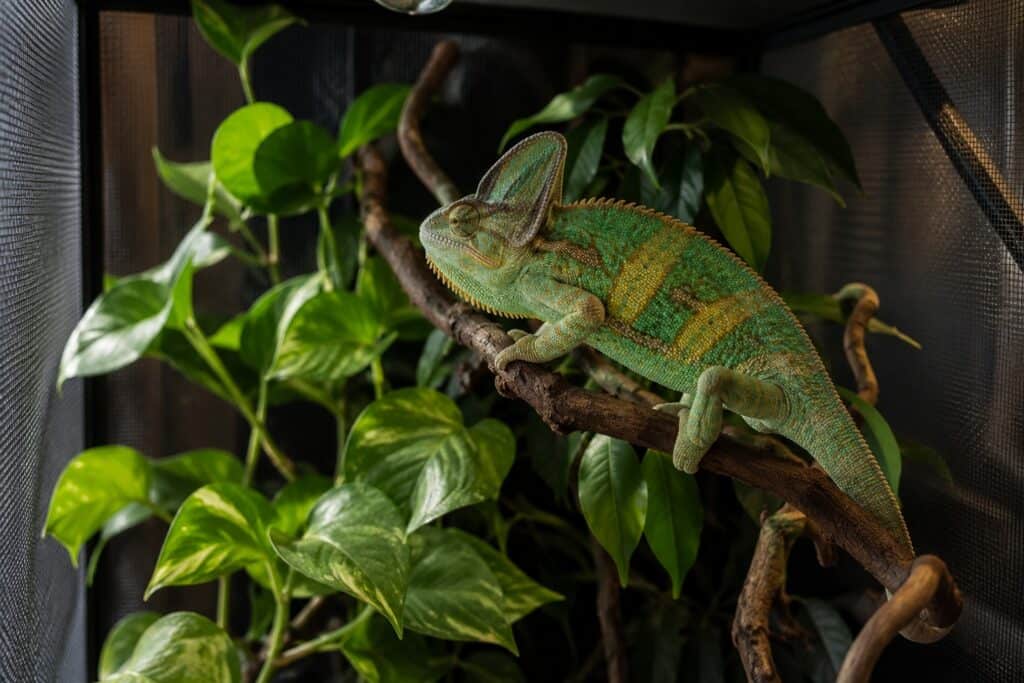
Screen, not glass. Chameleons need constant airflow, and stagnant humid air in a glass tank causes respiratory infections, which are one of the leading killers in captivity.
A male needs a minimum of 24 by 24 by 48 inches, and bigger is genuinely better. Females can go slightly smaller. Height matters more than floor space, since these are arboreal animals that climb.
Fill it densely with branches at varying heights and thicknesses, plus foliage for cover. A chameleon that can’t hide feels exposed and stressed permanently. Live plants like pothos, ficus, and schefflera work well and hold misting water on their leaves.
Our chameleon enclosure guide covers the full build, including ventilation, lighting placement, and drainage, which matters more than you’d think once you’re misting daily.
Bioactive is possible, but it’s a different build here. A screen cage doesn’t hold substrate moisture the way glass does, so a chameleon bioactive needs a solid-bottom tray and a proper drainage layer to handle daily misting runoff. Plenty of keepers skip it and run a bare bottom with a drainage pan, which is simpler and perfectly fine. If you want the planted-floor route, our bioactive enclosure guide covers drainage layers and substrate.
Temperature, Lighting, and Humidity
Basking spot 85 to 95F for adults, cooler at 80 to 85F for juveniles. Ambient should sit at 72 to 80F with genuine cooler space lower in the enclosure. A night drop to 60 to 70F is beneficial and matches their natural conditions.
Measure the basking branch surface with an infrared temp gun, and position the bulb so the chameleon cannot climb within burning distance of it. Screen tops conduct heat, and chameleons burn themselves on hot mesh regularly.
UVB is essential and not negotiable. Use a linear T5 HO tube at 5 or 6 percent laid across the screen top, spanning a good portion of the enclosure length. Replace it every 12 months. Without adequate UVB, calcium absorption fails and you get metabolic bone disease, described in veterinary references as the most common bone disorder in pet reptiles.
Humidity should run 40 to 60 percent with a clear dry-down between mistings. Veiled chameleons handle drier conditions than other chameleon species, and constant dampness in a screen enclosure is worse for them than brief dryness. If you keep several species, our reptile temperature and humidity guide puts the ranges side by side.
Hydration Is the Part People Get Wrong
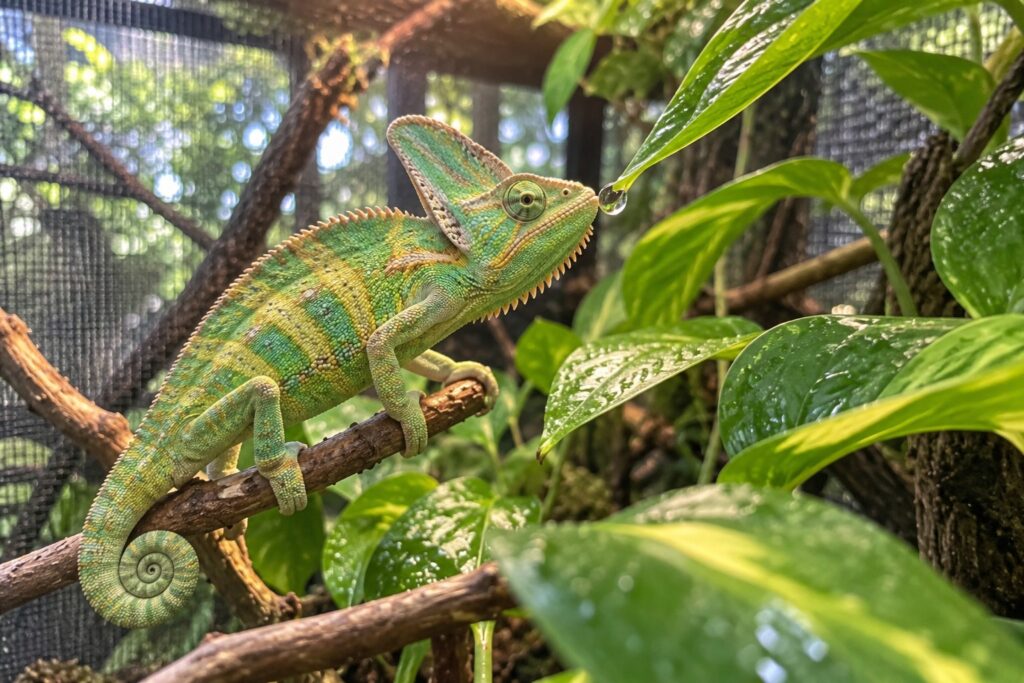
Chameleons do not drink from bowls. They drink moving water droplets off leaves, and a still dish of water will be ignored until the animal is dehydrated.
You need either a dripper or an automatic misting system, ideally both. A dripper positioned to drip onto foliage gives a chameleon something to drink from throughout the day. Misting two or three times daily for a few minutes wets the leaves and raises humidity briefly.
Signs of dehydration: sunken eyes, orange or dark yellow urates instead of white, lethargy, and skin that stays tented when gently pinched. Urate colour is the single most useful daily check you can do, and it’s visible in the enclosure floor without disturbing the animal.
Shower or long misting sessions can help a dehydrated chameleon, but a genuinely dehydrated animal needs a vet, since fluids under the skin are often required.
Dehydration also tops the list in our chameleon care guide, which ranks the five mistakes that kill most first chameleons.
Veiled Chameleon Care: Diet and Supplements
Primarily insectivorous, with veileds being unusual among chameleons in that they also eat plant matter. Many will nibble leaves, which is one reason to keep only non-toxic plants in the enclosure.
Staple feeders: crickets, dubia roaches, and black soldier fly larvae. For variety and hydration, hornworms and silkworms. Superworms and waxworms are treats rather than staples, being high in fat.
Gut load feeders for 24 to 48 hours before offering, using carrot, squash, leafy greens, and a commercial gut load. What goes into the insect goes into your chameleon, and this matters more for chameleons than most species.
The supplement routine is where people slip, and it’s genuinely fiddly. Calcium without D3 at most feedings. Calcium with D3 roughly twice a month. A multivitamin containing preformed vitamin A twice a month. Over-supplementing D3 causes its own problems, so precision matters in both directions.
Feed juveniles daily, as much as they’ll take in a session. Adults do well on every other day, five to ten appropriately sized insects. Nothing longer than the space between the eyes.
Given how easy it is to lose track of a twice-monthly supplement across months, our guide on tracking reptile feeding schedules covers the habit side of this.
Handling and Stress
Keep it minimal. Veiled chameleons tolerate handling at best and are stressed by it at worst. Some individuals become tolerant of hand-walking. Many never do.
Let a chameleon walk onto your hand rather than grabbing it. Approach from below rather than from above, since overhead movement reads as a predator.
Stress signs: dark or blackened colouration, gaping, hissing, flattening the body sideways, and hiding constantly. Persistent dark colouration in an animal that isn’t basking is a warning, not a mood.
House them alone. Always. Chameleons are solitary and territorial, and even the sight of another chameleon through glass causes chronic stress. This includes not placing two enclosures where the occupants can see each other.
Health Problems
Metabolic bone disease from inadequate UVB or calcium, showing as weak grip, trembling, a swollen or soft jaw, and bowed limbs. Respiratory infection from poor ventilation or cold, showing as open-mouth breathing, wheezing, and mucus. Dehydration and kidney damage, often together. Egg binding in females. Mouth rot, appearing as swelling or discharge around the mouth. And thermal burns from contact with the screen top.
Chameleons decline fast once symptoms are visible, so treat any of these as urgent. Use the ARAV vet directory to find a vet who works with chameleons specifically, since they’re a specialty even among reptile vets.
Catching Problems Early
The core difficulty in veiled chameleon care is that these animals mask illness thoroughly. A chameleon that looks slightly off has usually been unwell for some time.
Weight is the earliest honest signal. Weighing weekly and logging it turns a vague impression into a line on a chart, and a chameleon losing weight over three weeks needs attention even if it’s still eating and climbing normally. The Exotic Reptile Care app tracks weight with growth charts and handles custom reminders, which is genuinely useful here given the twice-monthly supplement rotation and the annual UVB swap.
Combine that with a daily glance at urate colour and you have a workable early warning system.
FAQ: Veiled Chameleon Care Questions
How big do veiled chameleons get?
Males reach 17 to 24 inches including the tail, females 10 to 14 inches. Males also have a noticeably taller casque.
How long do veiled chameleons live?
Males typically 6 to 8 years, females 4 to 6. The shorter female lifespan is largely due to the strain of egg production.
Do veiled chameleons need a screen enclosure?
Yes. They need constant airflow, and glass enclosures trap stagnant humid air, which leads to respiratory infections. Screen is standard for this species.
Can veiled chameleons be handled?
Minimally. They tolerate it at best. Let the chameleon walk onto your hand rather than grabbing it, keep sessions short, and expect some individuals never to accept it.
Do veiled chameleons drink from a water bowl?
No. They drink droplets from leaves, so you need a dripper, a misting system, or both. A standing water dish will be ignored.
Can two veiled chameleons live together?
Never. They’re solitary and territorial, and even seeing another chameleon through glass causes chronic stress. Keep enclosures out of sight of one another.
If you’re weighing this species up, the honest summary is that veiled chameleon care rewards people who enjoy getting husbandry exactly right and observing an animal rather than interacting with it. Get the ventilation, UVB, and hydration correct, weigh weekly, and check urate colour daily. Most chameleon deaths trace back to one of those four things being quietly wrong for a month.