Bearded dragon lighting is the part of the setup that kills more dragons than anything else, and it does it slowly enough that nobody connects the two. The animal looks fine for a year, then starts trembling, and by then the damage is done.
The frustrating part is that it isn’t complicated. Two fixtures, one for heat and one for UVB, both doing a job the other can’t. Most bad setups come from a pet shop starter kit that bundled the wrong bulb and a wrong assumption that a light which looks bright must be doing something.
| Component | What You Need |
|---|---|
| UVB | Linear T5 HO tube, 10 to 12 percent |
| UVB length | Two thirds of enclosure length |
| Basking bulb | White halogen flood |
| Basking temp (adult) | 95 to 105F |
| Basking temp (juvenile) | 105 to 110F |
| Photoperiod | 12 to 14 hours |
| Night lighting | None, ever |
| UVB replacement | Every 12 months |
Heat and UVB Are Two Different Jobs
Start here, because this single misunderstanding is behind most failed setups.
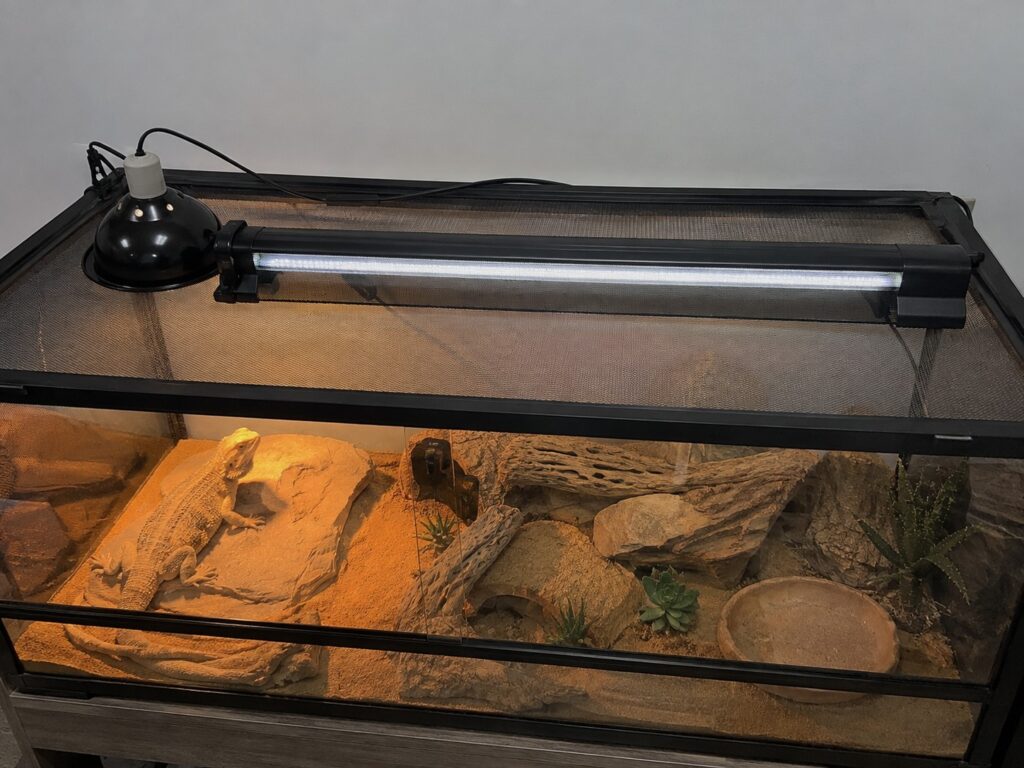
A basking bulb produces heat. It does not produce meaningful UVB. A UVB tube produces ultraviolet light. It produces almost no heat. You need both, from two separate fixtures, and neither one substitutes for the other.
Dragons need heat to digest food and regulate their body. They need UVB to synthesise vitamin D3, which is what allows them to absorb the calcium in their diet. Without UVB, a dragon can eat a perfectly calcium-rich diet and still develop metabolic bone disease, which veterinary references describe as the most common bone disorder in pet reptiles.
Bearded dragons come from the Australian outback. They’re one of the highest UV requirement species commonly kept, which is why bearded dragon lighting is less forgiving than it is for a nocturnal gecko or a ball python.
The UVB Tube Is the Non-Negotiable Part
Use a linear T5 HO fluorescent tube at 10 to 12 percent output. That’s the standard, and it’s what nearly every experienced keeper runs.
Length matters as much as strength. The tube should span roughly two thirds to three quarters of the enclosure length. A short tube creates a narrow UV window your dragon has to sit in exactly, and dragons don’t cooperate with that. A long tube creates a gradient across the enclosure, which is the whole point.
Mount it over the warm end so the dragon gets heat and UVB in the same spot, which is how it works under a real sky.
What to avoid: compact coil bulbs and screw-in “UVB” bulbs. They produce a small, concentrated, unreliable output and have a history of causing eye problems. Mercury vapour bulbs combine heat and UVB in one unit and can work, but they’re harder to position correctly and you lose independent control of each. Stick to a separate tube.
Anything sold as a full spectrum, daylight, or plant bulb is not UVB. Brightness has nothing to do with it, and this is the trap that catches most new keepers.
Distance and Mesh Change Everything
A UVB tube sitting at the wrong height is nearly as bad as none at all, and mesh is the reason.
A standard screen lid blocks somewhere in the region of 30 to 40 percent of the UVB passing through it. So the working distance depends on whether the fixture sits on top of the mesh or inside the enclosure.
Mounted above mesh, a 12 percent T5 wants the basking surface roughly 12 to 15 inches below it. Mounted inside the enclosure with no mesh in the way, that becomes closer to 16 to 18 inches. Too close and you risk overexposure. Too far and the output falls off sharply, since UV intensity drops with the square of the distance.
Measure from the tube to the top of the dragon’s back when it’s basking, not to the floor. A dragon on a tall rock is much closer to the tube than a dragon on the substrate.
If you want to be certain rather than approximately right, a UV index meter reads the actual output at the basking spot. You’re aiming for a UV index around 3 to 4 there. It’s the one piece of measuring equipment most keepers skip and the only way to genuinely know.
The Basking Bulb
A plain white halogen flood bulb is the best choice. Halogen produces heat with a strong infrared component that penetrates the way sunlight does, and the white light supports normal behaviour and appetite.
Wattage depends entirely on your enclosure size, height, and room temperature, so don’t buy by number. Buy something in the right range, measure the basking surface with an infrared temp gun, and adjust by changing the bulb or the height of the basking platform. Adults want 95 to 105F on the surface. Juveniles want it hotter, around 105 to 110F.
Use a dome fixture with a ceramic socket, since halogen bulbs run hot enough to damage plastic ones.
Skip ceramic heat emitters as the daytime basking source. They provide heat with no light, which is useful overnight in a cold room but wrong for a diurnal animal’s daytime basking spot.
If you’re seeing a dragon that avoids the warm end, gapes constantly, or hides through the day, the bulb may be overpowered for the space, which our post on a bearded dragon basking temperature that’s too high works through.
Never Use Night Lights
Coloured night bulbs, red bulbs, blue bulbs, and moonlight bulbs should not be on your enclosure. Dragons see red light. It disrupts sleep, and chronic poor sleep shows up as stress, appetite loss, and lethargy.
Bearded dragons need complete darkness at night, and they need a temperature drop with it. Down to about 65 to 70F is fine and closer to natural conditions than a constantly heated enclosure.
If your room genuinely drops below the mid 60s, use a ceramic heat emitter on a thermostat. Heat with no light. That’s the only acceptable overnight source.
Photoperiod and Seasonal Change
Run lights 12 to 14 hours a day. A timer costs almost nothing and removes the possibility of forgetting.
Shortening the photoperiod toward 10 or 11 hours in autumn and winter is normal and matches what the animal expects. It’s also one of the triggers for brumation, so if your dragon starts sleeping heavily and refusing food after you make that change, it’s probably behaving correctly rather than falling ill. Our guide to bearded dragon brumation signs covers what that looks like.
Keep lights and darkness consistent day to day. Erratic schedules are stressful.
Replacing the Tube Before It Fails
This is the failure mode that catches long-term keepers rather than beginners.
A UVB tube keeps producing visible light long after its UV output has collapsed. It looks identical. It still glows. It’s doing nothing useful.
Replace linear T5 tubes every 12 months. Older T8 tubes need replacing every 6 months, which is one reason T5 is worth the upgrade. Write the date on the tube in marker when you install it, because a year is exactly long enough to forget.
A tube quietly expiring is one of the more common explanations behind a dragon that stops eating, loses condition, or starts moving oddly with no other change in husbandry. It’s on the checklist in our guide to why a bearded dragon is not eating for exactly that reason.
UVB also does not remove the need for calcium supplementation. The two work together, and our bearded dragon food guide covers the dusting schedule. If you keep multiple species, our reptile temperature and humidity guide puts the requirements side by side.
Setting a Reminder You’ll Actually See
The annual tube swap is the single easiest thing in reptile keeping to miss, because nothing prompts you. There’s no warning light and no visible change, just a slow decline in an animal that hides problems well.
A recurring reminder solves it outright. The Exotic Reptile Care app handles custom reminders for exactly this kind of long-interval task alongside feeding, cleaning, and vet visits, and it logs weight so a slow decline shows up as a chart rather than a feeling. If your dragon’s weight starts drifting and you can see the UVB tube is eleven months old, you’ve usually found your answer.
FAQ: Bearded Dragon Lighting Questions
What UVB do bearded dragons need?
A linear T5 HO tube at 10 to 12 percent output, spanning two thirds to three quarters of the enclosure length and mounted over the warm end.
How often should I replace a bearded dragon UVB bulb?
Every 12 months for T5 tubes and every 6 months for T8. Output falls well before the bulb stops producing visible light, so replace on schedule rather than on appearance.
Do bearded dragons need light at night?
No. They need full darkness and a temperature drop. Coloured night bulbs disturb sleep. If the room gets too cold, use a ceramic heat emitter on a thermostat, which gives heat without light.
Can I use a coil UVB bulb for a bearded dragon?
It’s a poor choice. Coil bulbs give narrow, concentrated, inconsistent output and have been linked to eye irritation. A linear tube is the reliable option.
How far should the UVB be from a bearded dragon?
Roughly 12 to 15 inches above the basking surface when mounted over mesh, or 16 to 18 inches when mounted inside with no mesh between. Measure to the dragon’s back, not to the floor.
Does a basking bulb provide UVB?
No. Standard heat and halogen bulbs produce essentially no UVB. Heat and UVB are separate jobs requiring separate fixtures.
If you take one thing from this: buy the long tube, mount it at the right height, and write the replacement date on it. That’s most of bearded dragon lighting solved, and it’s the difference between a dragon that thrives for a decade and one that starts trembling at eighteen months.